At the start of Richard
Linklater’s 1992 breakthrough movie Slacker, a passenger in a cab monologues
away about life and hope and the randomness of it all. The young man, played by
Linklater himself, tells the driver about his weird dreams: having lunch with
Tolstoy, being Frank Zappa’s roadie. He proceeds to create an alternate reality
in which he stays at the bus station, rather than gets the cab, meets a cute
girl, plays pinball with her, falls in love. Three minutes later, he gets out,
saying: “Man! Shit. I should have stayed at the bus station.” It’s beautifully
constructed, and in a way it became the template for all the films that
followed.
Linklater doesn’t do drama. There
is often no plot. His characters wander about, talk (how they talk!), fall in
and out of love, get stoned and drunk and disappointed, make good and bad
decisions. His films amble along gloriously, eavesdropping on life.
Talking to the director is like
being in one of his movies. The conversation starts in the middle, and you
don’t have a clue how you got there. “Brits take a gap year, hey?” he says, as
soon as he sits down. And we talk about how we didn’t take gap years, how when
we were growing up they were for privileged students. “Yeah, I like the idea of
a gap year, but we had no money. Who was going to pay for it? I don’t come from
the posh!”
Linklater’s new film is a return
to college days – a follow-up, 23 years later, to his third movie, Dazed And
Confused. While that film celebrated the last day of high school in the summer
of 1976, Everybody Wants Some!! is set in 1980, the weekend before college
starts for a group of baseball-playing jocks. There are the familiar Linklater
ingredients: youthful dreams, horniness, hippy dudes, punk, pot and endless
chatter.
But it’s also a surprising film
for a man who has become known for his tender sensibility. These boys are as
macho as they come: sporty, stupid, endlessly competitive. When not getting
stoned or trying to get laid, they challenge each other to knuckle-flicking
fights. Perhaps the most surprising thing is that it is autobiographical. Young
Rick Linklater was a ferociously competitive jock who had to beat everybody at
everything. He won a sports scholarship to Sam Houston State University in
Texas, and planned to become a baseball star. At college, he was one of 18 boys
living in two houses with their eye on the same major league prize.
“We were very competitive at
basketball, card games, pinball, everything,” he says. “There was a lot of
gambling. A college athlete is going to be competitive. You don’t get to that
level if you’re not.” Could he have made it? “Every college player thinks they’re
on their way. But, delusions aside, I might have toiled in the minor leagues
for a bit.”
Towards the end of his second
year, Linklater discovered he had a heart condition called atrial fibrillation.
“I was suddenly getting light-headed and I couldn’t run any more. One minute
you’re starting left fielder, hitting home runs, the next it’s career over. I
was 20.” Today, he looks back at it as a blessing: “I was so glad to leave that
behind.”
I tell him the knuckle-flicking
game in the film made me wince, and ask if he played it. He grins. Sure he did.
Is it as painful as it looks? He grins some more. Sure it is. Show me, I say.
“You want me to flick your knuckles?” he asks, delighted.
He does, with his thumb and index
finger. Ouch! I shout. We are sitting in a smart hotel in Los Angeles. People
stare. I ask him to do it again. It is even more painful, and I shout louder.
He nods. “It hurts. Ten more and I would have drawn blood! Those guys are
cruel.”
At 55, Linklater looks little
different from the young man he was in Slacker: boyish face, pinchable cheeks,
tanned, smiling eyes, long fringe. Nor does he sound any different; there are
the singsong sentences that often rise towards the end, as he asks one of those
big questions that have been nagging away at him all his life.
As in the new film, he met a girl
at college who was into theatre and this began his love affair with the arts.
“I saw it as a great relief; a new phase of my life.” Why? “Because you’re an
immature little twit when you’re trying to win. It’s a pretty base nature. I
don’t see the arts as competitive at all. It was a better angel of my nature.
Sports is zero-sum: winner, loser, demonstrable.”
At college, Linklater started to
write plays. When he was told about his irregular heartbeat, he didn’t brood on
it. Instead, he decided it was meant to be, left college, and went to work on
an oil rig in the Gulf of Mexico. It was hard, dangerous work – and well paid.
It also gave him the opportunity to read novel after novel.
By the time Linklater returned to
Texas, he had earned enough money to buy himself a Super 8 camera, projector,
editing equipment, and to cut himself some slack. He moved to Austin, enrolled
in film school, started the Austin Film Society, and decided he would become a
director.
Looking back, he says, it was a
ridiculous ambition. Nobody he knew did creative jobs like that. “It was
unheard of. If you could see where I grew up and the people I grew up around… I
can’t explain how far the idea of making films would be from my background.”
His father did a dull job in insurance; his stepfather was a prison guard. Did
he ever consider working in the prison service? “No. But half the guys on my
college football team did, and the other half became prisoners.”
His parents married young and
divorced young. “When my mom was having me, she was 22 and I was her third kid.
A little Catholic girl.” A single mother, she went back to school, got an MA
and went on to teach at university. “I got to see my mom coming into her own.
We grew up together – she was always studying for tests and doing her
dissertation. Boyhood is very personal.”
Boyhood is the groundbreaking
film Linklater released in 2014. The story? A boy and girl grow up, and a
divorced couple learn to respect each other. Nothing remarkable there, except
that it was filmed over 12 years, so we see six-year-old Mason Evans Jr
transform into a photography-loving 18-year-old student; his older sister
Samantha (played by Linklater’s daughter, Lorelei) go from adorable chatterbox
to sulky teen; and, best of all, his mother, Olivia, in a wonderful performance
by Patricia Arquette, grow into middle age, educate herself, move in and out of
relationships, and almost wise up to life. As a conceit, it’s brilliant; but
Linklater’s humour and humanity turn it into one of the great movies of the
21st century.
Arquette won an Oscar for her
performance, but Linklater missed out on best director, best film and best
original screenplay (the film was nominated for all three). Is he making a
sequel? “Not currently,” he says, chewing on bread and olive oil (he has been
vegetarian since his 20s, and doesn’t fancy anything on the meaty menu). “Well,
it wouldn’t be Boyhood! I have no current ideas, but never say never.”
Just do something that fulfils
you and you might get lucky and you might be able to make a living out of it. I
did
Is it true that Lorelei got bored
with the project halfway through and wanted to be killed off? “Oh, there was
one year she thought she didn’t want to film. She was feeling self-conscious,
puberty hit. But then she realised she was getting paid, and she was like, oh,
OK!”
Linklater talks a lot about his
three daughters, always with pride, occasionally with fear. His greatest fear
is that they don’t follow their dream, whatever that may be. His twins are 11
years old, while Lorelei is now 22 and an artist. He says he is constantly
driving home the same message to Lorelei: do your thing, never sell out to the
Man. “She is a passionate visual artist. I told her I’ll support you in
anything you’re meant to be doing. Fuck money, fuck career, just do something
that fulfils you and you might get lucky and you might be able to make a living
out of it. I did.”
Given the age difference, I ask
if the twins have a different mother. “Nope,” he says. “Same mom. Somehow.” Do
they live with each other? “Yeah,” he says, but it sounds more like a question
than an answer. “We’re fluid. I have a couple of properties. But we’re always
around. Let’s put it like this: it’s an ongoing adult relationship that has
produced three children.” How long have they been together? “The age of my
daughter, plus nine months!” He bursts out laughing; he laughs a lot.
After Slacker, he was regarded as
a spokesman for Generation X, but Linklater never saw the slacker generation
the same way as the establishment did. “Slacker means two different things to
me and the rest of the world,” he says. “The slacker world was the world I
found myself living in. The 1980s underground was pretty interesting. Everyone
I met was an artist of some kind, a musician or writer or painter; lovers of
life, appreciators, and punk rocker-type people, who you didn’t know what they
did but you could tell they sure liked their music. Nobody talked about their
jobs, what they had to do to pay their rent. It was no surprise that mainstream
culture decided these were a bunch of lazy do-nothings, because, by their
judgment, they were not productive. They weren’t fitting into the free-market
society, and that’s like Jack Black in School Of Rock: he’s a guy with a
passion. I admire anyone who is just living their life and following what they
want to do.”
School Of Rock, about a
struggling rock singer who cheats his way into teaching at a prestigious prep
school, is one of the few films Linklater has made for a studio. Most of his
films are structured around a period of time rather than plot. So Slacker,
Dazed And Confused and the swooningly romantic (and occasionally devastatingly
bleak) Before… trilogy, starring Julie Delpy and Ethan Hawke, all take place on
one day. In Before Sunrise, French Céline and American Jesse meet on a train in
Europe, get off at Vienna and spend a day and night together. In Before Sunset,
made nine years later, they are reunited in Paris: Jesse is now the successful
author of a novel about a chance encounter he had with a woman called Céline
nine years earlier. In Before Midnight, made another nine years later, they are
a couple with twin girls, facing up to life’s painful compromises.
Anyone who thinks it’s
improvised, film the two most interesting people you know, walking and talking.
It'll be terrible
Linklater doesn’t shy away from
conflict: a confrontation between Céline and Jesse in Before Midnight is
brutal, as they address their different resentments and everything unravels.
But, at heart, there is an optimism to these films: however compromised, life
has its beauty and meaning, even if it’s just a fractured memory of an
afternoon’s love.
“I guess I was interested in how
cinema worked with reality,” Linklater says. “How you could sculpt out real
time. I was never that interested in conventional storytelling – my mind
doesn’t work that way. I’m looking for experiential moments. Plot twists just
seem antithetical to how we process the world. One thing follows the next.”
With their broken, overlapping
conversation, many of his films seem improvised. In fact, they are closely
scripted. “I’m not interested in improvisation,” Linklater says. “Everything is
structured. Anyone who thinks it’s improvised, get a camera and film the two
most interesting people you know, walking and talking, and see how it works
cinematically. It will be terrible.”
The naturalism and pacing nod to
François Truffaut and Eric Rohmer. Perhaps you’re the most European film-maker
working today, I suggest. Linklater smiles. “I think I’m an old-school
existentialist. I should have been a French film-maker in the late 1950s and
60s. I’d avoid the car ride with Camus, but I would have fit right in there. So
many of my films are very personal explorations of ideas, things I’m trying to
learn more about or make peace with.”
Has he made a good living?
“Overall, yeah. The pay scale in the entertainment industry is like in sports.
It’s not nearly as much as you think for most things, then the other end of the
scale is more than you can imagine. I’ve been lucky to get
more-than-you-can-imagine, for whatever reason.”
Did he enjoy his
more-than-you-can-imagine experiences? “Well, the trickle-down into my life enjoys
it, because I then don’t have to do certain things for money. I’m not talking
crazy money.” What’s the most he’s ever been paid? “A couple of million? For
something like School Of Rock.”
While School Of Rock was made for
$20m, most of his films are made on much smaller budgets (Slacker cost
$23,000), and many are set in Texas. One of them, Bernie, is unusual in that it
is not autobiographical – and it has a plot. But art and life are rarely too
far apart in Linklater’s life, as turned out to be the case here. The film,
released in 2011, was based on the true story of Bernie Tiede, a much-loved
mortician who became the companion of curmudgeonly heiress Marjorie Nugent,
more than 40 years his senior. In 1996, he shot her in the back four times and
hid her in the freezer for nine months. When her body was discovered, Tiede,
who had no previous criminal record, was sentenced to life imprisonment.
After the film was released, with
Jack Black and Shirley MacLaine as the leads, Tiede appealed against his
sentence. It was revealed he had been sexually abused as a child by his uncle,
and claimed he had been verbally and emotionally abused by Nugent. His counsel
argued that he shot her in a brief dissociative episode brought on by his
abusive relationship with her. His sentence was reduced, and at his appeal in
May 2014 he was told he could be released, after more than 16 years in jail,
provided he had somewhere to live. This was where Linklater stepped in,
suggesting Tiede move into the garage apartment of his home in Austin; Tiede
has lived there for the past two years.
How is he doing? “He’s singing in
a gay men’s choir, he has friends, he’s trying to do good in the world. He
works for two non-profit corporations that help people in prison, and people
getting out of prison. He’s a real sweetheart.”
Was he not worried about taking
in a convicted murderer? “No. I did for a second worry that I was dropping him
in on my family, and they hadn’t met him.” He smiles. “It’s not every day that,
hey, someone’s going to be living back there, and he’s murdered somebody. But
if my family of all families can’t deal with that… And he’s been great. He’s an
incredibly nice, generous man, who did a horrible thing 20 years ago. He
watches our animals. I have a small pet pig and he reads the paper to it every
day. Pigs are unique in that way; they like people treating them as equals.
He’s just there, helping out in any way he can.”
But this month Tiede has been on
trial again, with prosecutors arguing that the murder was premeditated and the
courts were wrong to reduce his sentence. He could be sent back to jail for
life, and Linklater’s anxiety is obvious. The week after we meet, he is due to
speak in court on Tiede’s behalf. “I’m primarily there to give witness to how
well he’s been doing these last two years.”
How would his girls feel if Tiede
were sent back to prison? “Oh, it would be devastating to everybody who knows
him. It would be horrible. No, it would really shake up a lot of people to see
the state of Texas be this cruel and crazy.”
For Linklater, Texas is a muse of
sorts, representing the best and worst of America. “There’s a real openness and
friendliness to people. It’s not snobby.” And the worst? “We just executed a
mentally retarded person. It can be a pretty unforgiving, Old Testament
system.”
The very worst of Texas, he says,
is represented by creationist Ted Cruz, candidate for the Republican nomination
for the presidency. “Cruz to me is more scary than Trump. He actually believes
what he says. Trump doesn’t believe anything – he’s just a needy narcissist.
Cruz is seen as the smart guy, but nobody’s asked him: ‘How old is the world?’
‘Do you believe in biology?’ Because he doesn’t.”
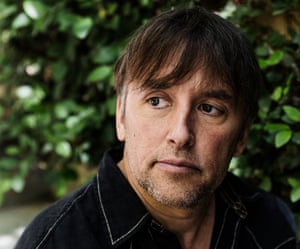
As his lodger, a convicted murderer, is sent back to prison, the director talks about the Texan justice system, the art of storytelling – and why he’ll always be a slacker at heart
Linklater has been telling his
daughters to observe the contest closely, because America might not witness
another like it. “I’ve seen every presidential election since the 1960s, and
this is the craziest ever. It’s the commodified stupidity of the political
dialogue in the US. The divisiveness. It’s all attitude and personality, like a
reality show.”
I’m kinda liking Bernie. I’ve
waited for a candidate like Bernie Sanders my whole adult life. I’m a natural
socialist
Linklater is already feeling
nostalgic for Obama, and believes we’ll look back at him as a political giant.
But, typically, he doesn’t talk about policy or achievement; he talks about
Obama the dude. “We haven’t tipped our glass to Obama yet, and we’re going to
because there is such vast dignity and intelligence. He never embarrassed our
country, not once. Not once. He’s so classy, and his wife’s so classy. People
give people hell when they screw up, Clinton and stuff, but nobody says: ‘Think
how much sex Obama has turned down in his lifetime.’” The more Linklater talks,
the more I feel I’m with the guy in the cab, shooting the breeze in Slacker all
those years ago.
“You think he couldn’t be getting
a blow job?” he continues. “Just the discipline and the bigger vision of what
he’s here for in the world – the restraint he’s shown.” He’s got Michelle, I
say. “Yeah. Come on, though, he’s a guy!”
Is he supporting Hillary Clinton
or Bernie Sanders for the Democrat nomination? “I’m kinda liking Bernie. I’ve
waited for a candidate like Bernie Sanders my whole adult life, so when there’s
a guy there who’s actually professing it, you have to support him. I’m a
natural socialist.”
For now, though, Linklater is
more concerned with the fate of another Bernie. A couple of weeks after meeting
in LA, we speak again. Linklater has given his evidence for Tiede’s defence –
to no avail. Tiede has been sent back to prison for 99 years or life. “I’m
heartbroken,” Linklater says. “It wasn’t really about truth or justice, it was
about getting a win for the prosecution and they definitely won this round. But
hopefully the legal process is open to another round and the truth can come
out.”
Trump, Cruz, Texan bigotry,
Bernie’s reconviction: look, he says, he’s aware how bleak the world can be,
but despair is not his bag. He’s going to keep campaigning for Tiede, focus on
all the positive stuff out there: his girls, the good people, the movies he
still wants to make. “People talk about how ambitious Bruce Springsteen was,
because he had 500 songs in him that he wanted to express. I felt that way, and
I still do. Like a musician, I’ve still got so many songs in me.”

No hay comentarios:
Publicar un comentario