Mostrando entradas con la etiqueta John F. Kennedy. Mostrar todas las entradas

Funeral de John F. Kennedy: Fotos inéditas, jamás publicadas (1)


Lunes 9 de abril de 2012


Funeral de John F. Kennedy: Fotos inéditas, jamás publicadas (1)

¿Por qué han estado clasificadas por el FBI casi 50 años? ¿Por qué las han desclasificado antes de los 50 años?
Nunca jamás el FBI había desclasificado un documento antes de los 50 años. INÉDITO,  pero hay están las 15 fotos que podéis copiar.
Fotos inéditas  sin publicar: Funeral de John F. Kennedy

                                                                                                          == 1 de 15 === +  Foto Siguiente.Next Photo


                                                                                                                  = 1, de 15 Siguiente == Next Photo
                                                                  

 Cinco décadas después, el asesinato de John F. Kennedy sigue siendo uno de los eventos de la señal por completo de cuantos la segunda mitad del siglo 20. Otros momentos emocionantes, algunos (la llegada a la luna, la caída del Muro de Berlín), otros horribles (los asesinatos de Martin Luther King Jr. y Robert Kennedy, el  Challenger  explosión) - han asegurado su lugar en los libros de historia y, más aún indeleble, en la memoria de aquellos que fueron testigos de ellos.Pero nada en la última parte de "el siglo americano" se define una época tan profundamente como los disparos de fusil que dividen a la de aire caliente de Dallas el 22 de noviembre de 1963, y la repentina muerte del presidente de 46 años de edad.
Hubo Camelot - una construcción de medios, por supuesto, pero una rareza en la que en realidad resonó con tanta gente, en todas partes-y luego se fue el período sombrío, profundamente incierto  después de  Camelot. Por incontables millones de personas en Estados Unidos y en todo el mundo que vivieron la transición casi surrealista, los días y semanas después del asesinato de John F. Kennedy se sentía como una pausa escalofriante, inquieto: un momento tan cargada de inquietud que incluso la reflexión, o hacer un balance, parecía imposible.
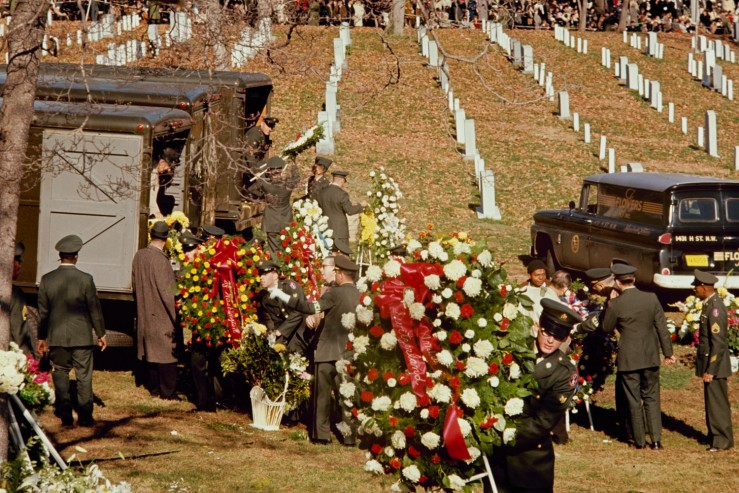
Aquí, en el 45 aniversario de marzo de JFK 1.967 reinterment, cuando sus restos fueron trasladados de su lugar de reposo inicial de la tumba permanente y el monumento en Arlington, ofrece una galería de fotografías del funeral muy cargada a cabo pocos días después de que Kennedy fue asesinado. Mientras que las dos ceremonias: el funeral de Estado en el '63, y el reinterment tres años y medio más tarde, fueron marcadas por el dolor, la crudeza de la evidente emoción en el año 1963 sigue siendo sorprendente, y desgarradora, en la actualidad.
"Una mujer se arrodilló y  besó suavemente la bandera", según testigos presenciales de la escena como ataúd de John F. Kennedy estaba en el estado durante dos días después de su asesinato. "La mano de una niña con ternura a tientas bajo la bandera de llegar más cerca. Así, en una intimidad abierta a todo el mundo, la esposa de John F. Kennedy y la hija de tocar frente a una barrera que ningún mortal jamás puede pasar otra vez. "
Al día siguiente, el cuerpo de Kennedy fue tomada "en el cuidado de orgullo imperturbable de su guardia de honor" y fue llevado desde la rotonda del Capitolio en Arlington.
"Por una tradición que es tan antigua como Genghis Khan", "un caballo sin jinete siguió" el ataúd envuelto en la bandera, "llevar botas vacías invertidas en los estribos en señal de que el guerrero no montar de nuevo .... A través de todo este esplendor fúnebre Jacqueline Kennedy marchó envuelta en valor y una dignidad real. Luego, a medianoche volvió una vez más, en la soledad, para poner unas flores sobre la tumba de su marido. "


John F. Kennedy’s Funeral: Rare and Unpublished Photos (1)


John F. Kennedy’s Funeral: Rare and Unpublished Photos

                                                                                                          ==1 of 15===+ Next Photo


                                                                                                                  =1 of 15== Next fhoto
                                                                  

 Five decades later, the assassination of John F. Kennedy remains one of the few utterly signal events from the second half of the 20th century. Other moments — some thrilling (the moon landing, the fall of the Berlin Wall), others horrifying (the killings of Martin Luther King Jr. and Robert Kennedy, the Challenger explosion) — have secured their places in the history books and, even more indelibly, in the memories of those who witnessed them. But nothing in the latter part of “the American century” defined an era as profoundly as those rifle shots that split the warm Dallas air on November 22, 1963, and the sudden death of the 46-year-old president.
There was Camelot — a media construct, of course, but a rarity in that it actually resonated with so many people, everywhere — and then there was the somber, profoundly uncertain period after Camelot. For countless millions in America and around the globe who lived through the near-surreal transition, the days and weeks after JFK’s assassination felt like a chilling, restless pause: a moment so charged with unease that even reflection, or taking stock, seemed impossible.
Here, on the 45th anniversary of JFK’s March 1967 reinterment, when his remains were moved from his initial resting place to the permanent grave site and memorial at Arlington,  offers a gallery of photographs from the deeply fraught funeral held mere days after Kennedy was killed. While both ceremonies — the state funeral in ’63, and the reinterment three-and-a-half years later — were marked by sorrow, the rawness of the emotion evident in 1963 is still striking, and rending, today.
“A woman knelt and gently kissed the flag,” the magazine reported of the scene as JFK’s casket lay in state for two days after his assassination. “A little girl’s hand tenderly fumbled under the flag to reach closer. Thus, in a privacy open to all the world, John F. Kennedy’s wife and daughter touched at a barrier that no mortal ever can pass again.”
The next day, Kennedy’s body was taken “from the proudly impassive care of his honor guard” and was carried from the Capitol rotunda to Arlington.
“By a tradition that is as old as Genghis Khan,” “a riderless horse followed” the flag-draped casket, “carrying empty boots reversed in the stirrups in token that the warrior would not mount again…. Through all this mournful splendor Jacqueline Kennedy marched enfolded in courage and a regal dignity. Then at midnight she came back again, in loneliness, to lay some flowers on her husband’s grave.”

John F. Kennedy’s Funeral: Rare and Unpublished Photos (8)


John F. Kennedy’s Funeral: Rare and Unpublished Photos

                                                                                                            8 of 15=Next Photo.


                                                                                                                        8 of 15=Next Photo
                                                                  

 Five decades later, the assassination of John F. Kennedy remains one of the few utterly signal events from the second half of the 20th century. Other moments — some thrilling (the moon landing, the fall of the Berlin Wall), others horrifying (the killings of Martin Luther King Jr. and Robert Kennedy, the Challenger explosion) — have secured their places in the history books and, even more indelibly, in the memories of those who witnessed them. But nothing in the latter part of “the American century” defined an era as profoundly as those rifle shots that split the warm Dallas air on November 22, 1963, and the sudden death of the 46-year-old president.
There was Camelot — a media construct, of course, but a rarity in that it actually resonated with so many people, everywhere — and then there was the somber, profoundly uncertain period after Camelot. For countless millions in America and around the globe who lived through the near-surreal transition, the days and weeks after JFK’s assassination felt like a chilling, restless pause: a moment so charged with unease that even reflection, or taking stock, seemed impossible.
Here, on the 45th anniversary of JFK’s March 1967 reinterment, when his remains were moved from his initial resting place to the permanent grave site and memorial at Arlington,  offers a gallery of photographs (some never published in The magazine) from the deeply fraught funeral held mere days after Kennedy was killed. While both ceremonies — the state funeral in ’63, and the reinterment three-and-a-half years later — were marked by sorrow, the rawness of the emotion evident in 1963 is still striking, and rending, today.
“A woman knelt and gently kissed the flag,” The magazine reported of the scene as JFK’s casket lay in state for two days after his assassination. “A little girl’s hand tenderly fumbled under the flag to reach closer. Thus, in a privacy open to all the world, John F. Kennedy’s wife and daughter touched at a barrier that no mortal ever can pass again.”
The next day, Kennedy’s body was taken “from the proudly impassive care of his honor guard” and was carried from the Capitol rotunda to Arlington.
“By a tradition that is as old as Genghis Khan,” “a riderless horse followed” the flag-draped casket, “carrying empty boots reversed in the stirrups in token that the warrior would not mount again…. Through all this mournful splendor Jacqueline Kennedy marched enfolded in courage and a regal dignity. Then at midnight she came back again, in loneliness, to lay some flowers on her husband’s grave.”

John F. Kennedy’s Funeral: Rare and Unpublished Photos (9)


John F. Kennedy’s Funeral: Rare and Unpublished Photos

                                                                                                siguiente=9 of 15=Next photo


                                                                                          Siguiente=9 of 15=Next Photo
                                                                  

 Five decades later, the assassination of John F. Kennedy remains one of the few utterly signal events from the second half of the 20th century. Other moments — some thrilling (the moon landing, the fall of the Berlin Wall), others horrifying (the killings of Martin Luther King Jr. and Robert Kennedy, the Challenger explosion) — have secured their places in the history books and, even more indelibly, in the memories of those who witnessed them. But nothing in the latter part of “the American century” defined an era as profoundly as those rifle shots that split the warm Dallas air on November 22, 1963, and the sudden death of the 46-year-old president.
There was Camelot — a media construct, of course, but a rarity in that it actually resonated with so many people, everywhere — and then there was the somber, profoundly uncertain period after Camelot. For countless millions in America and around the globe who lived through the near-surreal transition, the days and weeks after JFK’s assassination felt like a chilling, restless pause: a moment so charged with unease that even reflection, or taking stock, seemed impossible.
Here, on the 45th anniversary of JFK’s March 1967 reinterment, when his remains were moved from his initial resting place to the permanent grave site and memorial at Arlington, LIFE.com offers a gallery of photographs (some never published in LIFE magazine) from the deeply fraught funeral held mere days after Kennedy was killed. While both ceremonies — the state funeral in ’63, and the reinterment three-and-a-half years later — were marked by sorrow, the rawness of the emotion evident in 1963 is still striking, and rending, today.
“A woman knelt and gently kissed the flag,” LIFE magazine reported of the scene as JFK’s casket lay in state for two days after his assassination. “A little girl’s hand tenderly fumbled under the flag to reach closer. Thus, in a privacy open to all the world, John F. Kennedy’s wife and daughter touched at a barrier that no mortal ever can pass again.”
The next day, Kennedy’s body was taken “from the proudly impassive care of his honor guard” and was carried from the Capitol rotunda to Arlington.
“By a tradition that is as old as Genghis Khan,” LIFE noted, “a riderless horse followed” the flag-draped casket, “carrying empty boots reversed in the stirrups in token that the warrior would not mount again…. Through all this mournful splendor Jacqueline Kennedy marched enfolded in courage and a regal dignity. Then at midnight she came back again, in loneliness, to lay some flowers on her husband’s grave.”

John F. Kennedy’s Funeral: Rare and Unpublished Photos (15)

John F. Kennedy’s Funeral: Rare and Unpublished Photos
                                                                                          <=15/15=>


Five decades later, the assassination of John F. Kennedy remains one of the few utterly signal events from the second half of the 20th century. Other moments — some thrilling (the moon landing, the fall of the Berlin Wall), others horrifying (the killings of Martin Luther King Jr. and Robert Kennedy, the Challenger explosion) — have secured their places in the history books and, even more indelibly, in the memories of those who witnessed them. But nothing in the latter part of “the American century” defined an era as profoundly as those rifle shots that split the warm Dallas air on November 22, 1963, and the sudden death of the 46-year-old president.
There was Camelot — a media construct, of course, but a rarity in that it actually resonated with so many people, everywhere — and then there was the somber, profoundly uncertain period after Camelot. For countless millions in America and around the globe who lived through the near-surreal transition, the days and weeks after JFK’s assassination felt like a chilling, restless pause: a moment so charged with unease that even reflection, or taking stock, seemed impossible.
Here, on the 45th anniversary of JFK’s March 1967 reinterment, when his remains were moved from his initial resting place to the permanent grave site and memorial at Arlington, LIFE.com offers a gallery of photographs (some never published in LIFE magazine) from the deeply fraught funeral held mere days after Kennedy was killed. While both ceremonies — the state funeral in ’63, and the reinterment three-and-a-half years later — were marked by sorrow, the rawness of the emotion evident in 1963 is still striking, and rending, today.
“A woman knelt and gently kissed the flag,” LIFE magazine reported of the scene as JFK’s casket lay in state for two days after his assassination. “A little girl’s hand tenderly fumbled under the flag to reach closer. Thus, in a privacy open to all the world, John F. Kennedy’s wife and daughter touched at a barrier that no mortal ever can pass again.”
The next day, Kennedy’s body was taken “from the proudly impassive care of his honor guard” and was carried from the Capitol rotunda to Arlington.
“By a tradition that is as old as Genghis Khan,” LIFE noted, “a riderless horse followed” the flag-draped casket, “carrying empty boots reversed in the stirrups in token that the warrior would not mount again…. Through all this mournful splendor Jacqueline Kennedy marched enfolded in courage and a regal dignity. Then at midnight she came back again, in loneliness, to lay some flowers on her husband’s grave.”