Happy Princess Anne’s.-Mia, the (utterly irresistible) royal rascal: Angelic blonde hair, blue eyes and chubby cheeks, but photos show she's a bit of a handful

Mia, the (utterly irresistible) royal rascal: Angelic blonde hair, blue eyes and chubby cheeks, but photos show she's a bit of a handful 

Even the usually inscrutable Princess Anne is clearly delighted by her granddaughter, who lives on Anne’s Gatcombe Park estate in Gloucestershire — close enough for regular babysitting stints. 
And, as these charming photos show, Anne must have her hands full . . . 
 
Good enough to eat: Mia, with chubby knees and wearing a natty sun hat, bites into a juicy apple
I love you, granny: Mia hugs a relaxed and happy Princess Anne’s leg as they take a break from watching mum Zara in action at the Gatcombe Horse Trials last autumn
Winter warmer: Mum Zara Phillips and Mia, all wrapped up against the January chill, cuddle close as they watch a point-to-point
There’s my girl! We don’t often see the Princess Royal beaming with unrestrained joy — but who could possibly stay po-faced when you are blessed with a gorgeous little granddaughter like Mia?
What fun: Squealing with delight, Mia is upended by Tim Laurence and her aunty Autumn Phillips
What does this do? Mia is pictured mischievously investigating a mobile electrical supply
Cheeky: Mia pokes her tongue out as she is carried by dad Mike as they watch Zara compete in the dressage phase of the Gatcombe Horse Trials
Got the message: That T-shirt says it all. Who could disagree? Mia Tindall wears a 'Super Cute' T Shirt as she watches mother Zara Tindall compete in the Badminton Horse Trials in Badminton, Gloucestershire
Mia Tindall with polo stick and Autumn and Isla Phillips. They are with the Duchess of Cambridge, Zara Phillips and Prince George to watch Prince William and Prince Harry play at Festival of Polo at the Beaufort Polo Club, Gloucestershire
Perfect pose: Mia holds on tight to great-granny’s handbag in a formal portrait for the Queen’s 90th


Megumi.-Japanese vagina kayak artist found guilty of obscenity


A Japanese artist who made a kayak modelled on her vagina has been found guilty of breaking the country’s obscenity laws, in a case that has invited widespread ridicule of attitudes towards images of female genitalia.

Megumi Igarashi, who works under the pseudonym Rokudenashiko – or good-for-nothing girl – was arrested in July 2014 after she distributed data that enabled recipients to make 3D prints of her vagina.
The 44-year-old was fined 400,000 yen (£2,575), half the penalty demanded by prosecutors, at the Tokyo district court on Monday after she was convicted of distributing “obscene” images. She was cleared of another charge of displaying similar material.
Igarashi distributed the data to help raise funds to create a kayak inspired by her genitalia she called “pussy boat”.
The judge, Mihoko Tanabe, said that the data, though “flat and inorganic”, realistically portrayed the shape of a vagina and could “sexually arouse viewers”, according to Kyodo News.


Megumi Igarashi and her lawyers pose with a sign reading ‘a part is not guilty’ in front of the Tokyo court on 9 May.
FacebookTwitterPinterest
 Megumi Igarashi and her lawyers pose with a sign reading ‘a part is not guilty’ in front of the Tokyo court on 9 May. Photograph: Kazuhiro Nogi/AFP/Getty Images

Igarashi was cleared, however, of another charge relating to the display of plaster versions of the kayak at a shop selling adult goods in Tokyo. Tanabe said the kayak did not obviously resemble female genitalia and could not be considered obscene.


In court appearances, Igarashi insisted her artworks were not obscene and challenged attitudes towards female genitalia in Japan.Igarashi was freed days after her arrest following a legal appeal and a public petition. But she was arrested again months later for displaying decorated plaster figures moulded in the shape of her genitals, and sending and selling CD-Roms containing computer code for the images.

“I am innocent because neither the data for female genitals nor my artworks shaped like female genitals are obscene,” she told the court last year.
In an online post, she said: “Because female genitalia were ‘overly hidden’ in Japanese society, I did not know what a pussy should look like.
“I thought it was just funny to decorate my [moulded] pussy and make it a diorama, but I was very surprised to see how people get upset to see my works or even to hear me say manko,” she added, using the Japanese slang word for vagina.
Commentators pointed out the hypocrisy of Igarashi’s trial, which began after Japanese authorities resisted pressure to ban pornographic images of children in manga and animated films, citing concerns over restricting freedom of artistic expression.
Her case drew criticism of the apparent double standards in how Japanese law treats sexual imagery. The country has a thriving pornography industry, but its obscenity laws ban the depiction of genitalia, which usually appear pixelated in images and videos.
Japan’s obscenity laws carry a maximum penalty of two years in prison or a fine of up to 2.5m yen, but prosecutors decided in February to seek only a fine.


Igarashi recently announced her engagement to the Waterboys’ frontman, Mike Scott. An English translation of her book What is Obscenity? is due to go on sale on Tuesday.

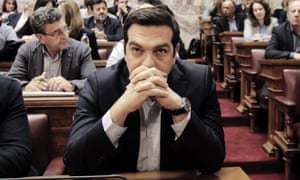
Greece, Alexis Tsipras.- The choice for Europe: rescue Greece or create a failed state

B
etween now and mid-June the European political elite must give its answer to an existential question. Will it honour the deal it made to rescue Greece last July; or will it push the radical left government into default –effectively creating a failed state in Europe?
That this is primarily Europe’s dilemma, not Greece’s or the IMF’s, is clear after Monday’s Eurogroup. The IMF boss, Christine Lagarde, warned the Europeans that the Washington-based fund will not participate in further bailouts without a substantial debt write-off.
In turn, the Greek prime minister, Alexis Tsipras, forced through the last of the main austerity measures demanded by creditors: reforms to the pension system that will leave worse off everyone who is receiving more than €1,000 (£800) a month, and demand much higher contributions from workers in future.
However, by delaying their approval until now, the lenders have managed, once again, to push Greece towards bankruptcy. Although growth is better than predicted, tax receipts are still dire and bailout disbursements suspended.
Worse, and more insidious, the months of callous inaction have pushed the mood in Greek society into a dangerous place. A population that, two years ago, started demanding and giving printed receipts as an act of collective moral renewal, has given up on them once again. The most popular graffiti tag has become “all this political shit”.
The only thing that can end the crisis is debt restructuring. One way or another, Europe’s creditors – the taxpayers of Germany, France, the Netherlands etc – have to lose money. It may be dressed up by extending repayment dates; or it may take the form of the “haircut”, whereby the treasuries of northern Europe – and the ECB – write down the value of the €350bn they have lent Greece. But it has to happen. And that means Germany’s politicians must change their minds.
The old problem in Europe was a transnational freemarket economy with no democratic government; a central bank obliged by treaty to impose deflation; and a Germany willing to take the upside of the project – 4% unemployment versus 25% in Greece – but never to lead it. The new problem is different: when the EU overturned the will of the Greek people last year July, it became, effectively, a political entity based on force, not law.


So, now it’s no longer about austerity: there is a three-way battle for the soul of Europe; between a beleaguered centre that’s seeing its consent to govern drain away; a resurgent nationalist and racist right; and a modernised radical left. The Greek request for debt relief poses to the European centre the question: which side are you on?Those applying the force were the German elite and a collection of east European countries who have in common weak democratic traditions, mafia-infested economies and rightwing electorates still traumatised by the Soviet era. Then, in a second act of force, by overturning the Dublin Treaty and letting nearly a million refugees come to Germany, Angela Merkel destroyed the coalition that had imposed the defeat on Greece. Eastern Europe has defied Merkel’s call for refugee quotas and answered her appeal for humanitarianism by putting razor wire at every border choke-point.
Amid this, the resurgent radical left faces tough decisions of its own. To understand why, we have to understand the source of its recent strength. Podemos came out of the millions-strong indignados movement in 2011; Syriza expanded during the “occupation of the squares” the same year. The 188,000 people who joined the Labour party during and after Corbyn’s campaign are not just trade unionists and old lefties; at their core are student activists who learned their politics during occupation movement of 2010/11, and hordes of returning Greens. Sinn Fein’s transformation and growth in Ireland is likewise driven by a grassroots protest movement against water charges.
But in every one of these left movements there is a disconnect between the political culture of the networked youth and structures and ideologies inherited from the mid-20th-century left.


With a vacuum on the left, what has broken through in Greece is pessimism, cynicism and economic nationalism, pooled with large amounts of suppressed anger. “Being held incommunicado in a cell drives you mad quicker than knowing you’re going to be executed,” is how they put it in the coffee bars of Athens.Syriza, although it governs, is substantially hollowed out as a political force. Although its leaders are still prepared to say, “We do austerity under protest,” they no longer so often complete the thought “... and it will not work.”
Tsipras has spent so long seeking closure with Greece’s lenders that, should he achieve a debt deal by June, it may feel like victory. But unless he finds a way to rebuild the left as a combined political and social movement, it will be hollow.
To return both Greece and Europe to the path of social justice and human rights, we need, yes, some modernised left parties prepared to fight the power of capital. But we also need grassroots action to achieve things from below.
If the worst happens, and the European project falls apart, then all the left can offer is that movement from below. From Madrid to Athens to Westminster, the new breed of radical left politicians needs to understand this and break out of the mesmeric bubble of parliamentary success. Europe’s leaders are dicing with disaster – and no longer just in Athens. Europe’s people must be mobilised to ensure that neither harsh austerity nor anti-migrant racism defines the end years of this decade.

Es evidente el oportunismo anti-Trump


Después de varios meses de silencio de los políticos mexicanos ante la campaña xenófoba y racista de Donald Trump, hoy que es inminente su candidatura republicana a la presidencia norteamericana, se ha desatado una suerte de competencia mediática entre algunos miembros de la clase política para ver quién parece más patriótico y así ganar credibilidad interna.

Algunos dirigentes políticos se han envuelto en la bandera tricolor para anunciar que buscarán incidir en el ánimo de los migrantes mexicanos para que no voten por Trump. Así lo señaló, por ejemplo, la senadora panista, Mariana Gómez del Campo. Eruviel Ávila, el gobernador del Estado de México, fue más allá del discurso inflamado al declarar a la prensa nacional que desplegará una campaña informativa anti-Trump entre la comunidad latina en EU, eso sí, respetando las normas de aquel país. ¿Hay alguna duda de que es oportunismo puro?
Ante tal despropósito, además de preguntarnos con qué recursos públicos y a través de qué medios va a lanzarla, habría que considerar qué pasaría si fueran nuestros vecinos los que abiertamente decidieran influir en el voto de nuestros ciudadanos. ¿Cómo reaccionaríamos ante semejante pretensión de parte de autoridades norteamericanas? Seguramente lo viviríamos como una reprobable intromisión en nuestros asuntos internos. Acá, se quiere presentar como un valiente pronunciamiento.
Lo que denotan estas reacciones de algunos gobernantes es que comparten una cultura política atrasada, fincada en sentimientos primarios antinorteamericanos, que no se hacen cargo de que el imaginario colectivo de los mexicanos es ahora más complejo y sofisticado; que los ciudadanos sabemos distinguir entre las agresiones de un precandidato externo y los deficientes resultados económicos y sociales de los gobiernos locales y federal y del creciente descontento de la población con la situación imperante . Tal parece, como bien señalara Andrew Selee, del Centro Woodrow Wilson de Washington DC, que se vuelve a recurrir a la vieja práctica de apostar a que duros posicionamientos en contra del vecino del norte sirvan para compensar el descrédito político interno.
El ruido mediático que provocan esos discursos, inspirados más en el síndrome del “niño héroe”, que en un verdadero análisis y diagnóstico de lo que significa Trump para nuestras delicadas relaciones bilaterales, sólo sirve para confirmar las limitaciones, o de plano la ignorancia de algunos políticos, cuando no el desprecio que tienen por los gobernados. ¿De verdad piensan que con enviar cartas o mensajes por internet a nuestros connacionales se logrará revertir el apoyo con el que cuenta el multimillonario? ¿Con qué autoridad moral se quiere sustentar la campaña de convencimiento? Si no fuera porque debemos tomarnos en serio el problema, parecería que lo que hay detrás es una profunda ingenuidad que en política es una mala consejera.
Está claro que la respuesta de México a la amenaza que representa Trump tiene que ser de carácter diplomático y, en ese sentido, político, utilizando los canales institucionales que existen en una relación tan complicada como la de dos países que compartimos una frontera extensa. Como bien ha señalado Paulo Carreño, subsecretario para América del Norte de la SRE, en el contexto actual y de cara al proceso electoral norteamericano, la alternativa es desplegar una estrategia de comunicación profesional, orientada a mejorar la imagen de México, con datos duros e información fundamentada, utilizando todas las herramientas diplomáticas, incluida la red consular y los aliados con los que se cuenta.
El patrioterismo no es la salida. Sólo con recursos profesionales lograremos reforzar nuestra agenda bilateral, independientemente de quién sea el próximo presidente de EU, porque eso no depende de nosotros

El Chavo se pregunta: ¿Dónde me llevan?

 “¿A dónde me llevan?”, preguntaba 'El Chapo'
“¿A dónde me llevan?”, preguntó El Chapo antes de abordar el helicóptero que iba a trasladarlo al aeropuerto de la Ciudad de México. Se mostraba asustado y consternado. No le respondieron. El Chapo buscó la respuesta durante un instante en los rostros de los funcionarios federales que lo escoltaban, pero no la obtuvo.
Cuando se le hizo subir a la aeronave se mostró excitado. “Creo que pensó que íbamos a llevarlo a Estados Unidos”, relata el comisionado nacional de Seguridad, Renato Sales Heredia.
Era poco antes de las once de la noche del viernes 6 de mayo. El Chapo leía un libro de autoayuda y motivación: El caballero de la armadura oxidada, de Robert Fisher. Según Wikipedia, el volumen narra la historia de “un caballero egocéntrico que no consigue comprender y valorar con profundidad lo que tiene, es descuidado sin querer con las cosas y las personas que lo rodean. De esta forma se va encerrando poco a poco dentro de su armadura, hasta que ésta deja de brillar y se oxida…”.
En ese momento llegaron a su celda misma, además de Sales Heredia, el comisionado general de la Policía Federal, Enrique Galindo; el comisionado de Protección Federal, Alfonso Ramón Bagur, y el comisionado del Órgano Administrativo Desconcentrado de Prevención y Readaptación social, Eduardo Guerrero. Por el carácter de alto riesgo del traslado, a los funcionarios los apoyaba un cuerpo de élite de la Policía Federal y la Secretaría de la Defensa.
Los objetos personales de Guzmán Loera (entre éstos, un paquete de correspondencia) fueron recogidos por personal de la CNS.
Veinte minutos después de que su lectura fuera interrumpida, El Chapo bajó del helicóptero y abordó el mini jet que lo condujo al aeropuerto internacional Abraham González, de Ciudad Juárez, Chihuahua. Ahora mostraba un poco de desesperación y enojo. Lo sentaron en la parte trasera de la nave, rodeado de guardias que tenían prohibido hablar con él. A lo largo del vuelo, sin embargo, El Chapo sólo abrió la boca una vez, para pedir agua.
Cien agentes federales habían llegado ese día a la frontera. En coordinación con efectivos militares, establecieron retenes en autopistas y blindaron el Cefereso. Los filtros de seguridad abarcaron un radio de cinco kilómetros.
De acuerdo con la prensa local, El Chapo llegó a Juárez esposado de pies y manos. Una aeronave de la Policía Federal lo trasladó al penal, ubicado en un paraje desértico a la altura del kilómetro 33 de la carretera Panamericana.
En ese penal se encuentra un lugarteniente de El ChapoEl Cholo Palacios. Están también cinco hombres que fueron detenidos con él en Los Mochis, según los diarios locales. El Diagnóstico de Supervisión Penitenciaria 2015 otorgó al Cefereso No. 9 la calificación más baja entre los penales federales: 6.63. Los principales problemas del centro, según el diagnóstico: sobrepoblación (49.79%), hacinamiento, deficiencia en los servicios destinados a garantizar una estancia digna.
En el centro de readaptación al que llegó El Chapo hay internos que provienen de La Línea, Gente Nueva, los Caballeros Templarios, los Aztecas, los Mexicles y los Artistas Asesinos. También, de los cárteles de Sinaloa y el GolfoLos Mexicles, organización integrada por ex reos deportados de Estados Unidos, es uno de los brazos armados del cártel del Chapo.
Se ha recordado la fuga escandalosa que sucedió en el Cefereso en marzo de 2014, y en la que cinco reos de La Línea saltaron una barda con ayuda de ganchos y cuerdas. El director y cuatro custodios fueron detenidos, aunque una semana más tarde se les liberó por falta de pruebas.
El Cefereso cuenta con un pabellón para internos de alto riesgo, que según el comisionado Sales fue revisado escrupulosamente en las semanas anteriores al traslado. La CNS no ha descuidado ningún detalle, declaró (en el tiempo en que se fugaron los miembros de La Línea, se reveló que el personal carecía de radios de comunicación y que las cámaras de vigilancia no funcionaban).
A ese penal llega El Chapo en un traslado determinado por el programa de rotación de internos de alto riesgo, el mismo que hace unos meses determinó el traslado de 200 reos de Topo Chico a diversos centros penitenciarios del país.
Se cree que El Chapo permanecerá en el Cefereso No. 9 hasta que se resuelva su proceso de extradición, el cual podría alargarse hasta 2017. Tiempo de sobra para leer y releer las 108 páginas de El caballero de la armadura oxidada. Si no ocurre otra cosa.