
Royals are meant to be different. Their survival requires it, as our 90-year-old monarch knows


God save Her Majesty, the Queen of irrelevance
Educating Joey Essex – Etiquette Special
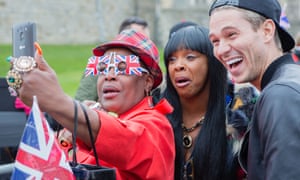
Selfies on set at Windsor Castle with the Educating Joey Essex – Etiquette Special crew for a celebration of the Queen’s 90th. Photograph: Rex/Shutterstock
T
here is no sillier location in the Venn diagram than the intersection of “people who are royalists” with “people who think the crown should miss out Prince Charles and go straight to Prince William”. How in the name of porphyria-by-proxy can they be both? The British monarchy is a hereditary gig as governed by the Bill of Rights and the Act of Settlement. You can’t just skip a round because you don’t like whoever the random figurehead generator has thrown up.

That’s the entire point: even if he or she is gibbering, has a chin that meets their nose, and wets the throne aged 59, they are the monarch. If you don’t like it call for a republic, where you really do get to choose. Otherwise what you’re suggesting is a popularity contest for head of state between three or fewer members of a family who couldn’t charisma their way on to a parish council in a blind judging test. I know we’re a self-loathing people, but that would seem to be going too far even for us. Wherever you stand on the main monarchy debate – which is to say, whether we should have one at all – I hope we can all agree the idea of effectively picking and choosing belongs in the domain of ghastly things like “meritocracy” and “democracy”.
Yet perhaps the only thing that should be more anathemic to the crown than this is the idea of “relevance”. Popular wisdom declares no one knows the second verse of the national anthem, but I feel sure it contains nothing about “relevance”. It can’t be a rhyming issue – John Bull or whoever composed it could have done something perfectly serviceable with “elephants”. Alas, on the occasion of the Queen’s 90th birthday this week you could hardly move for discussions about relevance. How had she managed to stay relevant? Was she relevant any more? How could she stay relevant in the future? Would the crown remain relevant after her death?
Dear me. What would she want with relevance? A few minutes’ research debunks my grandmother’s claim that royals are “two a penny on the continent”. Even so, modern royal relevance feels very continental, and consequently something that should be shunned for the moral health of our nation, like bidets or enjoying sex. If the Danes or the Norwegians wish to be relevant that is, of course, a matter for them. But it’s not something ours should be involved with.
I can’t remember who wrote it, but someone once distilled the appeal of the early-era Spice Girls perfectly, saying that they came across as people who you could swap makeup with before heading out together to Topshop. This was their cheery relevance, and very well it served them. Relevance is most desirable in our early Spice Girls, but not in Buckingham Palace. Relevance feels something that Prince Charles might place his faith in, much as he has done with homeopathy, only with potentially even more devastating results.
Fortunately, most of this week’s ceremonial relevanting was people projecting relevance on to Her Majesty, as opposed to her getting sidetracked by it. The Queen was so modern, panted one “royal watcher” (as we have to call the professional wing of the Franklin Mint completists), that the official monarchy Twitter account was tweeting all her birthday engagements. Rising to the challenge of relevance, every single member of the cabinet weirdly tweeted happy birthday wishes to the Queen, 90, even though the royal motto is actually Honi soit qui @ me.
Elizabeth II has occupied the throne for over six decades and, for my money, she has done so rather majestically (if you’ll excuse the tautology). But an inherent part of her occupation of the office, whether or not sentimentalists can bear to face it, is epitomised by that faintly heartbreaking photo of her returning home from a six-month foreign tour, and greeting the six-year-old Prince Charles with a formal shake of the hand. Like the past, the royal family is another country. They do things differently there.
And it has worked. Though I’m not really a monarchist, I can’t help feeling she has known best. Far from being “relatable”, any royal family wishing to stick around should surely be something of an enigma to their subjects. Not for the health of their family dynamics – those frequently seem to be collateral damage, but are none of our beeswax except as matters of gossip. No, the monarch must remain remote and other for the preservation of the crown. They are not the same as us, or we’d be them. Their survival depends on their otherness. The lesson of the celebrity era, with its endless oversharing and stars’ insistence that they’re “just like us” is that over-familiarity breeds raging contempt. By far the most dangerous threat to the monarchy in all of Elizabeth’s reign thus far came from the world of celebrity, in the form of the megastarry Diana. The more people could relate to Diana, the more the institution in which she had shot to fame looked vulnerable.
Her death saw the famous outpouring of emotion, and a demand that the Queen behave uncharacteristically. Having awoken from that late summer night’s dream, and subsequently enjoyed various Helen Mirren dramas, many people have now rewritten their own history of the period, and maintain that they always admired the Queen’s obvious bafflement at it all, until she was helped to realise that the display of a very small amount of public emotion was a matter of obligation. Obligation was something she understood. Consequently, she discharged it promptly and faultlessly, though clearly in the hope that it would not be necessary to make a further exception to the rule for another four decades: one per reign is quite sufficient. But other than that, the Queen has remained in character for over 60 years. Take that, Daniel Day-Lewis.
It is the performance of a lifetime – or rather, the lifetime has been the performance. Its only nod to dynamism has been her glacial ageing and the clockwork turn of her daily engagements. That, all told, looks to have been something far more permanent than mere relevance, which Her Majesty wisely appears to have regarded as royal kryptonite.

Barack Obama: Brexit would put UK back of the queue for trade talks

US president, visiting London, says ‘part of being friends is being honest’ as he lays out perils of leave vote in EU referendum
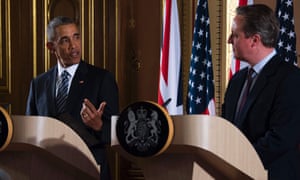
Barack Obama (left) at his press conference with David Cameron.
Barack Obama (left) at his press conference with David Cameron. Photograph: Jim Watson/AFP/Getty Images
The US would not do a trade deal with the UK any time soon if Britain voted to leave the EU, Barack Obama has said.
The US president said Britain would be “at the back of the queue” when it came to negotiating a new trade agreement because it was better to strike a transatlantic deal with Europe as a whole.
Appearing with David Cameron at the Foreign Office, Obama said he was delivering the warning that the UK is better off in the EU because “part of being friends is being honest”.
Campaigners for Britain to leave the EU have reacted furiously to Obama’s intervention, with the mayor of London, Boris Johnson, suggesting the US president’s part-Kenyan ancestry might have left him with a grudge against the UK.
Asked whether it was right for him to speak out, Obama stressed the EU referendum was a decision for the British people but added: “I’m not coming here to fix any votes. I am offering my opinion and in democracies everyone should want more information, not less, and you shouldn’t be afraid to hear any arguments being made. That is not a threat.”
He went on to cast doubt on the claims of leave campaigners that the UK would easily be able to strike a separate trade deal with the US.
“I think it’s fair to say maybe some point down the line but it’s not going to happen any time soon because our focus is on negotiating with the EU,” he said. “The UK is going to be at the back of the queue.”
He said it would not be a priority “not because we don’t have a special relationship” but because it was more efficient to have one agreement with a lot of countries as a bloc rather than piecemeal arrangements with each one.
Addressing the issue of whether the US would put up with a similar loss of sovereignty as Britain has undergone in the EU, he said his country in its own way constrained itself under norms and rules that made everyone more prosperous.
He added: “I would tell you this. If right now I’ve got access to a massive market where I sell 44% of my exports and now I’m thinking of leaving the organisation that gives me access to that market and is responsible for millions of jobs and an enormous amount of commerce, that is not something I would probably do.”
Cameron said the “strong and essential partnership between our nations has never been more important” and echoed Obama’s argument that the UK’s influence in the world is amplified by EU membership.
The prime minister said he had “never felt constrained in anyway in strengthening our relationship by our membership of the EU – in fact the reverse”.

Manchester United paid over £10m to player agents last summer as it is revealed Premier League clubs spent total of £47m to complete transfer dealings Manchester United spent £10m on agents' fees during first half of season Includes sale of Angel di Maria and the purchase of Memphis Depay In total, Premier League clubs spent £46.5m to agents to complete deals Liverpool's total came to £6.6m, while Manchester City paid £5.8m 10 Football League clubs didn't spent anything on agents' fees

Manchester United paid over £10m to player agents last summer as it is revealed Premier League clubs spent total of £47m to complete transfer dealings

  • Manchester United spent £10m on agents' fees during first half of season
  • Includes sale of Angel di Maria and the purchase of Memphis Depay 
  • In total, Premier League clubs spent £46.5m to agents to complete deals
  • Liverpool's total came to £6.6m, while Manchester City paid £5.8m
  • 10 Football League clubs didn't spent anything on agents' fees 
Among their negotiations were the sale of Angel di Maria to Paris Saint-Germain, the purchase of Memphis Depay from PSV Eindhoven and David de Gea's new contract.
United spent £10,023,318 net on agents' fees, considerably more than the second-highest, Liverpool, with £6,672,713.
Manchester United's transfer dealings last summer included the signing of Memphis Depay from PSV
Executive vice-chairman Ed Woodward oversaw spending of over £10m on agents' fee during first four months
Net total paid to agents and intermediaries by Premier League clubs between October 2015 and February 2016
The figures, which cover every transfer dealing and new contract negotiations by Premier League, Football League and National League clubs between October 1, 2015 and February 1, 2015, were published by the Football Association on Friday.
They have been disclosed in accordance with new FIFA transparency regulations into the dealings of agents and intermediaries.
Liverpool's dealings included the signings of Christian Benteke from Aston Villa, Roberto Firmino from Hoffenheim and Nathaniel Clyne from Southampton.
Among Manchester United's outlay on agents' fees were negotiations over David de Gea's new contract
United's dealings also included the sale of Angel di Maria to Paris Saint-Germain last August
Manchester City come in third-highest in the Premier League with £5,880,098, while Arsenal shelled out £3,135,483 net to agents.
In all, the 20 Premier League clubs paid a net total of £46,582,843 to ensure transfers went through smoothly.
In the Sky Bet Championship, Queens Park Rangers were the only team to spend in excess of £1m on agents' fees during this period. In all, the 24 second-tier clubs racked up £6,985,109 paying intermediaries.
In League One, £658,791 was paid and in League Two, £163,334. 
Bury, Peterborough United, Rochdale, Swindon Town, Accrington Stanley, AFC Wimbledon, Cambridge United, Hartlepool United, Mansfield Town and Morecambe didn't spend anything. 
More to follow. 
 
BREAKDOWN OF AGENTS' FEES PAID BY DIVISION 
SKY BET CHAMPIONSHIP 
Sky Bet Championship 
SKY BET LEAGUE ONE 
Sky Bet League One
Sky Bet League One
SKY BET LEAGUE TWO 
Sky Bet League Two
Sky Bet League Two
OTHER CLUBS 
Other clubs below the Football League

Bruch der Waffenruhe in Syrien: Mehrere Tote bei Luftangriffen in Aleppo

Zerstörter Markt in Aleppo (Archivbild)


AFP
Zerstörter Markt in Aleppo 
In Genf sollen das syrische Regime und die Rebellen über Frieden verhandeln. Doch die Gespräche werden von neuen Kämpfen überschattet: Jets bombardieren Aleppo, mindestens zehn Menschen starben.
Auf dem Papier gilt in Syrien noch immer die Waffenruhe, in Genf sollen Regime und Rebellen über einen Friedensprozess verhandeln. Doch die Realität im Bürgerkriegsgebiet sieht anders aus: Bei Luftangriffen sind in der umkämpften Stadt Aleppo mindestens zehn Menschen ums Leben gekommen.

Kampfjets des Regimes und Russlands hätten am Freitag mehrere von Rebellen kontrollierte Wohnviertel bombardiert, berichtete ein Aktivist, der sich in der Stadt aufhält. Weitere Aktivisten bestätigten die Angriffe. Die Großstadt ist zwischen Regimetruppen und verschiedenen Rebellengruppen heftig umkämpft.Die Kämpfe gefährden den weiteren Verlauf der Gespräche in Genf. US-Präsident Barack Obama sagte am Donnerstag, die Feuerpause leide unter einer "enormen Belastung". Die Opposition macht dafür die Regierung verantwortlich. Aus Protest gegen den Bruch der Waffenruhe kündigte sie ihre Abreise von den derzeit in Genf stattfindenden Friedensverhandlungen an. "Die Waffenruhe ist tot", sagte ein Mitglied der Delegation.
Der Uno-Sonderbeauftragte für Syrien, Staffan de Mistura, hatte für Freitag Zwischenbilanz zum Stand der Gespräche angekündigt. Diplomaten rechneten damit, dass erneut eine Pause eingelegt wird.
In den vergangenen Tagen hatte die Gewalt im Norden Syriens insgesamt wieder zugenommen. Auch in der nordöstlichen Stadt Kamischli kam es zu Gefechten. Einheiten von Machthaber Baschar al-Assad beschossen am Freitag kurdisch kontrollierte Gebiete. Nach Angaben kurdischer Medien und der in London ansässigen Syrischen Beobachtungsstelle für Menschenrechte wurden mehrere Menschen getötet, beide Seiten hätten außerdem Gefangene genommen.
Im Nordosten hatte zuletzt eine relative Stabilität zwischen Regime und Kurden geherrscht. Die YPG, ein Ableger der verbotenen kurdischen Arbeiterpartei PKK, und ihre Verbündeten kontrollieren weite Gebiete im Norden Syriens und gelten als wichtigster Partner des Westens im Kampf gegen die Terrormiliz "Islamischer Staat".

Syrische Opposition: "Der Schlüssel für die Lösung des Konflikts liegt in Moskau"

Luftangriff in der Nähe von Aleppo


Zur Großansicht
REUTERS
Luftangriff in der Nähe von Aleppo
Die Waffenpause in Syrien ist brüchig, die Friedensgespräche in Genf kommen kaum voran. Oppositionssprecher Salem al-Meslet zeigt sich frustriert - und fordert mehr Druck auf Putin.
Vor genau zwei Monaten einigte sich die Syrien-Kontaktgruppe unter Führung der USA und Russlands bei ihrem Treffen in München auf eine Waffenruhe für das Bürgerkriegsland . Seit Ende Februar laufen indirekte Verhandlungen zwischen dem Regime von Baschar al-Assad und der syrischen Opposition. Derzeit findet in Genf die dritte Gesprächsrunde statt.


Die Feuerpause ist brüchig, in dieser Woche meldeten Aktivisten mehrere Angriffe der russischen und syrischen Luftwaffe, bei denen Dutzende Zivilisten getötet wurden. In den Reihen des High Negotiation Council (HNC), der Vertretung der syrischen Opposition in Genf, wächst der Unmut über den Verlauf der Gespräche. Die Assad-Gegner drohen sogar mit einem Abbruch der Verhandlungen.
HNC-Sprecher Salem al-MesletZur Großansicht

HNC-Sprecher Salem al-Meslet
HNC-Sprecher Salem al-Meslet äußert sich im Interview mit SPIEGEL ONLINE über den Stand der Gespräche. Er fordert Russland auf, endlich Druck auf Assad auszuüben. Nur so sei ein Verhandlungserfolg noch möglich. Lesen Sie hier das gesamte Interview im Wortlaut:
S ONLINE: Hallo Herr Meslet, wo erreiche ich Sie denn gerade? Es hieß, die Unterhändler der syrischen Opposition wollten die Friedensverhandlungen abbrechen und bis Freitag aus Genf abreisen.
Salem al-Meslet: Ich bin nach wie vor in Genf, genauso wie der Großteil unserer Delegation. Die Verhandlungen gehen bis kommenden Mittwoch auf Expertenebene weiter, danach ziehen wir Bilanz und schauen, wie und ob es weitergeht.
S ONLINE: Wie sieht denn Ihre Bilanz derzeit aus?
Meslet: Negativ, denn an der Lage vor Ort hat sich überhaupt nichts verändert. Noch immer belagert das Regime Städte und verweigert den Bewohnern humanitäre Hilfe. Und es wird immer schlimmer: Aleppo wird mehr denn je von den Truppen des Regimes und der Terrororganisation "Islamischer Staat" bedroht. Und die Luftwaffe bombardiert täglich Städte und verübt Massaker am syrischen Volk .
S ONLINE: Aber es gibt doch auch Orte wie Fua und Kefraja, die nach wie vor von Aufständischen abgeriegelt werden.
Meslet: Ja, das stimmt und wir lehnen das ab. Wir fordern, dass die Belagerung aller syrischen Orte aufhört. Aber die Kämpfer der Pro-Assad-Milizen in Fua und Kefraja haben immerhin Lebensmittel und Medikamente erhalten. Andererseits bekommen Orte, die vom Regime belagert werden, gar nichts, wie zum Beispiel Daraja. Assad hat nicht einmal Impfstoffe für Kinder in den Ort gelassen.
S ONLINE: Wie können die Genfer Verhandlungen denn noch zu positiven Ergebnissen kommen?


Meslet:
 Die Gespräche sind sinnlos, solange unser Verhandlungspartner, das Assad-Regime, sein eigenes Volk tötet. Russland hatte sich beim Treffen der internationalen Kontaktgruppe in München verpflichtet, den Waffenstillstand zu überwachen und zu schützen. Präsident Putin muss nun endlich Druck auf Assad machen, dafür braucht es nur einen Anruf. Der Schlüssel für die Lösung des Konflikts liegt in Moskau, nicht in Damaskus. Und auch Angela Merkel sollte mehr Druck auf Putin machen. Die Syrer, die Sie in Deutschland zu großzügig aufgenommen haben, wollen schließlich zurück in ihre Heimat. Das geht aber nicht, solange ihre Heimat in Schutt und Asche gelegt wird.S ONLINE: Worüber haben Sie in den vergangenen Tagen eigentlich konkret verhandelt?
Meslet: Wir haben dem Uno-Sondergesandten Staffan de Mistura unsere drei wichtigsten Themen genannt: Die Freilassung der politischen Gefangenen, die Aufhebung der Belagerungen und das Ende der Luftangriffe auf Zivilisten. Das ist die Voraussetzung für Gespräche über die Bildung einer Übergangsregierung. Das Regime ist an diesen Punkten gar nicht interessiert. Assads Delegation wollte mit de Mistura über die Rückgabe der israelisch besetzten Golanhöhen sprechen. So lange täglich Syrer sterben oder flüchten, kann das aber nicht ernsthaft das wichtigste Thema sein.

Merkel räumt Fehler in Böhmermann-Affäre ein

Kanzlerin Merkel nannte das Böhmermann-Gedicht über den türkischen Präsidenten Erdogan "bewusst verletzend". Jetzt ärgert sie sich über die eigene Äußerung. Ihre Entscheidung über die Ermächtigung zur Strafverfolgung verteidigt sie aber.

Kanzlerin Angela MerkelZur Großansicht

Kanzlerin Angela Merkel
Bundeskanzlerin Angela Merkel hat einen Fehler im Umgang mit der Affäre um das umstrittene Gedicht des Satirikers Jan Böhmermann über den türkischen Staatschef Recep Tayyip Erdogan eingeräumt. Die Ermächtigung für Ermittlungen gegen Böhmermann sei richtig, aber sie ärgere sich darüber, dass sie vorher das Gedicht als "bewusst verletzend" bezeichnet habe, sagte Merkel. Damit sei der Eindruck entstanden, dass ihre persönliche Bewertung etwas zähle: "Das war im Rückblick betrachtet ein Fehler."

Merkel hatte in der vergangenen Woche der Staatsanwaltschaft die Ermächtigung erteilt, gegen den ZDF-Moderator weiter zu ermitteln. Die Mainzer Ankläger - dort hat das ZDF seinen Sitz - hatten bereits kurz nach der Ausstrahlung des Schmähgedichts über den türkischen Präsidenten Recep Tayyip Erdogan wie rechtlich vorgesehen mit Ermittlungen nach diesem Paragrafen begonnen.In einem als Schmähkritik betitelten Gedicht hatte Böhmermann in seiner satirischen ZDF-Show "Neo Magazin Royale" über den türkischen Präsidenten gespottet. Er hatte dabei deutlich gemacht, dass er dies bewusst tue, um die Grenzen von Presse-, Meinungs- und Kunstfreiheit aufzuzeigen. Das ZDF hatte den Beitrag später aus der Mediathek genommen, stellte sich in dem Rechtsstreit jedoch hinter den Moderator. "Wir gehen mit ihm durch alle Instanzen", Intendant Thomas Bellut dem SPIEGEL.
Die Entscheidung der Kanzlerin war in Deutschland und international kritisiert worden und hatte auch in der Regierung für erhebliche Kontroversen gesorgt. Grundlage für die Ermittlungen ist Paragraf 103 des Strafgesetzbuchs (StGB). Demnach muss, wer einen ausländischen Staatschef beleidigt, mit bis zu drei Jahren Haft oder einer Geldstrafe rechnen.
Die Fakten zur Staatsaffäre Böhmermann