The French capital is deeply divided along right-left lines, but November’s terror attacks have made Anne Hidalgo determined that it remain a city of ‘liberty, tolerance and humanism’. Kim Willsher shadows her for a day
“I’d never seen a war zone before,” she recalled later. “Those haggard faces, the bodies I saw, they were just youngsters, hipsters. Some had bullets in the head … The heads of those youngsters were the heads of my children. I knew life could not continue as normal.”
Sitting in Paris’ Gare du Nord waiting for a train to London, the mayor of Paris is living that night again. She frowns and looks pained. It was, of course, the second major terror attack on the French capital in less than a year; Hidalgo knew several of the murdered Charlie Hebdo cartoonists, and was one of the first on the scene that day too. Now the people of Paris were looking to her for guidance again.
“That night, as I tried to console those who survived, I found people wanted to touch,” she says. “They wanted to hug. It was a very physical need; the need to feel others around them.”
Hidalgo describes seeing the dead laid out on the pavement outside the Bataclan: “It had all been planned, but the killing was so random. When you looked at the names of those who died, you saw they came from everywhere, and in a way this united all Parisians, wherever they were from.”

At that moment, the old-fashioned socialist policies (she calls them “humanist”) that have bitterly divided the capital since Hidalgo took office were put to one side, as she stepped into the role Rudolph Giuliani took on in New York after 9/11.
“She could have been defeated, but she held the city together,” Mathias Vicherat, her chief of staff, told Libération. “She succeeded in finding a balance between the compassion she was clearly feeling and that I could see on her face, and a kind of determination.”
Throughout the day that I follow her, Hidalgo demonstrates her fondness for physical contact; continually giving her security team the jitters by breaking away to say hello to fellow Parisians. As she is rushed through the Gare du Nord to catch the Eurostar train, “la Patronne” – as City Hall staff call her – stops to shake hands and exchange a few words with cleaners, security officers and waiters.
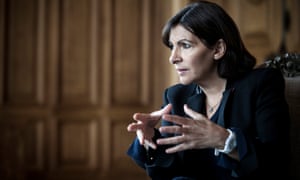
Her appearance, like her image, is understated: Hidalgo sports her usual combination of black trousers and matching tailored jacket. There is no expensive jewellery, barely a trace of lipstick, no nail varnish.
The mayor is on her way to London with her sports adviser, former rugby international Pierre Rabadan, to watch the Champions League return leg betweenParis Saint-Germain and Chelsea at Stamford Bridge. It is a flying visit to London, and she will not be meeting her counterpart Boris Johnson, who she insists – perhaps a little too strongly – that she admires: “He’s such a character, cultivated and intelligent ...”
London brings out a competitive streak in Hidalgo, who famously once dismissed the British capital as “a suburb of Paris”. After some petulant huffing from across the Channel, she tactfully added: “Seen from Shanghai, both cities are suburbs of each other” – but she had made her point.

Hidalgo says she is surprised – and disappointed – by Johnson’s Brexit campaign, and jokes that she is tempted to turn the tables on him. “Remember when a socialist government was elected, and he offered to roll out the red carpet for French businesses that wanted to leave? I’m going to offer to do the same for British companies if you leave Europe.” She smiles, but it is clear she is only half-joking.
Running Paris leaves Hidalgo precious little family time but, after two hectic years in office, she insists it is still her dream job. “It’s a role where you can really change things on a human level; we are involved in all aspects of people’s daily lives. One minute I am looking at the organisation of public services like creches, childcare and school canteens; the next, wider issues like pollution and street cleaning.”Rabadan has recently become a father, and photographs are duly swapped during the journey. Hidalgo, who has two grown-up kids and a teenage son, all of whom have gone through state education, discusses their academic and sporting achievements like any proud maman. She talks warmly about her parents – father Antonio, an electrician, and mother Marie, a dressmaker – who live in their native Spain (Hidalgo herself was born near Cádiz), and her elder sister Marie, who is in Los Angeles.
On an average working day, she will be up at 6.30am to read the newspapers and any reports that need dealing with. She is at her grand office at City Hall overlooking the Seine – at 155 square metres, the biggest public office in France – at 8am. Staff say she is rarely home before 11pm, and this particular day she will not get home before 4am.
Today has begun with a visit to a “flood crisis centre”, where a simulation of the Seine rising by up to 6.5 metres above normal is being enacted. The exercise sprang out of a wider reflection of how to deal with crises after the November attacks, including flooding.
It is not an idle threat: in 1910 after heavy rain, snow and ice, the river, normally around 2m deep, rose to 8.63m, inundating the city’s drainage and sewerage system, sending torrents of foul icy water down the streets and causing 400 million francs – the equivalent of €1.6 billion today – of damage. Experts say it is only a matter of time before the Seine rises again.

In the crisis centre, officials jump to their feet as “Madame La Maire”, as she insists on being known (Le Maire is grammatically correct), arrives. “Pretend I’m not here,” she tells them, as photographers and camera crew jostle around her. It is day three of the pretend catastrophe: the Seine is 3.2m higher than normal, 210,000 people are without heating, the mobile telephone networks and refuse collection are threatened. Schools will have to closed
Then we are off in the mayoral “limousine” – an electric Renault Zoe – for a crawl across the city to the 19th arrondissement, where Hidalgo is opening Le Cargo, an immense “digital business incubator” (the biggest in Europe until the end of this year, when another, Halle Freyssinet, will open in Paris and become the biggest in the world).True to character, Hidalgo asks detailed technical questions; more fodder for those who accuse her of being a technocrat. The officials are delighted. The journalists yawn.
Attracting new business and global investment is one of the totems of Hidalgo’s programme for the French capital. Where the City of London has marketed itself as the financial capital of Europe, Hidalgo is on a mission to make Paris the continent’s digital hub.
Our progress is slowed by demonstrations at the Place de la République over work reforms proposed by France’s socialist government. Hidalgo, one of the few Parti Socialist figures whose popularity is rising, launches into a critique of the government and certain ministers. She has publicly opposed reforms that have led to clashes between riot police and protesters, claiming the measures will worsen working conditions. “This, from a left-wing government … hard to believe,” she says.
At Le Cargo, Hidalgo is joined by Valerie Pecresse, a former minister from the centre-right Les Republicains party who, after a surprise victory in December’s local elections, controls the regional council. Pecresse speaks first: her speech is brief, jovial and short on detail. Hidalgo follows: hers is long and serious.
Critics accuse Hidalgo, who took a while to emerge from the shadow of her mentor and City Hall predecessor Bertrand Delanöe, of having little charisma. She counters: “When it comes to taking decisions, if you know the details you know what’s at stake.”

As she leaves, Hidalgo is baited by a TV reporter over her working relationship with Pecresse; it is no secret the two have fundamentally opposed political views and little in common. Hidalgo’s smile drops briefly, and the response is what the French call “sec” (curt).
“We have different political ideas, but we work well together,” she says. “I know the media prefers women in politics to be hysterical so they can portray us as aliens, but it’s hard enough already for a woman to get to the top in politics.” With that she smiles, turns and walks off.
Hidalgo wants to know – in detail - what she and Paris can do to support the doctor’s work. Her interest is not for the media (apart from The Guardian, none are present) and as the clock ticks, jittery assistants appear at the door, shuffle their feet and look at their watches, but she will not be hurried.Before leaving for London, Hidalgo has a hastily scheduled meeting with Congolese gynaecologist Denis Mukwege, who won the 2014 Sakharov Prize for his work with raped and sexually abused women, as well as victims of Female Genital Mutilation.
Since taking office two years ago, Hidalgo has set out to change the landscape of French capital with a series of innovative ideas. Her insistence that the city’s wealthier arrondissements must bear their fair share of both social housing and centres for the city’s growing population of homeless and refugees, have proved divisive to the point of public revolt. At one recent meeting in the chic 16th arrondissement, one of Hidalgo’s deputies – sent to explain details of a proposed centre for the homeless in the area – was called a “crook”, “collaborator”, “bastard” and “son of a bitch”.
Hidalgo is clear that housing and pollution are the twin prongs of her mayoral mandate – and the keys to achieving greater social equality in Paris. Following the success of last September’s first car-free day, this summer a large stretch of highway along the Seine will be closed to vehicles, and eventually transformed into a pedestrian walkway from the Bastille to the Eiffel Tower. The most polluting cars are to be progressively banned from the city.

Paris’s symbolic squares, including Place de la Bastille and Place de la Nation, will also be given makeovers including more pedestrian and cycle space. Motoring organisations are outraged and claim shutting streets to vehicles will gridlock surrounding areas – adding to, not reducing, pollution. But Hidalgo will not budge on the issue, insisting Parisians have to be weaned off their dependence on private vehicles. And polls show a majority of people support her: even the most divisive, the closure of the Seine highway, is supported by 60% of Parisians.
But that’s far from the end of her ambitions. Hidalgo has promised to make all Paris’s public transport electric by 2030, all its public buildings energy efficient by 2050, and has introduced “participative democracy” – an annual poll in which Parisians propose and decide on ideas for 5% of the annual municipal budget (a sum amounting to around €20 million).
“I’ve been elected at a time of major economic crisis, and a crisis of confidence, in France,” she says. “We have to ask how we respond to that, and give added value by being responsible politicians. So we have introduced more participative democracy, with closer relations between the elected, the administration and the people. Parisians are now actors in this process and they often have good solutions. They feel more implicated in their city.”
“On one side, there’s a Paris that is young and female … on the other, a Paris that is older and male, settled in the bourgeois arrondissements and very critical [of Hidalgo],” says Frédéric Dabi, of the pollsters IFOP. “She’s very strongly appreciated by her electorate on the left, and she is, overall, maintaining that support – which is encouraging for her when you see the catastrophic state of the left at national level.”The city, though, is divided, according to a recent poll in the Journal du Dimanche(JDD), which found that 52% of Parisians judged her record since taking office “favourably”. While this rose to 72% of those who consider themselves left wing, and 60% among the under 35s, on the right, 70% of those asked were “unhappy” with her record. The JDD concluded that this was both “disappointing and encouraging” for Hidalgo.
Hidalgo says she is “reflecting” on the criticism, admitting: “Sometimes we need to shift boundaries and upset the way things have always been done to become more efficient, but these changes can disturb people.”
The mayor is also behind the “Reinvent Paris” scheme, an international competition to find environmentally friendly urban designs to transform neglected and run down city-owned sites. If elected president of the C40 global cities group – she recently announced her candidature – she hopes to take the idea worldwide.
From the ground, however, those details can look like broad brush strokes. One of Parisians’ biggest grouches is how the city seems increasingly grimy: the dog dirt on pavements; the tons of cigarette ends casually tossed into the street (not to mention the flouting of no-smoking laws); the motorcyclists and parked cars on pavements … the details that blight everyday life.
Hidalgo nods. “I know, I know … we are looking at these issues. But sometimes there are other priorities.”
Paris may be deeply divided along right-left lines, but November’s attacks have made her impatient to be rid of “petty power games”. She is equally dismissive of any talk of being a future presidential candidate (the current incumbent, François Hollande, is in freefall in the popularity ratings), insisting – as most mayors do – that she has the “best job in the world” until her mandate ends in 2020.
For Hidalgo, it has already been an extraordinary time in office. “Paris has changed permanently,” she tells me. “After the attacks, there was suddenly a sense of community, of closeness; a need to stand up and be together. I felt that change in people and I can still feel it. It fills me with hope.”