.Drowned worlds: Egypt's lost cities. As a major new exhibition opens at the British Museum, Charlotte Higgins.

The Guardian

Near the tiny farming villages of Rashwan and Abu Mishfa in the Nile Delta – the kind of villages where you might see a girl tugging on the harness of a recalcitrant water buffalo as she leads it out to graze, or a mule-drawn cart loaded with animal feed – is a scrappy lake, the haunt of innumerable egrets. Under this lake, and surrounding fields and houses, lie the remains of Naukratis, a city established by Greeks as a trading port in around 620BC. It is here that a British Museum excavation is under way, and some of the archaeologists’ most intriguing discoveries in the city – which you might think of as a kind of Hong Kong of the ancient world – are about to form part of a major exhibition.
It takes an effort of imagination to conjure this place back to its ancient flourishing before its abandonment in the seventh century. But once it was a city with perhaps 16,000 inhabitants, full of temples to gods such as Hera, Aphrodite and the Dioskouroi (Castor and Pollux), and dominated by a vast sanctuary dedicated to the Egyptian deity Amun-Ra, from which a sphinx-lined avenue led to the Canopic branch of the Nile, which long ago flowed here.


FacebookTwitterPinterest
 The Hong Kong of the ancient world … a 3D animation of Naukratis. Video: Grant Cox/Alexandra Villing/Ross Thomas/Naukratis Project/Trustees of the British Museum.

There was also a Hellenion, a sanctuary dedicated to all the gods of the Greeks: an early expression of pan-Hellenic identity from the politically independent city-states that, according to the historian Herodotus, jointly founded the city at the invitation of the pharaoh. The Greek temples started off as simple affairs, sacred enclosures with outdoor altars, but pedimented structures were built once the Greeks had learned the knack of building colonnaded temples from the Egyptians. Surrounding the sanctuaries were mud-brick houses several storeys high, some with dovecotes on their roofs. The same kind of conical pigeon houses can be seen in the villages today.


Colossal ... this pharaoh was found in five separate pieces before it was reassembled underwater.
 Colossal … a five-metre pharaoh found at Naukratis’s sister port, Thonis-Heracleion. Photograph: Christoph Gerigk/Franck Goddio/Hilti Foundation

All Mediterranean traders who had dealings with Egypt – not just Greeks, but also Phoenicians, Cypriots, Levantines – were obliged to come to Naukratis to trade their oil and wine and pay their tax, sailing more than 40 miles inland down the Nile via Thonis-Heracleion, a sister port at the mouth of the river on the Mediterranean. (That port was overwhelmed in antiquity by the encroaching sea: impressive finds have been made by marine archaeologists, which can also be seen in the British Museum exhibition.)
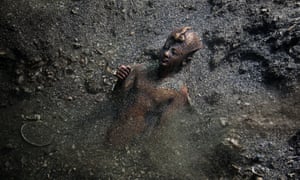

Bronze statue of Pharaoh with khepresh crown - 26th-29th dynasty (664-380BC) Thonis Heracleion
 A bronze Pharaoh in akhepresh crown at Thonis-Heracleion. Photograph: Christoph Gerigk/Franck Goddio/Hilti Foundation

After the traders had done their deals, there was entertainment to be had: Herodotus tells us that Naukratis was famous for its excellent courtesans. Charaxos, the brother of the poet Sappho, came here on trading trips from Lesbos and so completely lost his heart to the beautiful Rhodopis that he bought her her freedom; she became fabulously rich.
Ross Thomas, who is directing the dig, walks me round the excavations, just a couple of days into the 2016 season, their fifth. No monuments remain, nor yet a whiff of the gorgeous Rhodopis, and yet the past is palpable. He points out a jalabiya-clad man sitting outside his house on a classical column base; and the recently ploughed fields are full of ancient potsherds. Ashraf Abdel-Rahman, a local official of the Supreme Council of Antiquities, picks up a piece. Thomas gives it a casual glance. “Fourth-century BC mushroom amphora, imported,” he says, with impressive taxonomical ease, and chucks it back.


‘So this is Naukratis!’ ... British Museum archaeologists following in the footsteps of Flinders Petrie at Naukratis
Pinterest
 ‘So this is Naukratis!’ … British Museum archaeologists following in the footsteps of Flinders Petrie at Naukratis. Photograph: British Museum

We meet Ben Pennington, a geoarchaeologist who, with young Egyptian trainees, is sinking an augur nine metres below the surface in order to glean information about the area’s ancient topography and environment. In another field, Eleanor Maw is in charge of a team surveying fields using the technique of magnetrometry– “basically, a non-invasive way of looking at what’s underneath”, she explains, through which she can chart the outlines of the old mud-brick tower houses. Another team is digging in a pair of trenches that may pinpoint the entrance to the Hellenion.
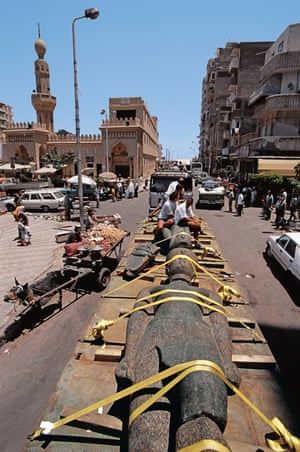

Lying in state ... the statue of a Ptolemaic pharaoh travels through the streets of Alexandria.
 Lying in state … the statue of a Ptolemaic pharaoh travels through the streets of Alexandria. Photograph: British Museum

Yet another group, perhaps most excitingly, is working at the edge of where the Nile once flowed. Naukratis has been partially excavated before, first by the great Flinders Petrie in the 1880s. (He realised he’d stumbled across the city when he read a Greek inscription saying so – it was built into the house he was staying in. “I almost jumped as I read,” he wrote in his journal. “So this is Naukratis!”). The course of the river, however, was established only by Thomas’s team, and he is excited at the prospect of discovering the quayside and, perhaps, well-preserved boat remains. It is highly possible, for the site is waterlogged, providing the anaerobic conditions that slow the decay of wood.
Today, though, the haul is potsherds from the sixth century BC. Most of them – bright reddish, sandy to the touch – are locally made Egyptian wares. There are also Greek mortaria – bowls for pounding ingredients into sauces – and all manner of wine amphorae from the east Greek world, the Hellenic cities on what is now the west coast of Turkey. Thomas and his colleague from the British Museum,Alexandra Villing, sort through them. Petrie and his Victorian successors tended to ignore the Egyptian pottery finds, leading to a skewed vision of what kind of cultural texture this city might have had. Ross and Villing suspect the interaction and cultural exchange between people here was richer and more complex than had been believed. “It’s not a Greek colony,” says Thomas. “It’s a mixed community.” (The other matter over which Flinders Petrie discreetly drew a veil was the vast number of little terracotta figures of Harpocrates, the child of Isis and Osiris, that he found around the city. The figurines had comically vast and engorged phalluses, associated with the god’s role in ensuring the land’s fertility.)

Pinterest
 Hidden depths … IEASM underwater excavations at Abu-Qir Bay, Egypt. Video: Roland Savoye/Franck Goddio/Hilti Foundation
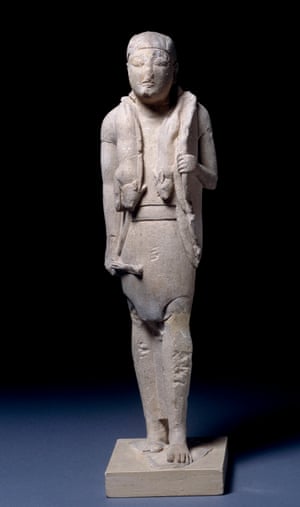
‘Kallias dedicated me to Aphrodite’ ... the sixth-century hunter and his piglets.
 ‘Kallias dedicated me to Aphrodite’ … the sixth-century hunter and his piglets, a Naukratis find. Photograph: Trustees of the British Museum

There is no more impressive evidence of the cultural encounters that occurred at Naukratis than in the Egyptian Museum, in Cairo, which Villing and I visit together. We are looking for a statue. Pass it by and you’d probably take it for another pharaoh: the four-metre-tall figure has an Egyptian ruler’s kilt, rigid arms and left foot striding forward. He’s not one, though: he was erected in the temple of Amun-Ra in Naukratis in around 300BC (a generation after Alexander’s conquest), and his name, according to the hieroglyphs on his back, is Horemheb. So far, so Egyptian, but the inscription goes on to tell us in no uncertain terms that “I am a Greek” – and that his father was Krates, a very Hellenic name, and his mother was the Egyptian-sounding Shesemtet.
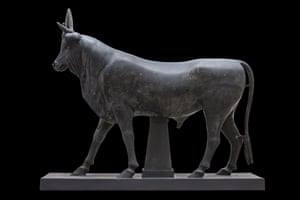
There is a lot of this intriguing cultural mingling in Egypt, and it runs right through to the Romans. In the catacombs of Kom el-Shoqafa in Alexandria, a Roman family is buried in an elaborate tomb arranged like a pedimented temple with niches for the sarcophagi, which are decorated with flower garlands and tragic masks – altogether very classical. But the pediment is carved with Egyptian falcons, the Roman couple are depicted as Egyptian from the neck down (another kilt and striding left leg) and the relief carvings above their tombs are of Egyptian scenes, including Anubis presiding over a mummification. Nearby, in the sanctuary below the temple of Serapis – a Greek-friendly version of Osiris – the Roman emperor Hadrian dedicated an extraordinary, lifesize bronze bull representing the Egyptian god Apis. A replica is in situ, but the original can be seen in the British Museum exhibition.


Fish food ... a pharaoh head from the 3rd century BC.A 2m statue of the Apis Bull from the reign of Hadrian.
 On show … the two-metre statue of the Apis Bull. Photograph: Christoph Gerigk/Franck Goddio/Hilti Foundation

In the Naukratis of 2016, there’s a breath of excitement: Ashley Pooley’s team, working at the ancient riverbank, has found some wood, preserved here in the mud since the sixth century BC. It’s not a stern or a prow, but it’s something; perhaps, they think, part of a quayside boardwalk. Not bad for day two in the field – and a hopeful sign that the fertile black soil of Egypt has more and more knowledge to impart.

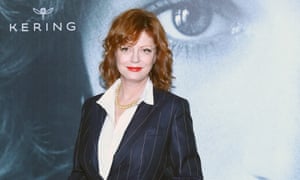
Susan Sarandon blasts Woody Allen and Donald Trump at Cannes-2016

Susan Sarandon
 Susan Sarandon : ‘I have nothing good to say about Woody Allen
Susan Sarandon did not hold back from airing her negative thoughts on Woody Allen, Donald Trump and Hillary Clinton on Sunday, during a lively chat at the Cannes film festival.
The subject of the Kering Women in Motion Talk, atop the Majestic Hotel, was the 25th anniversary of Thelma and Louise, with Sarandon accompanied by her co-star in that film, Geena Davis.
But Sarandon, spurred by questions from the press, also addressed myriad other topics with typical abandon. (Most recently, Sarandon, a registered Democrat and avid Bernie Sanders supporter, courted controversy for saying she might abstain from voting for Clinton, should the former secretary of state win the nomination to contest the presidency with Trump.)
A reporter asked the actor what she made of Allen’s comment at a press conference for his Cannes opener, Café Society, that he didn’t have “anything to really draw on” to one day make a film about a younger man and an older woman (his narratives often center on an older man and a much younger woman).
Sarandon at first appeared to shut it down: “I have nothing good to say about Woody Allen, so I don’t think we should go there.”
Pressed to elaborate, Sarandon said: “I think he sexually assaulted a child and I don’t think that’s right … It’s gotten very quiet in here, but that’s true.”
Sarandon was referring to allegations made by Allen’s daughter and brought back into the public eye this week by his son, Ronan Farrow. The allegations, which Allen denies, were investigated in 1993 and dropped. No charges were brought.
Later, Sarandon was asked what a Trump presidency would look like. Sarandon said she did not imagine the billionaire businessman and Republic candidate winning, because “he’s alienated so many minorities and women”.
“It doesn’t matter what [Trump] thinks because nothing will be able to happen,” she said. “The thing interesting about Trump is the things he’s talking about are impossible. They’re not what’s threatening. He’s obviously not going to build a wall; he’s not going to be able to export all the Muslims in the United States. All of those things are impossible to do.But should he beat Clinton, Sarandon said Trump would not be able to enact many of his grand policies.

“What he did that was terrible is that he legitimatized racism and homophobia in order get that very discontented base that wants something authentic. What he did in the process was say, ‘It’s OK to be violent.’ That’s why he has the KKK as one of his representatives. That’s been really terrible, besides the fact that America looks ridiculous.”
In fact, earlier this year, Trump hesitated to disavow an endorsement from a former grand wizard of the Ku Klux Klan. This week, it was revealed that the Trump campaign’s California delegates to the national convention included an avowed white nationalist.
Sarandon praised Sanders for “activating minorities … people who have not been engaged in the political process before, especially millions of millennials”. She said she believed Sanders supporters would not let Trump go through with his agenda, and would fuel a widespread backlash, should he be elected president.
Lastly, Sarandon targeted the American mainstream media for being “irresponsible”.
“The election has exposed how lame the media is,” she said. “They weren’t even covering Bernie Sanders until he won Iowa. That’s why the millennials knew so much, because they were online. The mainstream media never paid attention to him.”
When Variety’s Ramin Setoodeh, who was moderating the event, pointed out that the media’s current narrative said Clinton would beat Sanders to win the Democratic nomination, Sarandon scoffed: “It’s been the narrative all along. I don’t agree with that narrative.”
Referring to the continuing investigation into Clinton’s use of a personal email server while secretary of state, she said: “I think a lot can happen besides the fact that [Clinton] can be indicted at any moment. She stands a very good chance.”

Entrevista a Pablo Echenique. Sin desperdicio. Metamorfosis de un gusano en gusarapo.

"Aspiramos a lograr el millón de votos que faltó para el 'sorpasso' al PP"

El secretario de Organización de Podemos, Pablo Echenique, se muestra convencido de que la “potencialidad” de la alianza con IU, que mantendrá su identidad y su programa propios en la campaña y en el Congreso, y las confluencias les permitirá desbancar al PP como lista más votada


El secretario de Organización de Podemos, Pablo Echenique. EFE/ TONI GALÁN
ZARAGOZA .- “El resultado habla por sí solo”, señala el secretario de Organización de Podemos, Pablo Echenique, sobre el cierre de las negociaciones con Izquierda Unida (IU) para crear Unidos Podemos, una alianza que, en su opinión, abre un horizonte electoral de sorpasso no solo al PSOE sino también al PP como lista más votada en España.

“Ha sido un proceso complejo, pero en todo momento ha primado el interés general por encima del partidista”, explica. “Todo el tiempo tuvimos en la cabeza que tenía que salir –añade-, y la reacción que hemos visto en la gente ha sido de alegría desbordada y de ilusión en toda la organización”. El acuerdo fue apoyado por el 87,8% de la militancia de IU ( ) y por el 98% en el caso de los morados.

¿Qué ha hecho posible ahora el acuerdo que no lo fue en diciembre?

Ha habido un cambio de actitud por ambas partes, las dos fuerzas hemos estado más abiertas a un acuerdo. Pero ha habido otras dos claves: una son los resultados electorales, que han permitido medir la correlación de cada uno en votos, y la otra es el bloqueo que hemos vivido estos cuatro meses en el Congreso. Hemos visto que si no hacíamos algo distinto era posible que volviéramos a una situación parecida a la de estos meses, con un empate técnico entre las fuerzas del cambio y las viejas que hiciera que la institución quedara atascada de nuevo.
“Hacía falta algún tipo de revulsivo para explicar a la gente que el 26-J es diferente del 20-D”
Para impugnar ese marco, y por cierto cuando PP, PSOE y C’s estaban cuestionando para qué íbamos a votar de nuevo, hacía falta algún tipo de revulsivo para explicar a la gente que el 26-J es diferente del 20-D. Eso ha pesado mucho en la generosidad y las ganas de llegar a un acuerdo que hemos demostrado las dos organizaciones.

Entre Podemos e IU hay obvios puntos de encuentro pero también discrepancias ¿Qué se ha dejado cada una de ellas en la negociación? ¿A qué han renunciado?

Cada organización acude con su programa. Ni IU nos ha pedido que renunciemos a nada ni nosotros se lo hemos pedido a ellos. Hemos alcanzado un acuerdo programático de mínimos, de cosas en las que estamos de acuerdo, pero el planteamiento básico del acuerdo es que nos reconocemos como distintos. No es una fusión sino una alianza, en la que cada organización va con su programa y mantiene su identidad.

¿El 27 de junio se va a mantener esa identidad propia de cada organización?

Sí. Tenemos que estudiar cómo encajar eso en el reglamento del Congreso, que es muy restrictivo y cuya interpretación depende de la mayoría de la Mesa, pero la voluntad y el compromiso es que esa identidad se mantenga también en el Congreso. Esa es intención política, falta el detalle jurídico.

¿Cuál sería el principal beneficio que prevén obtener en términos electorales?

Con la hipótesis más sencilla, que es la suma de votos y la repetición de resultados del 20-D, se obtendrían alrededor de diez escaños adicionales para la coalición frente a lo que supondría ir por separado. Esto habla de la injusticia de la ley Electoral, especialmente con formaciones como IU. Pero yo creo que esto va más allá de la suma. Por la manera en la que se lo ha tomado la gente, creo que puede ocurrir que mucha gente que no votaba a Podemos ni a IU porque no les parecía bien que llegásemos a acuerdos, a lo mejor el 20-D se quedó en su casa pero el 26-J vota.
“Este acuerdo tiene potencialidad, veo posible que vayamos mucho más allá de la suma de Podemos e IU”
Y también creo que va a haber gente que, aunque no simpatiza con ninguna de las dos fuerzas a priori, valora el esfuerzo que se ha hecho y entiende que cuando dos formaciones dejan en segundo plano sus intereses partidistas para preocuparse por la situación de España, a lo mejor hay que votarles. Este acuerdo tiene potencialidad, yo veo posible que vayamos mucho más allá de la suma.

Se habla mucho de 'sorpasso' en el sentido que le daba Julio Anguita, para referirse a que una formación pueda imponerse al PSOE en el ámbito de la izquierda, pero originariamente se utilizaba en Italia para aludir a la posibilidad de que el PCI adelantara a la Democracia Cristiana y llegara al Gobierno. ¿A qué sorpasso aspira Unidos Podemos?

Nosotros mantenemos el objetivo con el que Podemos fue creado, que es desbancar al PP en las elecciones. Ahora, más todavía. La hipótesis más conservadora, la de la suma, ya nos sitúa en segundo lugar. Y la posibilidad de multiplicación hace que aspiremos a conseguir el millón de votos que le faltó a la suma de Podemos, IU y las confluencias para superar al PP. Ese millón de votos está al alcance de la mano con la capacidad de multiplicación que tiene este acuerdo. Es poco propio de nosotros renunciar a ese objetivo, aunque la suma de los votos ya es más que lo que tiene el PSOE.

¿De qué se va a hablar en la próxima campaña electoral, cuando los programas se explicaron para el 20-D y las querencias para pactar quedaron claras después?

Hay fuerzas políticas, como el PSOE o Ciudadanos, que no quieren decir con quién van a pactar, y yo creo que es una pregunta importante. Va a haber una resistencia importante por parte de algunas fuerzas para ocultar al electorado lo que van a hacer después del 26 de junio. Puede que algunos votantes se hubieran replanteado sus apoyos al PSOE y a C’s si hubieran sabido lo que iban a hacer después.
“Si estamos en disposición de formar Gobierno vamos a invitar al PSOE”
Nosotros vamos a explicar a la gente nuestro programa, nuestra visión del país, y les vamos a decir claramente con qué fuerzas políticas estamos dispuestos a formar Gobierno tras el 26 de junio, que es con el PSOE. Creemos que es difícil que vaya a haber una mayoría absoluta de Podemos y el PSOE es un apoyo. Con C’s nos distancias las propuestas económicas y con el PP no vamos a ir ni a la vuelta de la esquina. Si tenemos un buen resultado electoral y estamos en disposición de formar Gobierno vamos a invitar al PSOE. Nos encantaría que el resto de propuestas fueran igual de claras y que nadie ocultara al electorado una información tan importante.

Se cumplen cinco años del 15-M ¿Cómo lo ve ahora?

Hasta el 15-M muchos estábamos en casa, dándonos cuenta de que se estaban cargando nuestro país, de que estábamos en manos de gente con poca ética y poca capacidad, pero no sabíamos cómo de acompañados estábamos. Hablábamos con los amigos, pero no sabíamos si éramos mil, un millón o dos millones.
“Es esperanzador que aquello tan hermoso y abstracto que pasó en el 15-M sea en solo cinco años algo tan concreto como Podemos y la posibilidad de cambiar las cosas”
Cuando se produce el 15-M y toda esa gente heterogénea se junta y empieza a estar de acuerdo, comenzamos a decir “no estoy solo, somos muchos, y eso significa que hay capacidad de cambiar las cosas”. El cambio fue poner sobre la mesa cosas de las que no se hablaba y darnos cuenta de que estábamos acompañados.

Es esperanzador que en tan poco tiempo, aunque se haya hecho largo, nuestro país haya convertido eso que pasó en el 15-M, que era hermoso pero era abstracto, en algo tan concreto como Podemos y en algo tan concreto como la posibilidad de cambiar las cosas y de llevar las preocupaciones de la gente a las instituciones. Ese paso de lo discursivo y lo abstracto a tener 69 diputados y diputados ha dado confianza a nuestro pueblo. Soy de la familia de los optimistas, y en este caso se trata de una elección basada en hechos.