Sheryl Swoopes.-Ex-Loyola basketball players say Sheryl Swoopes' coaching methods behind mass transfers


In the summer of 2013, less than four months after beginning her first coaching job at Loyola, Sheryl Swoopes gathered her team at a campus theater to watch an ESPN documentary about her emergence as one of the best women's basketball players ever to compete, as well as her trials with finances and relationships.
In the ensuing months and years, as Loyola players acquainted themselves with Swoopes, some say another picture emerged, one of a coach who was extremely difficult to play for, prompting a mass exodus.
"Just because you're a great player doesn't mean you're a great coach," said Cate Soane, who transferred from Loyola after the 2013-14 season. "She was the Michael Jordan of women's basketball. She didn't know how to teach.
"In the beginning of the year (after watching the documentary), I actually felt bad for the things she went through. But at the end of the season, I was like, everything made sense. She seems to thrive off drama. Wherever she goes, the drama is."

The Tribune spoke with five former Loyola players, three of whom requested anonymity, who said Swoopes' unusual coaching style has caused many players to leave the program. In addition to Soane's departure, five Ramblers transferred after the 2014-15 season, and the university has granted 10 of the 12 returning players from last season's roster their requests to be released from their scholarships.
The volume of departures was serious enough that Loyola announced April 15 that it had launched an "independent and comprehensive university investigation" into the program.
Swoopes has declined to comment on any allegations. Loyola released a statement Thursday in response to Tribune inquiries that read in part: "Until the investigation is completed, the athletics department and women's basketball coaching staff are conducting business as usual as we prepare for the 2016-2017 season."
Nobody is accusing Swoopes of physical abuse or of violating any laws or NCAA regulations. There remains support for Swoopes: Chicago Hoops Express coach Jerald Davis said some players have a tough time competing for a coach with Swoopes' standards, and the three recruits who signed in November still plan to join the Ramblers next season.

Resultado de imagen de Loyola to investigate complaints about Sheryl Swoopes after mass transfers
Swoopes, who had never coached before, came to Loyola with an almost unparalleled resume as a player: the first player drafted in the WNBA, a three-time league most valuable player and three-time Olympic gold medalist. Earlier this month, she was elected to the Naismith Memorial Basketball Hall of Fame.The Loyola investigation comes at a time of heightened scrutiny of how college athletes are treated, on and off the field. Last year, for instance, Illinois fired athletic director Mike Thomas in the wake of allegations of mistreatment in the football, women's basketball and women's soccer programs.
But red flags quickly arose. Even before Swoopes' first season began, the parent of a player lodged a complaint with then-athletic director Grace Calhoun, who had hired Swoopes in a surprising move.
The five players who transferred after Swoopes' second season — Bailey Farley, Tiana Karopoulos, Destiny Washington, Cortney Williams and fifth-year graduate transfer Simone Law — included two players Swoopes recruited. Nine of the 10 leaving the team after last season were players Swoopes brought into the program.
The players who requested releases, according to sources, are freshmen Whisper Fisher, Grace Goodhart and Dakota Vann; sophomores Tashawnya Edwards, Ryaen Johnson, Sam Lambrigtsen and Katie Salmon; and juniors Taylor Johnson, Nieka Wheeler and Taylor Manuel, who transferred to Loyola from Purdue.
Only freshman guards Brandi Segars and Citiana Negatu plan to return, according to sources, joined by the three signees — leaving not only Swoopes' coaching career but also the program in a state of crisis.
And it hasn't been only players leaving.
Only one assistant coach, Jeanine Wasielewski, has remained on Swoopes' staff since she was hired. Six staffers departed over her first two seasons, either dismissed by Swoopes or because they didn't feel comfortable with her style, sources said. Two were directors of basketball operations; the rest were assistant coaches.
'Just too emotional'
Every day was like "walking on eggshells," one former player said, requesting anonymity.
Three players said Swoopes cried during halftime of games in the locker room, begging players to rebound better in one instance, and cried during practices while imploring the team to perform better. She stormed out of the gym during practice about four times last season, frustrated at players' lack of execution, said one player who asked to be anonymous.
At another practice, Swoopes sat on a chair in silence the entire time, multiple players said.
"She was just too emotional," said another player who requested anonymity. "I wasn't used to that. She would get frustrated and say, 'You guys don't care. I'm done,' and just walk out."
Players alleged Swoopes often threatened them with yanking their scholarships. She shared with teammates personal information told to her in confidence, according to sources.
Soane said Swoopes frequently singled her out and verbally abused her. She alleged Swoopes asked to see text messages on her phone from a former teammate during a team meeting.
"Not only did she belittle and mock me herself, but she encouraged other players on the team to do the same," said Soane, who transferred to Illinois-Chicago, where she stopped playing basketball to concentrate on academics. "She even called on players that hadn't said anything to tell me how I wasn't a loyal member of the program and how I wasn't a good teammate."
Soane said Swoopes reacted harshly when Soane's mother called an assistant coach to inquire about her daughter. Soane said Swoopes asked for a meeting with Soane's parents and "berated" her mother for questioning her authority. She said Swoopes later scolded her and told her to stop talking to her family about team issues.
"I had to watch my mom get ripped to shreds," Soane said, "and I couldn't do anything about it due to the fact I was already on thin ice and didn't want to give Swoopes another reason to not renew my scholarship."
'People were scared'
One former player said Swoopes treated her unfairly regarding her scholarship.
Lauren Hibbard was on Loyola's roster from 2010 to 2013. She told the Tribune that after she had suffered knee injuries, Swoopes "pressured" her to sign a medical hardship form, telling her another school would not want her as a transfer and that Swoopes would bring her back as a team manager.
"I basically signed my last two years away," Hibbard said.
When a medical hardship is granted, the school pays for tuition and it frees up an athletic scholarship on the team, but it ends the player's NCAA athletic career.
"She said if you sign the medical waiver, I promise you can still be on the team as a manager, you can still go on our trip to Italy and take summer classes," said Hibbard, who graduated from Loyola in 2014. "She told me nobody would take me (as a transfer) and she wouldn't consider playing me any longer. She said she needed a spot open. I was the only one with enough medical history."
About a week later, Hibbard said, Swoopes called her into her office for a brief meeting and told her she wouldn't be a manager or travel with the team to Europe. Hibbard said she could never get an answer from Swoopes about why she changed her mind.
"I had been playing basketball my whole life," she said. "It's more than a sport to me."
Her mother contacted the Missouri Valley Conference in July 2013 as well as athletic director Calhoun. The conference referred her complaints back to Loyola, and Calhoun declined to discuss the matter, saying Hibbard's mother, Kelly Manvilla, was not her legal guardian, according to emails the Tribune obtained. (Hibbard said she was raised by two mothers and the school had communicated with Manvilla previously.)
"I can share that the department's administration has been involved throughout this process and we are comfortable that Lauren was treated fairly," Calhoun said in an email to Manvilla in July 2013.
Calhoun, who left Loyola in March 2014 for the AD job at Penn, did not return a message from the Tribune requesting comment.
Hibbard said former assistant coaches and administrators later apologized to her.
"The AD wasn't going to go against Sheryl Swoopes because she has a big name," Hibbard said. "She has celebrity status. People were scared to talk against her."


'Someone who cares'
In three seasons at Loyola, Swoopes has compiled a 31-62 record without a winning season. After her first season, in which the Ramblers went 11-21, she received a contract extension through 2017-18 from then-interim AD Susan Malisch, who cited Swoopes' "commitment to performance excellence, energy and passion for the game."
"She challenges and inspires players and coaches alike to be the best they can be," Malisch said at the time.
The Ramblers finished the next season 6-25 before improving to 14-16 last season.
After Loyola announced its investigation, Swoopes tweeted a meme that read, "No need for revenge, just sit back and wait," before quickly deleting it. A Twitter account named We Support Swoopes was created April 20, and she retweets its messages of encouragement.
All three recruits who signed national letters of intent in November — Morgan Park guard Deja Cage, Montini guard Tiara Wallace and guard/forward Kiana Coomber of Prairie Central in Fairbury, Ill. — are still on board to join the team for the 2016-17 season.
Coomber has no hesitation about playing for Swoopes, her family said.
"Coach Swoopes said from the beginning: 'I'm tough and I'll keep track of you off the court also because you represent the school and team. I want you to be a strong young woman, and the first thing is to graduate,'" said Kim Coomber, Kiana's grandmother, who raised her.
"Kiana has had tough coaches and does well. She understands coaches are hardest on their best players. If something was harmful, that would be different. From what I've heard, that stuff doesn't seem abusive to me."
Davis, who coaches the Chicago Hoops Express travel team, said he supports Swoopes and has formed a friendship with her, as two of his former players competed for her at Loyola.
"She played at such a high level, her expectations of her players when it comes to level of commitment is greater than other coaches I've spoken to," he said. "She has an old-school temperament as a coach, being as successful as she has been. She always has come across to me as someone who cares ... as someone who has keen maternal instincts."
Davis said he talked to Swoopes recently.
"She assured me she has not mistreated anybody," he said. "She said once the investigation (ends), it would clear everything up. ... I always believe that some coaches are good for some people and not good for others."


if only for moral reasons.-I saw the darkness of antisemitism, but I never thought it would get this dark

Ken Livingstone claimed Hitler was a Zionist.

Racism is not a specific illness but a general sickness. Display one symptom and you display them all. If you show me an anti-Muslim bigot, I will be able to guess his or her views on the European Union, welfare state, crime and “political correctness”. Show me a leftwing or Islamist antisemite and, once again, he will carry a suitcase full of prejudices, which have nothing to do with Jews, but somehow have everything to do with Jews.

The Labour party does not have a “problem with antisemitism” it can isolate and treat, like a patient asking a doctor for a course of antibiotics. The party and much of the wider liberal-left have a chronic condition.
As I have written about the darkness on the left before, I am not going to crow now that it has turned darker than even I predicted. (There is not much to crow about, after all.) I have nothing but respect for the Labour MPs who are trying to stop their party becoming a playpen for fanatics and cranks. It just appears to me that they face interlocking difficulties that are close to insoluble.
They must first pay the political price of confronting supporters from immigrant communities, which Labour MPs from all wings of the party have failed to do for decades. It may be high. While Ken Livingstone was forcing startled historians to explain that Adolf Hitler was not a Zionist, I was in Naz Shah’s Bradford. A politician who wants to win there cannot afford to be reasonable, I discovered. He or she cannot deplore the Israeli occupation of the West Bank and say that the Israelis and Palestinians should have their own states. They have to engage in extremist rhetoric of the “sweep all the Jews out” variety or risk their opponents denouncing them as “Zionists”.


George Galloway, who, never forget, was a demagogue from the race-card playing left rather than the far right, made the private prejudices of conservative Muslim voters respectable. Aisha Ali-Khan, who worked as Galloway’s assistant until his behaviour came to disgust her, realised how deep prejudice had sunk when she made a silly quip about David Miliband being more “fanciable” than Ed. Respect members accused her of being a “Jew lover” and, all of a sudden in Bradford politics, that did not seem an outrageous, or even an unusual, insult. Where Galloway led, others followed. David Ward, a now mercifully forgotten Liberal Democrat MP, tried and failed to save his seat by proclaiming his Jew obsession. Nothing, not even the murder of Jews, could restrain him. At one point, he told his constituents that the sight of the Israeli prime minister honouring the Parisian Jews whom Islamists had murdered made him “sick”. (He appeared to find the massacre itself easier to stomach.)


Shah is not alone, which is why I talk of a general sickness. Liberal Muslims make many profoundly uncomfortable. Writers in the left-wing press treat them as Uncle Toms, as Shah did, because they are willing to work with the government to stop young men and women joining Islamic State. While they are criticised, politically correct criticism rarely extends to clerics who celebrate religious assassins. As for the antisemitism that allows Labour MPs to fantasise about“transporting” Jews, consider how jeering and dishonest the debate around that has become.Naz Shah’s picture of Israel superimposed on to a map of the US to show her “solution” for the Israeli-Palestinian conflict was not a one-off but part of a race to the bottom. But Shah’s wider behaviour as an MP – a “progressive” MP, mark you – gives you a better idea of how deep the rot has sunk. She ignored a Bradford imam who declared that the terrorist who murdered a liberal Pakistani politician was a “great hero of Islam” and concentrated her energies on expressing her “loathing” of liberal and feminist British Muslims instead.

When feminists talk about rape, they are not told as a matter of course “but women are always making false rape accusations”. If they were, they would suspect that their opponents wanted to deny the existence of sexual violence. Yet it is standard in polite society to hear that accusations of antisemitism are always made in bad faith to delegitimise justifiable criticism of Israel. I accept that there are Jews who say that all criticism of Israel is antisemitic. For her part, a feminist must accept that there are women who make false accusations of rape. But that does not mean that antisemitism does not exist, any more than it means that rape never happens.


When Jeremy Corbyn defended the Islamist likes of Raed Salah, who say that Jews dine on the blood of Christian children, he was continuing a tradition of communist accommodation with antisemitism that goes back to Stalin’s purges of Soviet Jews in the late 1940s.Challenging prejudices on the left wing is going to be all the more difficult because, incredibly, the British left in the second decade of the 21st century is led by men steeped in the worst traditions of the 20th. When historians had to explain last week that if Montgomery had not defeated Rommel at El Alamein in Egypt then the German armies would have killed every Jew they could find in Palestine, they were dealing with the conspiracy theory that Hitler was a Zionist, developed by a half-educated American Trotskyist called Lenni Brenner in the 1980s.

It is astonishing that you have to, but you must learn the worst of leftwing history now. For Labour is not just led by dirty men but by dirty old men, with roots in the contaminated soil of Marxist totalitarianism. If it is to change, its leaders will either have to change their minds or be thrown out of office.
Put like this, the tasks facing Labour moderates seem impossible. They have to be attempted, however, for moral as much as electoral reasons.
Allow me to state the moral argument as baldly as I can. Not just in Paris, but in Marseille, Copenhagen and Brussels, fascistic reactionaries are murdering Jews – once again. Go to any British synagogue or Jewish school and you will see police officers and volunteers guarding them. I do not want to tempt fate, but if British Jews were murdered, the leader of the Labour party would not be welcome at their memorial. The mourners would point to the exit and ask him to leave.
If it is incredible that we have reached this pass, it is also intolerable. However hard the effort to overthrow it, the status quo cannot stand.

New Deal.-Museums face ethics investigation over influence of sponsor BP

Protesters against BP sponsorship at the British Museum last year.
The Museums Association is investigating claims that some of Britain’s most revered cultural institutions have broken its code of ethics in the way they dealt with one of their commercial sponsors, BP.
The move follows the release of internal documents seen by the Guardian that appear to show the British Museum, National Portrait Gallery and other institutions bending to accommodate the demands of the oil company.
The Art Not Oil alliance of campaign groups argues that BP influenced curatorial decision-making, shaped cultural institutions’ security strategies and used museums to further its political interests in the UK and abroad. 
Alistair Brown, policy officer at the Museums Association, said its code of ethics encouraged museums to act transparently and to only seek support from organisations whose values were consistent with their own.


Police at a protest against BP sponsorship outside the National Portrait Gallery.
Pinterest
 Police at a protest against BP sponsorship outside the National Portrait Gallery. Photograph: Akira Suemori/AP

“The Museum Association’s ethics committee will consider Art Not Oil’s claims if they wish to seek further guidance on this matter and will contact all parties involved to seek their views,” he added.
The documents obtained through the Freedom of Information Act by the Art NotOil alliance show:
  • The British Museum apparently gave BP the last word on the inclusion of an artwork in an exhibition of aboriginal art at a time when the company was trying to progress the controversial offshore Great Australian Bight project.
  • BP worked with cultural institutions to manage legitimate protests and successfully urged the British Museum and National Portrait Gallery to send staff to a counter-terrorism training programme it had set up.
  • The oil company requested information about the involvement of trade unions at the different arts institutions amid worry that their members might be opponents of fossil fuel arts sponsorship.
One email shows Pim Baxter, director of communications at the National Portrait Gallery, fighting off an attempt by BP to put its logo on the front of an NPG book about commissioning. BP responds: “OK to go on this occasion but one to discuss in our catch ups.”


Email from BP to Pim Baxter
Pinterest
 The email to Pim Baxter.

In another the British Museum tells BP it has heard back from the Spinifex groupof female painters, from the Great Victorian Desert of South Australia, who are offering one of their works to the museum.
The email, sent on 17 February 2014, has the names of the sender and recipient redacted but says: “The curator of the exhibition is keen to move forward with this so we just wanted to make sure you had no objection to this?”


Email correspondence between BP and the British Museum
Pinterest
 Email correspondence between BP and the British Museum

Another email dated 26 February 2016 from BP, also with the name of the sender and the recipient (at the Scottish National Galleries) redacted, says: “I just wanted to flag up the attached intelligence which I am sure you are already aware of. It may be that this [campaign] group will try and give you some attention in the near future to attempt to influence sponsorship leanings.”
Another email from BP dated 20 May 2015 asks the National Portrait Gallery whether any staff are members of the PCS union, raising concerns that the labour group opposes oil sponsorship of arts institutions.
A response cc’d to Baxter says: “I believe the PCS union does represent some gallery employees … I have shared this information with a wider group of colleagues so that we can be aware and prepared for any potential impacts.”
Chris Garrard, lead author of the report, BP’s Cultural Sponsorship: A Corrupting Influence, and a part of the Art Not Oil campaign coalition, said he had little doubt the Museums Association’s code of ethics was being challenged.

“We’ve always known that BP uses sponsorship deals to buy a social legitimacy that it doesn’t deserve. But now we have specific evidence of where our museums and galleries have been complicit in advancing BP’s business interests and keeping the voices of the company’s critics in check,” he said.
He added: “How can we have trust in these institutions when they have repeatedly put BP’s needs before the public good?”
Mark Serwotka, the PCS general secretary, said his union was proud to support the Art Not Oil campaign that is continuing to expose the links between multinationals like BP and our nation’s cultural institutions: “We are committed to campaigning against the creep of corporate influence and the privatisation of our cultural assets.”
The issue of fossil fuel companies providing cash for the arts has become increasingly controversial but BP’s chief executive, Bob Dudley, insisted at the company’s annual general meeting two weeks ago that its sponsorship came “with no strings attached”.
The National Portrait Gallery dismissed the Art Not Oil claims. “The gallery was not pressured to attend an anti-terrorism meeting. On this occasion it was a Met police (Project Argus) organised awareness day at BP. We feel it is essential to take advice on security issues from all relevant parties and often meet with partner organisations on the planning for the safety of our visitors and guests at events and when the gallery is open to the public.”


Anti-BP protesters at the British Museum.
FacebookTwitterPinterest
 Anti-BP protesters at the British Museum. Photograph: Niklas Halle'N/AFP/Getty Images

BP said: “The company takes security very seriously; this includes the safety and security of guests and visitors to the museums that we support. BP invited, not pressured, our arts partners to a knowledge sharing event hosted in our offices by the Met police.”


And BP said it “never seeks curatorial influence” saying it was only helping the British Museum to acquire a work of art. It added: “We provided nothing more than funding.”On the use of its logo the oil company said: “BP and the National Portrait Gallery have a strong and longstanding relationship. The line you point to is nothing more than a discussion between partners on how to demonstrate that partnership on a relevant product.”
The British Museum also categorically denied there was any curatorial interference in its displays: “Corporate partners of the British Museum do not have any influence over the content of our exhibitions. The situation you reference concerns the acquisition of a work for the permanent collection, which was being generously supported by BP. Originally, the museum had hoped (with BP funding) to commission a new work from the Spinifex women painters group which would have been exhibited as part of the temporary exhibition Indigenous Australia: Enduring Civilisation and would have entered the permanent collection.
“Unfortunately, due to time constraints the group were unable to produce a new work but instead suggested several works already made which were available for sale that the museum could acquire. The curator decided on the particular work for the collection. The reference in the email therefore was an update for the funders on this change of plan. Without this support, the museum would not have been able to acquire a large collaborative painting such as this.”
A spokesman for the National Galleries of Scotland denied the oil company had put pressure on the arts organisation over security.


“This was something that the Scottish National Portrait Gallery was already mindful of and it’s difficult to see how it could be felt to represent undue influence. In the event a peaceful protest took place on 27 February.”“In the correspondence referred to, advice that there might be some activity or ‘attention’ by the BP or Not BP group during the final days of the BP Portrait Award exhibition was sent by a representative of BP to staff at National Galleries of Scotland.
BP, which has recently severed its ties with Tate Britain and the Edinburgh International Festival for what it said were financial reasons, is not the only fossil fuel company to run into criticism over sponsorship.
In May last year Shell was accused of putting pressure on the Science Museum to influence a climate change exhibition it was sponsoring. The charge was denied by the company and the museum but within six months the partnership had been scrapped.
Art Not Oil is made up of various campaign groups including Platform, Tar Sands Network and Rising Tide. Protests against fossil fuel companies have grown over the last 18 months as oil, coal and gas groups are seen to be hindering the switch to low carbon fuels to counter global warming.

About the Texan justice system.-Richard Linklater: ‘Someone’s living back there, and he’s murdered somebody’

At the start of Richard Linklater’s 1992 breakthrough movie Slacker, a passenger in a cab monologues away about life and hope and the randomness of it all. The young man, played by Linklater himself, tells the driver about his weird dreams: having lunch with Tolstoy, being Frank Zappa’s roadie. He proceeds to create an alternate reality in which he stays at the bus station, rather than gets the cab, meets a cute girl, plays pinball with her, falls in love. Three minutes later, he gets out, saying: “Man! Shit. I should have stayed at the bus station.” It’s beautifully constructed, and in a way it became the template for all the films that followed.

Linklater doesn’t do drama. There is often no plot. His characters wander about, talk (how they talk!), fall in and out of love, get stoned and drunk and disappointed, make good and bad decisions. His films amble along gloriously, eavesdropping on life.

Talking to the director is like being in one of his movies. The conversation starts in the middle, and you don’t have a clue how you got there. “Brits take a gap year, hey?” he says, as soon as he sits down. And we talk about how we didn’t take gap years, how when we were growing up they were for privileged students. “Yeah, I like the idea of a gap year, but we had no money. Who was going to pay for it? I don’t come from the posh!”

Linklater’s new film is a return to college days – a follow-up, 23 years later, to his third movie, Dazed And Confused. While that film celebrated the last day of high school in the summer of 1976, Everybody Wants Some!! is set in 1980, the weekend before college starts for a group of baseball-playing jocks. There are the familiar Linklater ingredients: youthful dreams, horniness, hippy dudes, punk, pot and endless chatter.

But it’s also a surprising film for a man who has become known for his tender sensibility. These boys are as macho as they come: sporty, stupid, endlessly competitive. When not getting stoned or trying to get laid, they challenge each other to knuckle-flicking fights. Perhaps the most surprising thing is that it is autobiographical. Young Rick Linklater was a ferociously competitive jock who had to beat everybody at everything. He won a sports scholarship to Sam Houston State University in Texas, and planned to become a baseball star. At college, he was one of 18 boys living in two houses with their eye on the same major league prize.

“We were very competitive at basketball, card games, pinball, everything,” he says. “There was a lot of gambling. A college athlete is going to be competitive. You don’t get to that level if you’re not.” Could he have made it? “Every college player thinks they’re on their way. But, delusions aside, I might have toiled in the minor leagues for a bit.”

Towards the end of his second year, Linklater discovered he had a heart condition called atrial fibrillation. “I was suddenly getting light-headed and I couldn’t run any more. One minute you’re starting left fielder, hitting home runs, the next it’s career over. I was 20.” Today, he looks back at it as a blessing: “I was so glad to leave that behind.”

I tell him the knuckle-flicking game in the film made me wince, and ask if he played it. He grins. Sure he did. Is it as painful as it looks? He grins some more. Sure it is. Show me, I say. “You want me to flick your knuckles?” he asks, delighted.

He does, with his thumb and index finger. Ouch! I shout. We are sitting in a smart hotel in Los Angeles. People stare. I ask him to do it again. It is even more painful, and I shout louder. He nods. “It hurts. Ten more and I would have drawn blood! Those guys are cruel.”

At 55, Linklater looks little different from the young man he was in Slacker: boyish face, pinchable cheeks, tanned, smiling eyes, long fringe. Nor does he sound any different; there are the singsong sentences that often rise towards the end, as he asks one of those big questions that have been nagging away at him all his life.

As in the new film, he met a girl at college who was into theatre and this began his love affair with the arts. “I saw it as a great relief; a new phase of my life.” Why? “Because you’re an immature little twit when you’re trying to win. It’s a pretty base nature. I don’t see the arts as competitive at all. It was a better angel of my nature. Sports is zero-sum: winner, loser, demonstrable.”

At college, Linklater started to write plays. When he was told about his irregular heartbeat, he didn’t brood on it. Instead, he decided it was meant to be, left college, and went to work on an oil rig in the Gulf of Mexico. It was hard, dangerous work – and well paid. It also gave him the opportunity to read novel after novel.

By the time Linklater returned to Texas, he had earned enough money to buy himself a Super 8 camera, projector, editing equipment, and to cut himself some slack. He moved to Austin, enrolled in film school, started the Austin Film Society, and decided he would become a director.

Looking back, he says, it was a ridiculous ambition. Nobody he knew did creative jobs like that. “It was unheard of. If you could see where I grew up and the people I grew up around… I can’t explain how far the idea of making films would be from my background.” His father did a dull job in insurance; his stepfather was a prison guard. Did he ever consider working in the prison service? “No. But half the guys on my college football team did, and the other half became prisoners.”

His parents married young and divorced young. “When my mom was having me, she was 22 and I was her third kid. A little Catholic girl.” A single mother, she went back to school, got an MA and went on to teach at university. “I got to see my mom coming into her own. We grew up together – she was always studying for tests and doing her dissertation. Boyhood is very personal.”

Boyhood is the groundbreaking film Linklater released in 2014. The story? A boy and girl grow up, and a divorced couple learn to respect each other. Nothing remarkable there, except that it was filmed over 12 years, so we see six-year-old Mason Evans Jr transform into a photography-loving 18-year-old student; his older sister Samantha (played by Linklater’s daughter, Lorelei) go from adorable chatterbox to sulky teen; and, best of all, his mother, Olivia, in a wonderful performance by Patricia Arquette, grow into middle age, educate herself, move in and out of relationships, and almost wise up to life. As a conceit, it’s brilliant; but Linklater’s humour and humanity turn it into one of the great movies of the 21st century.

Arquette won an Oscar for her performance, but Linklater missed out on best director, best film and best original screenplay (the film was nominated for all three). Is he making a sequel? “Not currently,” he says, chewing on bread and olive oil (he has been vegetarian since his 20s, and doesn’t fancy anything on the meaty menu). “Well, it wouldn’t be Boyhood! I have no current ideas, but never say never.”

Just do something that fulfils you and you might get lucky and you might be able to make a living out of it. I did
Is it true that Lorelei got bored with the project halfway through and wanted to be killed off? “Oh, there was one year she thought she didn’t want to film. She was feeling self-conscious, puberty hit. But then she realised she was getting paid, and she was like, oh, OK!”

Linklater talks a lot about his three daughters, always with pride, occasionally with fear. His greatest fear is that they don’t follow their dream, whatever that may be. His twins are 11 years old, while Lorelei is now 22 and an artist. He says he is constantly driving home the same message to Lorelei: do your thing, never sell out to the Man. “She is a passionate visual artist. I told her I’ll support you in anything you’re meant to be doing. Fuck money, fuck career, just do something that fulfils you and you might get lucky and you might be able to make a living out of it. I did.”

Given the age difference, I ask if the twins have a different mother. “Nope,” he says. “Same mom. Somehow.” Do they live with each other? “Yeah,” he says, but it sounds more like a question than an answer. “We’re fluid. I have a couple of properties. But we’re always around. Let’s put it like this: it’s an ongoing adult relationship that has produced three children.” How long have they been together? “The age of my daughter, plus nine months!” He bursts out laughing; he laughs a lot.

After Slacker, he was regarded as a spokesman for Generation X, but Linklater never saw the slacker generation the same way as the establishment did. “Slacker means two different things to me and the rest of the world,” he says. “The slacker world was the world I found myself living in. The 1980s underground was pretty interesting. Everyone I met was an artist of some kind, a musician or writer or painter; lovers of life, appreciators, and punk rocker-type people, who you didn’t know what they did but you could tell they sure liked their music. Nobody talked about their jobs, what they had to do to pay their rent. It was no surprise that mainstream culture decided these were a bunch of lazy do-nothings, because, by their judgment, they were not productive. They weren’t fitting into the free-market society, and that’s like Jack Black in School Of Rock: he’s a guy with a passion. I admire anyone who is just living their life and following what they want to do.”

School Of Rock, about a struggling rock singer who cheats his way into teaching at a prestigious prep school, is one of the few films Linklater has made for a studio. Most of his films are structured around a period of time rather than plot. So Slacker, Dazed And Confused and the swooningly romantic (and occasionally devastatingly bleak) Before… trilogy, starring Julie Delpy and Ethan Hawke, all take place on one day. In Before Sunrise, French Céline and American Jesse meet on a train in Europe, get off at Vienna and spend a day and night together. In Before Sunset, made nine years later, they are reunited in Paris: Jesse is now the successful author of a novel about a chance encounter he had with a woman called Céline nine years earlier. In Before Midnight, made another nine years later, they are a couple with twin girls, facing up to life’s painful compromises.

Anyone who thinks it’s improvised, film the two most interesting people you know, walking and talking. It'll be terrible
Linklater doesn’t shy away from conflict: a confrontation between Céline and Jesse in Before Midnight is brutal, as they address their different resentments and everything unravels. But, at heart, there is an optimism to these films: however compromised, life has its beauty and meaning, even if it’s just a fractured memory of an afternoon’s love.

“I guess I was interested in how cinema worked with reality,” Linklater says. “How you could sculpt out real time. I was never that interested in conventional storytelling – my mind doesn’t work that way. I’m looking for experiential moments. Plot twists just seem antithetical to how we process the world. One thing follows the next.”

With their broken, overlapping conversation, many of his films seem improvised. In fact, they are closely scripted. “I’m not interested in improvisation,” Linklater says. “Everything is structured. Anyone who thinks it’s improvised, get a camera and film the two most interesting people you know, walking and talking, and see how it works cinematically. It will be terrible.”

The naturalism and pacing nod to François Truffaut and Eric Rohmer. Perhaps you’re the most European film-maker working today, I suggest. Linklater smiles. “I think I’m an old-school existentialist. I should have been a French film-maker in the late 1950s and 60s. I’d avoid the car ride with Camus, but I would have fit right in there. So many of my films are very personal explorations of ideas, things I’m trying to learn more about or make peace with.”

Has he made a good living? “Overall, yeah. The pay scale in the entertainment industry is like in sports. It’s not nearly as much as you think for most things, then the other end of the scale is more than you can imagine. I’ve been lucky to get more-than-you-can-imagine, for whatever reason.”

Did he enjoy his more-than-you-can-imagine experiences? “Well, the trickle-down into my life enjoys it, because I then don’t have to do certain things for money. I’m not talking crazy money.” What’s the most he’s ever been paid? “A couple of million? For something like School Of Rock.”

While School Of Rock was made for $20m, most of his films are made on much smaller budgets (Slacker cost $23,000), and many are set in Texas. One of them, Bernie, is unusual in that it is not autobiographical – and it has a plot. But art and life are rarely too far apart in Linklater’s life, as turned out to be the case here. The film, released in 2011, was based on the true story of Bernie Tiede, a much-loved mortician who became the companion of curmudgeonly heiress Marjorie Nugent, more than 40 years his senior. In 1996, he shot her in the back four times and hid her in the freezer for nine months. When her body was discovered, Tiede, who had no previous criminal record, was sentenced to life imprisonment.

After the film was released, with Jack Black and Shirley MacLaine as the leads, Tiede appealed against his sentence. It was revealed he had been sexually abused as a child by his uncle, and claimed he had been verbally and emotionally abused by Nugent. His counsel argued that he shot her in a brief dissociative episode brought on by his abusive relationship with her. His sentence was reduced, and at his appeal in May 2014 he was told he could be released, after more than 16 years in jail, provided he had somewhere to live. This was where Linklater stepped in, suggesting Tiede move into the garage apartment of his home in Austin; Tiede has lived there for the past two years.

How is he doing? “He’s singing in a gay men’s choir, he has friends, he’s trying to do good in the world. He works for two non-profit corporations that help people in prison, and people getting out of prison. He’s a real sweetheart.”

Was he not worried about taking in a convicted murderer? “No. I did for a second worry that I was dropping him in on my family, and they hadn’t met him.” He smiles. “It’s not every day that, hey, someone’s going to be living back there, and he’s murdered somebody. But if my family of all families can’t deal with that… And he’s been great. He’s an incredibly nice, generous man, who did a horrible thing 20 years ago. He watches our animals. I have a small pet pig and he reads the paper to it every day. Pigs are unique in that way; they like people treating them as equals. He’s just there, helping out in any way he can.”

But this month Tiede has been on trial again, with prosecutors arguing that the murder was premeditated and the courts were wrong to reduce his sentence. He could be sent back to jail for life, and Linklater’s anxiety is obvious. The week after we meet, he is due to speak in court on Tiede’s behalf. “I’m primarily there to give witness to how well he’s been doing these last two years.”

How would his girls feel if Tiede were sent back to prison? “Oh, it would be devastating to everybody who knows him. It would be horrible. No, it would really shake up a lot of people to see the state of Texas be this cruel and crazy.”

For Linklater, Texas is a muse of sorts, representing the best and worst of America. “There’s a real openness and friendliness to people. It’s not snobby.” And the worst? “We just executed a mentally retarded person. It can be a pretty unforgiving, Old Testament system.”

The very worst of Texas, he says, is represented by creationist Ted Cruz, candidate for the Republican nomination for the presidency. “Cruz to me is more scary than Trump. He actually believes what he says. Trump doesn’t believe anything – he’s just a needy narcissist. Cruz is seen as the smart guy, but nobody’s asked him: ‘How old is the world?’ ‘Do you believe in biology?’ Because he doesn’t.”
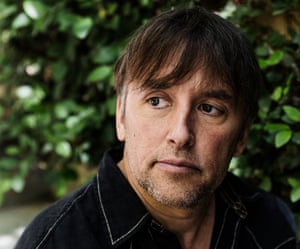
 Director Richard Linklater photographed at the Sunset Marquis Hotel in Los Angeles, CA on Tuesday, March 29, 2016

As his lodger, a convicted murderer, is sent back to prison, the director talks about the Texan justice system, the art of storytelling – and why he’ll always be a slacker at heart
Linklater has been telling his daughters to observe the contest closely, because America might not witness another like it. “I’ve seen every presidential election since the 1960s, and this is the craziest ever. It’s the commodified stupidity of the political dialogue in the US. The divisiveness. It’s all attitude and personality, like a reality show.”

I’m kinda liking Bernie. I’ve waited for a candidate like Bernie Sanders my whole adult life. I’m a natural socialist
Linklater is already feeling nostalgic for Obama, and believes we’ll look back at him as a political giant. But, typically, he doesn’t talk about policy or achievement; he talks about Obama the dude. “We haven’t tipped our glass to Obama yet, and we’re going to because there is such vast dignity and intelligence. He never embarrassed our country, not once. Not once. He’s so classy, and his wife’s so classy. People give people hell when they screw up, Clinton and stuff, but nobody says: ‘Think how much sex Obama has turned down in his lifetime.’” The more Linklater talks, the more I feel I’m with the guy in the cab, shooting the breeze in Slacker all those years ago.

“You think he couldn’t be getting a blow job?” he continues. “Just the discipline and the bigger vision of what he’s here for in the world – the restraint he’s shown.” He’s got Michelle, I say. “Yeah. Come on, though, he’s a guy!”


Is he supporting Hillary Clinton or Bernie Sanders for the Democrat nomination? “I’m kinda liking Bernie. I’ve waited for a candidate like Bernie Sanders my whole adult life, so when there’s a guy there who’s actually professing it, you have to support him. I’m a natural socialist.”

For now, though, Linklater is more concerned with the fate of another Bernie. A couple of weeks after meeting in LA, we speak again. Linklater has given his evidence for Tiede’s defence – to no avail. Tiede has been sent back to prison for 99 years or life. “I’m heartbroken,” Linklater says. “It wasn’t really about truth or justice, it was about getting a win for the prosecution and they definitely won this round. But hopefully the legal process is open to another round and the truth can come out.”


Trump, Cruz, Texan bigotry, Bernie’s reconviction: look, he says, he’s aware how bleak the world can be, but despair is not his bag. He’s going to keep campaigning for Tiede, focus on all the positive stuff out there: his girls, the good people, the movies he still wants to make. “People talk about how ambitious Bruce Springsteen was, because he had 500 songs in him that he wanted to express. I felt that way, and I still do. Like a musician, I’ve still got so many songs in me.”