Iran Tehran Bureau Why so many Iranians have come to hate the hijab

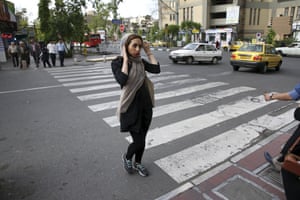
..An Iranian woman adjusts her head scarf while crossing a street in downtown Tehran, Iran.
Over the years the state crackdown on women’s dress has become more of a show to placate the country’s hardline base. Our correspondent shares stories from her personal repertoire illustrating the point
An Iranian woman adjusts her head scarf while crossing a street in downtown Tehran, Iran. Photograph: Vahid Salemi/AP
A
s summer approaches, police in Tehran have once again begun to crack down on Iranians who fail to comply with the country’s Islamic dress code. This year, besides the customary uniformed morality police, 7,000 undercover agents are reportedly also on the case. I was spared the early years of the Islamic Republic, but my mother recalls how diligent she had to be to avoid giving the morality police – or anyone else with the authority to judge appearances – any pretext to find fault with her, as jail sentences for “protesting” were all too common for dress-code transgressors.

It was a hot day in the early 1980s and my parents were going to an international exhibition in Tehran. As my older sister, then a baby, lay in her carriage, my mom wheeled her into the room filled with female agents who were in charge of checking the women’s compliance. They would ask some to fix their hijab, passing tissues to others to wipe off their makeup. As one agent finished scrutinizing my mother, she looked at my sister in the carriage.
“Khanoum!” – “lady” – she exclaimed. “Why are your daughter’s bare legs showing?” she asked, in apparent shock.
“She’s just eight months old,” my mother, in even greater shock, replied.
“So what? She’s a girl, isn’t she?”
My mom covered my sister’s legs with a blanket. Back then, nobody would argue further. People were scared.
As time went by, the younger generation gradually became accustomed to the morality police, then known as komiteh. Just one encounter with them, and the spell of dread was broken. You were not scared of them any more. At least those in my circle were not.
During the early 1990s, the komiteh arrested my sister and her friend on the street. They were on their way to buy ice cream when a van pulled up beside them. A woman in black chador opened the van door and asked them to enter. Frightened, my sister and her friend ran toward an idling taxi a few meters away and jumped in. The van shot forward and veered in front of the taxi. Two soldiers leaped out and pointed their guns at the car while the woman in chador shouted at the top of her lungs for my sister and her friend to get in the van. They did.

A few days later, the girls in the van showed up for their group trial and were fined 5,000 tomans each – the equivalent then of less than 20 dollars.Accompanied by other women, mostly young, who had similarly been arrested, they were driven to Vozara Detention Center where a group trial date was scheduled. A few hours later, my parents took my sister home. My mother was stunned, my father confused. My sister, who was then in middle school, had a very different take. She entered our house with a wide smile on her face, telling me it was the “coolest experience”. She excitedly described how all the women were singing and clapping as they waited together in a communal cell. A few of their fellow scofflaws, apparently regulars at that particular detention center, were handcuffed. As my sister and her van companions entered the cell, one of them held her hands up in the air and shouted, “Hey kids! Check this out! They have given me bracelets!”

In the early 2000s, my dad was driving my sister back from a class when, a few blocks from home, they were stopped by the morality police.
“What’s the relation between you two?” a male agent asked my father.
“She’s my daughter,” he calmly replied.
“Why are you in the car with this man? Who is he?” a female agent asked my sister.
“He’s my dad,” she calmly replied.
The agents asked for documents that could prove these incredible claims. My father and sister didn’t have any. The agents talked between themselves for few minutes and let them go. By this point, no one took such encounters to heart. Hearing the story, my mom responded with an incredulous “What?” I just laughed.

One policeman exited the car and walked toward us.This was during the reformist presidency of Mohammad Khatami, when many of us young people felt emboldened to publicly bend the morality rules and even, yes, protest. One night around that time, four of us were tooling down the Modarres Highway when a police car signaled for us to pull over. My sister’s boyfriend was behind the wheel, while she rode shotgun. I was in the rear alongside my boyfriend, who’d been smoking out the window.

“What’s the problem, officer?” my sister’s boyfriend asked.
“This lady was sitting improperly,” he said, pointing at me. I was resting my knees on the back of the front seat.
I’m certain that none of us were scared. My sister even chuckled quietly. I got angry and started shouting and crying. I felt insulted. It was the policeman, if anyone, who seemed less than sure of himself. He apologized, asked us to sit “properly”, and invited us to go.
No, it was not always that easy. There were times we sensed that arguing would make things worse.
One evening during the mid-2000s, we were on our way back from a day trip to the Alborz Mountains near Firouzkuh, northeast of Tehran. There were nine of us, girls and boys, filling up two cars. As we drove down the dusty road of a small village, a man on a motorbike pulled up alongside the lead car and requested we stop. We did. The biker parked directly in front of us so as to thwart any potential escape. He displayed his militia card and said he wouldn’t let us go.
“But why?” one friend asked.
“Because you think you can do all the filthy things you want in the mountains and run away,” he replied.
In fact, it had been a fairly innocent hike. Sure, some of us had been smoking. Yes, maybe we held hands and hugged as we posed for the camera. That’s all.
As we argued with the militia member, men and boys from the village surrounded the car. Some were holding shovels. This time, we were a bit scared.
Then the militia guy, who was in his twenties, delivered the strangest soliloquy I have ever heard in my life, more surreal than anything else I’ve experienced, even on stage, from Beckett on down.
“You Tehranis think you are so cool? No, you are not. You think we villagers don’t understand anything, but we do. Do you think only you know things? Do you think only you read books? I also know who Sigmund Freud is. I read his books. I know what the Oedipus complex is. Do you know what the Oedipus complex is?”
That was just the beginning. After what seemed like an hour of breathless lecturing on matters Freudian and Sophoclean, he did at long last let us go. During the rest of the trip we tried ever so hard to interpret what he was trying to communicate. We didn’t get very far.
When Mahmoud Ahmadinejad took office in 2005, the shift toward conservatism was palpable. It was August, height of morality police season. Their numbers seemed to multiply virtually overnight, and they would pick on anybody.
Another trip to the Alborz, a couple years into the Ahmadinejad era. Not so far this time, and we were walking back. It was already dark. I was exhausted, having hiked to the peak of Mount Tochal. On the trek home, I had been joined by my aunt and her friends, a small group of women in their fifties. Sweating all day in my baggy khaki pants and loose white shirt with thin khaki stripes, I looked miserable.

The officer lead me over to a van by which a pair of fellow female agents were standing. I looked at all three of them. They each wore full makeup. One had manicured polished nails. Another was strikingly beautiful, like an innocent angel.As we approached Darband Square at Tehran’s northern edge, where my aunt had left her car, a female agent stopped me. “Khanoumi!” little lady. “Could you please come with me for a second?” To this day, I feel like breaking out in a rash whenever I hearkhanoumi or khanoumam, so closely associated are they with the special vocabulary of Iran’s morality myrmidons.

“Where’s your manteau?” one asked.
“What do you mean? This is all I have,” I replied.
“This is not a manteau, Khanoumi. This is a shirt.”
“But what’s the difference? Can you see any part of my body? You can’t even see my body shape in these loose clothes.”
“I know, but this is not a manteau.”
We argued politely for a while as she showered me with her khanoumis andkhanoumams. In the end my aunt ran to her car and brought me a cloak. I put it on and was allowed to rejoin my companions. We were all calm. No one was scared or even angry. We were simply fed up.
This is just a sample of some particularly memorable encounters. I won’t tire you with the many times my friends and I were called “prostitutes” by vigilant citizen-agents for laughing loudly on the street, the countless occasions on which we were asked to roll down our sleeves to obscure our forearms, cover our hair, and sit “appropriately” in public.
My personal repertoire of such stories stopped growing once I left Iran in late 2008, but friends who stayed are still adding to their collections. One recently told me how she was arrested right next to her home, driven to the police station and had her mugshot taken. She was laughing non-stop, saying it was just “so funny” to have an “improper dressing” charge on one’s permanent record.
Meanwhile, many with less self-confident senses of humor conscientiously attempt to avoid the morality patrols, skirting certain locations around the capital where they are known to concentrate. There is even an app, Gershad, that purports to pin down the latest danger spots.
The adventures of Iranian citizens with the morality police remind me of Shahrazad and her unending stories. They just go on and on. And it seems like no one who might want to do anything about it has the power to. Last week, President Rouhani gently criticized the deployment of undercover morality agents, saying that the first duty of those who enforce the law is “to respect people’s dignity and humanity.”
Yes. Very well. And? Until that blessed day of respect for Iranians’ dignity and humanity dawns, I’ll still be attempting to decipher what that militia man in the mountain village so many years ago was trying to make us understand.


Jessica.-Why do girls want labiaplasty? They're told to hate every inch of themselves

2014.35 Georgia O'Keeffe Jimson Weed/White Flower No. 1, 1932 Oil on canvas 48 × 40 in. (121.9 × 101.6 cm) Framed: 53 in. × 44 3/4 in. × 2 1/2 in.
‘We tell our daughters that they are beautiful, but also that looks don’t matter.’ Photograph: Edward C. Robison III/Georgia O’Keeffe
I
t would almost be easier if there were a specific moment that sparks self-loathing in a young girl. A particularly nasty comment made, maybe. Or an advertisement that inspires just the right amount of doubt in her appearance and forever shifts the way she thinks about herself. If only it were that simple, if there were just one moment we could help our daughters avoid.

The truth is much more complicated – and much more intimate. For all the feminist progress made, there is still a shocking amount of disdain for women’s anatomy when it is not firm, tucked, primped and waxed.
As labiaplasty – surgery to change your vulva’s appearance – has become increasingly popular among women, it’s also become the surgery of choice for anever-growing number of girls. So much so, in fact, that the American College of Obstetricians and Gynecologists has issued a set of recommendations for doctors on how to talk to adolescent patients seeking the procedure. Hopefully, guidelines for parents considering allowing their minor daughters get the procedure aren’t far behind.
“The first step is often education and reassurance regarding normal variation in anatomy, growth and development,” the guideline reads. In other words, girls need to be told that not everyone’s body looks the same. The ACOG also outlines possible reasons for the increase in girls getting surgery, like pubic hair removal trends and “exposure to idealized images of genital anatomy” (a polite way of saying “porn”).
Apparently it isn’t enough that 80% of 10-year-old girls in the US have been on a diet, or that the celebrity best known right now for having her lips plumped with artificial filler is a teenager. Now teenagers are worrying about their genitals being too fat or long or uneven.
It’s easy to be outraged; some girls hating the most intimate parts of their bodies enough to seek out surgery is incredibly distressing. But it shouldn’t be surprising. We live in a country where the mere act of saying the word “vagina” can get you fired, or barred from speaking, as Michigan representative Lisa Brown was after using the word in a speech against an anti-choice bill.

It’s no wonder girls would feel they need to keep their bodies in check, trying to look the way that will bring them the most praise – or the least amount of negative attention.When I spoke to Miki Agrawal, co-founder and CEO of Thinx period panties for an upcoming podcast, she recounted how New York City’s public transit system initially refused to carry her ads on the subways because one of them featured a picture of a peeled grapefruit that too closely resembled a vagina. (Using grapefruits for ads about breast augmentation, however, was fine.)
And so we tell our daughters that they are beautiful, but also that looks don’t matter. We enroll them in sports and try not to talk about dieting in front of them. But even with all the proactive parenting we take on, it’s hard to be hopeful when women are constantly finding new and innovative ways to hate every inch of themselves.

El socialismo ha muerto, porque los que se hacen llamar socialista han dejado de ser hasta de izquierdas-

“No se trata de reformar la propiedad privada, sino de abolirla; no se trata de paliar los antagonismos de clase, sino de abolir las clases; no se trata de mejorar la sociedad existente, sino de establecer una nueva.”
Carlos Marx, Mensaje a la Liga de los Comunistas, 1850

Por muchos motivos el siglo XX ha sido, seguramente, el más movido, prolífico y controversial de la historia. Marcó de forma indeleble el curso general de los acontecimientos de la humanidad con una fuerza imperecedera: para bien o para mal nos hizo asistir al surgimiento de incontables procesos nuevos, tales como la revolución científico-técnica imparable aplicada al mejoramiento de la vida cotidiana, las primeras experiencias socialistas, la universalización de la economía y la cultura (hoy día bautizada como “globalización”), guerras con aplicación de las fuerzas más destructivas que se pudieran concebir, inicio de la conquista espacial, inicio de la liberación femenina, aparición del síndrome de inmunodeficiencia adquirida, sociedades masificadas y apoyadas con fuerza creciente en los medios de comunicación, poderes hegemónicos de escala planetaria. Todo esto fue nuevo en la historia, y el siglo pasado es su punto de arranque, punto de inflexión del que probablemente no se retrocederá más...

Cada uno de estos distintos aspectos representa, en sí y por sí mismo, un mundo aparte; cada uno ha corrido suertes diversas, con perspectivas futuras muy disímiles entre sí. De entre todos ellos nos interesa ahora particularizar lo correspondiente al discurso contestatario que trajo el socialismo y la suerte que el mismo tuvo durante todo el siglo.

Al hablar de la historia del socialismo, es decir: la esperanza genuina fue -ahora no- un nuevo mundo de justicia, nos referimos no tanto a su génesis y primeros tanteos en el siglo XIX como cosmovisión sino a lo que, ya en tanto propuesta madura, significó en las expectativas que fue abriendo. Sin dudas –nadie podría negar esto– movió a lo mejor de la humanidad, en todo sentido: a aquellos más nobles, abnegados y honestos que vieron en su aparición como teoría y en la primera revolución –la rusa de 1917– el inicio de un paraíso posible, el fin de las injusticias, la puerta de entrada a “la patria de la humanidad”. En la URSS movió, igualmente, lo mejor que cada uno de los seres humanos podemos tener: el espíritu de solidaridad, la fraternidad, la generosidad auténtica y desinteresada.

Muchas cosas han marcado el siglo XX, por supuesto; pero el inicio de las experiencias socialistas está entre aquellas que más reacciones produjo, tanto de aceptación como de rechazo. Lo que allí estaba en juego era mucho más grande que lo que podía abrir cualquier descubrimiento científico o tendencia artística. La profundidad de la transformación anhelada produjo pasiones igualmente intensas. Nadie pudo quedar impasible ante la magnitud de su propuesta.

En cierta forma podría decirse que todo el siglo se vio atravesado por este fenómeno: las primeras luchas sindicales con vistas a socializar la propiedad, el triunfo de las primeras revoluciones socialistas, la reacción del mundo capitalista ante su aparición, la construcción que se empezaron a dar los países que comenzaron a transitar esos caminos, la guerra fría entre los bloques antagónicos que fueron delineándose y el posterior triunfo del capitalismo sobre su modelo opositor hacia fines del siglo, nada de esto dejó de conmover hondamente a cualquier habitante del planeta. Durante los largos años que duró esta pugna entre bloques, entre cosmovisiones, las ideas generadas por el socialismo empezaron a ser moneda corriente en la cultura popular. Nadie se asombraba por hablar de “explotación”, y tampoco eran crípticos términos de cenáculo para iniciados la “lucha de clases”, el “reparto de la riqueza”, la “toma del poder”, el “imperialismo”.

Hoy día, inicios del siglo XXI, habiendo corrido mucho agua bajo el puente y caídas esas primeras esperanzas, sin modelos alternativos a la vista que sirvan de contrapeso a la hegemonía agobiante del neoliberalismo y de la unipolaridad militar de los Estados Unidos, todo aquel discurso de apenas unas décadas atrás parece haberse esfumado. Pero, en sustancia, nada de lo que esas palabras significaban ha cambiado: sigue la lucha de clases, continúa el desigual reparto de la riqueza, el poder continúa en poquísimas manos, el imperialismo se ha acrecentado.

¿Por qué salieron de escena todos estos términos? ¿Acaso “pasaron de moda”?

En realidad cambió la agenda política, cambiaron los escenarios, pero no hubo cambios reales en las estructuras. Aunque sea casi una mala palabra y nadie la use hoy, ¿no hay más imperialismo? La historia la escriben los que ganan, por lo que en la actualidad, habiéndose impuesto el mercado como deidad absoluta, todo lo que vaya en su contra es blasfemo. De ahí que no se nombre todo lo anterior, sean anatemas. Hablar de lucha de clases o imperialismo es hoy anacrónico…

¡Pero no tanto! Es cierto que la historia la escriben los ganadores, ¡pero hay otra historia! Aunque la fuerza arrolladora con que se presenta el triunfo del gran capital pueda tenernos abrumados –manejo mediático mediante–, las realidades que están tras esos términos, hoy “blasfemos”, no han desaparecido. Seguramente por la misma imposición que esa victoria del gran capital trajo, le hemos tomado miedo a ese discurso contestatario y nos atemoriza ser visto como nostálgicos de tiempos idos. Plegarse a los poderes dominantes, por supuesto, es más fácil que ir en su contra. El aturdimiento que produjo la caída del Muro de Berlín, vendido luego en pedacitos como souvenir turístico, aún nos tiene desconcertados y pareciera que nos hizo ir olvidando la sana irreverencia y la cuota de rebeldía que alentó pasadas luchas décadas atrás. Pero eso no está muerto.

El mundo post Guerra Fría dio como resultado fenómenos bastante patéticos: por un lado, cuotas de explotación inmisericordes que recuerdan el capitalismo decimonónico, sin leyes sociales de protección a los trabajadores ni regulaciones estatales. La precarización laboral de estos últimos años (léase: la explotación más descarnada) volvió a mostrar la verdadera cara del sistema económico-social en que nos movemos. Junto a ello, como otra de las consecuencias de esa caída (que fue la caída no sólo de un muro sino de las esperanzas que allí se jugaban) se nos presenta el intento de vaciamiento del discurso y la práctica transformadora, revolucionaria. La protesta se aguó, se degradó, y el sistema –sabiamente– pudo ir criminalizándola. Sin temor a equivocarnos podríamos decir que el discurso dominante nos hizo pasar de la lucha de clases a la criminalización de las relaciones sociales como motor de la historia. De Marx (abolición de la propiedad privada de los medios de producción y de la sociedad de clases basada en ella) fuimos pasando a Marc’s (métodos alternativos de resolución de conflictos).

Menudo cambio, sin dudas. Las luchas de clases salieron de escena. Pero entiéndase bien: dejaron de ser tema de debate, objeto de discusión académica, referente en el discurso político…., aunque ahí siguen estando. La “preocupación” que nos fue creando el omnímodo discurso dominante puso otros temas como “principales”. Además de la apología del dios-mercado, se entronizó la democracia representativa como modo superior de gobierno, y los problemas sociales quedaron resumidos en dos cosas: la mala práctica de gobierno (la “culpa” la tienen los políticos) o el crimen desbocado, que en estos últimos años pareciera haberse ido transformando en un nuevo demonio omniabarcativo.

En otros términos: de la lucha de clases a la delincuencia como factor de explosividad de las sociedades. La cotidianeidad de estos últimos tiempos, cada vez más plagada de hechos corruptos (hoy día ya no es noticia que “caiga” algún funcionario por algún hecho de corrupción) y delincuencia de todos los calibres (ciudades cada vez más inseguras, narcoactividad, pandillas juveniles y un largo etcétera), no deja ver la explotación económica, la lucha de clases, el fenomenal descontento que anida en todas las sociedades. En definitiva: la injustica más rampante, que se nos ha hecho ya “natural”, dejó de ser el tema principal. Para tapar eso, para maquillarlo convenientemente el sistema ha ido encontrando formas cada vez más sutiles y efectivas de control: fundamentalismos religiosos de toda laya, masificación global y saturante del show deportivo, fundamentalmente de fútbol (se habló de hacer el Campeonato Mundial cada dos años incluso), bombardeo inmisericorde de los medios de comunicación aliados al sistema (guerra de cuarta generación le llaman a eso los estrategas del Pentágono). Es decir: el descontento social producto de la explotación, de las injusticias de base que siguen existiendo, se fue manejando, controlando, moldeando. Y así se puso como tema principal de cualquier discusión cotidiana la violencia callejera…., o el fútbol. Pero las luchas de clases, aunque “pasadas de moda”, ahí siguen estando.

Con la llegada del socialismo del siglo XXI en la República Bolivariana de Venezuela hace algunos años se desempolvaron viejos conceptos que parecían ya olvidados, patrimonio de “dinosaurios como los cubanos”. El ideario sepultado bajo los escombros del Muro de Berlín tímidamente volvió a salir a luz. Quizá esperamos mucho –justificadamente sin dudas– de ese proceso en el país caribeño. Hoy día no sabemos bien para dónde se dirigirá la experiencia venezolana, si mira realmente hacia un horizonte socialista (del siglo que sea) o si la “conciliación de clases” termina imponiéndose. Lo que sí, sin dudas, levantó esperanzas que habían quedado adormecidas estos años; el “socialismo” dejó de ser mala palabra. Y cuando nadie se lo esperaba (al menos desde el mundo occidental) allí golpea a la puerta de la historia el renacer de los pueblos árabes con este huracán de protestas que se está sucediendo.

Tomando palabras de José Steinsleger al referirse a los sucesos de Egipto, válidas para todo el proceso que se da hoy en buena parte del mundo árabe: “¿Hay [allí] una situación prerrevolucionaria? Los anarquistas se oponen a la solución autoritaria; los socialistas celebran el aliento democrático de la sublevación; los comunistas piensan en si las condiciones están dadas; los trotskistas agitan el programa; los nacionalistas evocan la dignidad de otras épocas; los liberales y conservadores revisan las páginas de “El gatopardo”, y los religiosos sueñan con el renacer del Islam”. ¿De qué se trata en realidad todo este volcán? Las lecturas pueden ser múltiples, antitéticas incluso, y todavía no puede vaticinarse para dónde se disparará el proceso. Pero definitivamente algo se mueve. Se mueve…. ¡y mucho! Todo lo cual evidencia que los problemas del mundo, los problemas básicos que produce este disparate civilizatorio en el que vivimos donde importa más una máquina que una vida humana, todo eso tiene como fundamento aquello que el viejo Marx denunciaba con vehemencia 150 años atrás.

En realidad no se trata de “vaticinar” qué pasará con esta ola de protestas que ponen en marcha los pueblos árabes; se trata de apoyarlas como momento importante, privilegiado quizá, en la historia. Apoyar, y si se ve que ello es un paso para la transformación social hacia mayores cuotas de justicia, tomarlo como propio, aunque no se pertenezca concretamente al mundo árabe. En todo caso, esa puede ser una batalla más de una lucha mucho más general, más universal, no sólo de los árabes por supuesto. En ese caso: todos somos árabes, todos estamos en la Plaza Tahrir de El Cairo, todos nos hacemos parte de ese volcán que ha despertado.

Pero además vale la pena tomar esta marea que se inició en el mundo árabe como un recordatorio que, más allá del fenomenal manejo mediático distractor que nos confronta con otros problemas, importantes sin dudas, pero menores en definitiva (la delincuencia cotidiana, las cuotas de corrupción, el “mal gobierno”), las luchas de clases no han muerto.

EU-Führern.-Türkei gibt Schutzzusage für Nicht-Syrer auf griechischen Inseln


türkei-eu
Den EU-Führern ist nach Monaten des Nichthandelns und anschließenden zögernden Handelns, endlich auch ein mal ein Durchbruch gelungen. Die Türkei hat sich verpflichtet auch nicht-syrische Migranten Schutz zu gewähren. Für die EU bedeutet das, Migranten aus Griechenland können schneller in die Türkei deportiert werden. Falls in Ankara niemand seine Meinung ändert…
Der Europäischen Union ist ein wichtiger Durchbruch in den Verhandlungen mit der Türkei über die Rücknahme von Flüchtlingen aus Griechenland gelungen. Bisher hatte Ankara nur Syrern eine Schutzzusage gegeben, nun erstreckt sie sich auch auf nicht-syrische Migranten. Das hat die türkische Regierung über ihren EU-Botschafter Selim Yenel der EU-Kommission in einem Brief mitgeteilt, wie die "Frankfurter Allgemeine Woche" in ihrer neuen Ausgabe berichtet.
Das neue Wochenmagazin der FAZ zitiert aus dem Schreiben: "Im Wege einer individuellen Prüfung wird jeder Nicht-Syrer, der in der Türkei erstmals um internationalen Schutz nachsucht, in einem vernünftigen Zeitraum registriert und die wirksame Gelegenheit haben, internationalen Schutz zu beantragen." Die Türkei sichert ausdrücklich zu, dass Antragsteller "Schutz vor Zurückweisung in Übereinstimmung mit internationalen Standards genießen". Diese Zusage betrifft nicht nur Bürgerkriegsflüchtlinge, sondern alle Migranten.
Ankara ging damit weiter, als es in den Gesprächen zuvor signalisiert hatte, berichtet die Frankfurter Allgemeine Woche weiter. Für die EU ist das von entscheidender Bedeutung, weil nun die Rückführung von Migranten aus Griechenland beschleunigt werden kann. Fast alle Flüchtlinge haben dort Asyl beantragt, sie dürfen gegen ablehnende Bescheide klagen. Griechische Asylrichter waren nur bereit, Einsprüche abzuweisen, wenn die Türkei eine Rechtsgarantie für die Betroffenen gibt. Nun können die ersten Verfahren abgeschlossen werden. Von den 6500 Migranten, die auf griechischen Inseln festsitzen, kommen 2500 Personen aus Syrien, die anderen aus Afghanistan, Irak, Iran, Pakistan, Bangladesch und weiteren Staaten.
Die Zusage ist das Ergebnis eines Gesprächs, das Bundeskanzlerin Merkel, EU-Ratspräsident Tusk und EU-Vizepräsident Timmermans vor kurzem mit dem türkischen Ministerpräsidenten Davutoglu in Gaziantep geführt hatten, schreibt die Frankfurter Allgemeine Woche weiter. Die europäischen Besucher hatten zuvor öffentlichkeitswirksam das Engagement der Türkei für syrische Flüchtlinge gewürdigt und das auf sechs Milliarden Euro angelegte Hilfsprogramm der EU symbolisch gestartet. Einen Tag später traf der türkische Brief in Brüssel ein.

Viktoria Nuland.-Achtung!!! Nuland kommt nach Kiew – Hat sie die Kekse dabei?


Victoria Nuland. Bild: Flickr / US-Botschaft Moldau, CC-BY-ND 2.0
Victoria Nuland. 

Achtung!!! Nuland kommt nach Kiew – Hat sie die Kekse dabei?

Viktoria Nuland, die Gehilfin des Außenministers der USA – zuständig für Europa und Eurasien – hat einen Besuch in Kiew begonnen. Welche Aufgaben hat Nuland während ihres Besuches und warum ist es für sie so wichtig, vorfristige Wahlen in der Ukraine zu verhindern? Davon berichtet uns Rostislaw Ischtschenko.
Von Rostislaw Ischtschenko, Übersetzung: Thomas Roth
Nuland kommt nach Kiew, weil sie im amerikanischen Machtsystem für die ukrainische Politik verantwortlich ist. Diese Frau Nuland teilte nicht nur das Gebäck mit den Putschisten auf dem Maidan, sondern sie verteilte auch die ministeriellen Aktentaschen nach dem Umsturz. Nuland betreut die Ukraine von Beginn an und war dort nicht nur einmal. Als die USA zum dem Schluss gekommen waren, dass direkte Kontakte vor Ort zu Russland wichtig sind, wurde Nuland mit dem Helfer des Präsidenten Russlands, Wladislaw Surkow, zusammengetan, um zu besprechen, auf welche Weise die USA und Russland Kontakt halten können, um einerseits die Interessen ihrer Länder zu schützen und andererseits dabei keine Verbündeten zu verlieren. Deshalb ist es vollkommen natürlich, dass sich Nuland gerade jetzt wieder einmal nach Kiew begibt.
Dieser Besuch findet aus dem Grund statt, weil sich in Kiew wieder einmal die Regierung geändert hat. Es ist ein besonders aktueller Besuch, nachdem dort die ganze exekutive Gewalt formell in den Händen Poroschenkos konzentriert wurde und die Presse ganz aufgeregt darüber berichtet, dass der Präsident der Ukraine fast gegen die USA rebelliert hat.
An einen Aufruhr Poroschenkos muss man dabei wirklich nicht glauben. Mit so einem Aufruhr kommen die USA ganz einfach zurecht: es kommt ein Mensch vorbei, der gut zu schießen versteht und schon gibt es im Land einen neuen Präsidenten. Aber es ist schon absolut klar, dass sich in der Ukraine eine neue politische Situation gebildet hat: eine Mannschaft, die auf Jazenjuk zugeschnitten und fixiert war, hat den Zugang zu bestimmten wichtigen Ressourcen verloren. Was weiter geschieht und welche weiteren Handlungen ihrerseits zu erwarten sind ist vorerst unverständlich. Unklar ist auch, wie lange Awakow durchhalten wird, oder ob er leise und unauffällig ersetzt werden muss.
Das heißt, es hat sich jetzt eine Situation entwickelt, in der zukünftig ein Teil der Anhänger Jazenjuks von der Futterkrippe fern gehalten wird. Wenn man zur Kenntnis nimmt, dass sich die "Volksfront" mit Poroschenko über den Eintritt in die Koalition verständigt hat und es sogar erreichte, dass ihnen diverse ministerielle Posten vorbehalten bleiben, so ist vollkommen klar, dass sie mit dem Präsidenten erneut um die Möglichkeit kämpfen werden, erstrangigen Einfluss auf die Politik nehmen zu können. Diese Möglichkeit haben zur Zeit die Parteien "Batkowschtschina" von Julia Timoschenko,  "Udar" von Witalij Klitschko, "Selbsthilfe" von Andrej Sadowoj und weitere kleine Fraktionen und Parteien verpasst. Sie träumen von vorgezogenen Parlamentswahlen, deshalb ist die Situation wacklig. Der Konflikt der Eliten ist mit dem Abgang Jazenjuks nicht erschöpft – er hat sich im Gegenteil verschärft.
Die USA müssen es verstehen, die jetzige Konstruktion bis zu den Wahlen im November hinzuziehen oder sie wird vorzeitig zerfallen. Zu den Plänen Washingtons gehörten vorgezogene Wahlen in der Ukraine noch nie, sie wollten schon immer ohne Erschütterungen bis zum November durchziehen.
Mit diesen aufgestauten Problemen wird sich auch der neue Präsident der USA zurechtfinden müssen, unabhängig davon, wer bei den Wahlen – Republikaner oder Demokrat – siegen wird.
Aber jetzt sind die Prozesse in der Ukraine in Bewegung gekommen und haben Tempo aufgenommen: auf Poroschenko wurde die volle Verantwortung für die komplizierte Lage im Land konzentriert. Infolgedessen spalten sich die Eliten ihm gegenüber in genügend starke und verzweigte Gruppierungen auf, einschließlich der Tatsache, das sie über befriedigend starke Positionen in den Regionen verfügen.
Das heißt, im Ergebnis dieser Situation kann man in der Ukraine wesentlich früher hausieren gehen, als es für die USA wünschenswert wäre. Und damit begibt sich Frau Nuland vollkommen folgerichtig in die Ukraine. Dorthin – wo sie schließlich die Verantwortung trägt – hat man sie zum Löschen des Brandes geschickt. Gleichzeitig kann sie natürlich erleben, was sie dort angerichtet hat. Und dann wird sie sich Mühe geben müssen, die Situation bis zum November (oder auch darüber hinaus) zu konservieren. Sonst wird es wohl schwierig mit ihren Plänen, wieder Staatssekretär zu werden – dann beim folgenden Präsidenten – unabhängig davon wer der Sieger bei den Wahlen wird. Oder, was noch wahrscheinlicher ist, Nuland wird die Situation nicht konsolidieren und es damit allen einfach machen, sie zu entsorgen. Dann werden sie sie mit einem Freifahrtsschein aus dem Staatsdienst hinauswerfen. Natürlich, sie wird ein kommerzielles Amt bekommen, alles wird in ihrem Leben finanziell in Ordnung sein, aber ihre politische Karriere wird beendet sein.

AIP California.-Demi Moore, George Wallace and Americans' abused voting rights

Demi Moore stuck on right wing party's voting list
Back in 2012, prior to that year's South Carolina presidential primary, I found myself in Charleston at a big rally for Mitt Romney. Sandwiched among voters waiting for their candidate to show up, I eavesdropped on an animated conversation between two vocally conservative men.
One of them was happily detailing how various Republican-controlled legislatures were passing new voting restrictions that would hurt Democrats. The other man was trying to sound equally enthusiastic, but it was clear he felt some ambivalence. He wondered out loud if it was a good idea for government to be subverting the most fundamental right in a democracy. Then, realizing he was straying uncomfortably from the party line, he quickly dropped this errant thought and agreed with his friend that GOP legislators were right to stick it to the other team.
It is a sad reflection on the state of our republic that the man in Charleston is far from alone in abandoning a sacred principle. Sometimes by nefarious design, sometimes through tired tradition and sometimes because of incompetence, political parties and state governments set up roadblocks to casting ballots instead of engaging as many people as possible in the political process.
The most egregious impediments to voting are the ones GOP legislators and officials have put in place in 17 states since the 2010 election. These new measures put limits on early voting and impose complicated identification requirements that particularly effect non-white citizens, low-income workers and students. It is estimated that more than 16 million registered voters in the United States lack the types of government-issued photo identification demanded by the new laws. (This is on top of a chronic situation where, in many jurisdictions, there are far fewer polling places and much longer waiting lines in African American and Latino neighborhoods than in more affluent, white neighborhoods.)


Fraudulent voting is the justification given for most of these voting restrictions, even though voter fraud has been proved to be more rare than a double rainbow. One Wisconsin legislator was recently caught on camera gleefully acknowledging the real intent of the new voting laws in his state: they will cut turnout for Hillary Clinton and the Democrats in the November general election.

In recent days, the established system of selecting presidential nominees has also come under scrutiny for the ways it discourages voting and subverts the will of those who do vote. Donald Trump has complained about how Ted Cruz and Republican Party insiders are gaming the complex delegate selection system to blunt the will of those voters who gave him victories in certain primaries. Even if he should have been smart enough to learn how to work the system himself, he is still correct about the wider reality that a lot of votes cast in both Republican and Democratic primaries do not really count because of arcane delegate selection procedures that vary from state to state.


All these voters intended to get listed as independents and instead ended up lumped with the strange bedfellows of Wallace’s old party. They got tripped up by a voter registration form that, as my L.A. Times colleague George Skelton says, “looks like it was written by a chimpanzee.”And speaking of independents, as many as three-fourths of the half-million registered members of California’s American Independent Party — the right-wing party that nominated Alabama’s segregationist governor, George Wallace, for president in 1968 — are members by mistake. Among the folks shocked to find they are listed on the rolls of the AIP is Hollywood starDemi Moore, who actively campaigned for President Obama, Patrick Schwarzenegger, the son of California’s last Republican governor, boxing champ Sugar Ray Leonard and actresses Emma Stone and Kaley Cuoco.
Happily, in California, the voting laws are relatively forgiving and those who have found themselves in the wrong party can rectify the problem before the June 7 primary. In other states, voters are not so lucky. In November, many of them them will find themselves standing in obscenely long lines when they try to exercise their right to vote and many more will be turned away or discouraged from showing up at the polls at all because of tricky identification requirements.
There are some smart ways to make voting easier and also more secure for everyone, but in too many states a majority of legislators do not actually believe every eligible citizen should get a say in who runs the government.

PRASA Niemiecka prasa: Czy Turcja przestanie być państwem laickim?


Prasa komentuje słowa przewodniczącego turckiego parlamentu, rozważającego zmianę konstytucji na islamską.
Türkei Mädchen mit Kopftuch
Za Atatuerka chusty były zakazane, za Erdogana zakaz zniesiono
„Frankfurter Allgemeine Zeitung” pisze: „Zapowiedź przewodniczącego tureckiego parlamentu Ismaila Kahramana, że Turcja jako kraj muzułmański potrzebuje także islamskiej konstytucji, może ożywić u wszystkich, którzy bacznie śledzą poczynania rządzącej partii AKP i prezydenta Erdogana, już od dawna istniejące podejrzenie, że partia ta prawdopodobnie ma ‘tajną agendę' islamizacji Turcji - najpierw dyskretnej, a potem nieodwracalnej. Reakcje na wypowiedź Kahramana były natychmiastowe i dają pewność, że zasada świeckości państwa nie będzie wykreślona z konstytucji. Wszystkie partie opozycyjne z oburzeniem odrzuciły ten pomysł. Nawet liderzy AKP zdystansowali się od przewodniczącego parlamentu. Jest więc wykluczone, by islamska konstytucja uzyskała poparcie większości”.
Türkei Parlamentspräsident Ismail Kahraman
Słowa przewodniczącego turckiego parlamentu, Ismaila Kahramana wywołały poruszenie i protest.
„Volksstimme” z Magdeburga pisze: „Kiedy szef tureckiego parlamentu zaczyna snuć wizje islamskiej konstytucji, musi to spotkać się z oburzeniem jako łamanie zasady świeckości państwa. Ale taki pomysł ze strony AKP właściwie nie dziwi, bo założyciel partii, prezydent Erdogan zdaje się formować Turcję na kształt osmańskiego sułtanatu. Czyli: precz z zasadami Atatuerka! Nowa konstytucja ma być ma tworzyć jego fundament i dawać prezydentowi wszechwładzę w nowym państwie religijnym. Opór przeciwko Erdoganowi istnieje właściwie już tylko na obszarach zamieszkałych przez Kurdów. Generałowie, będący dotąd strażnikami spuścizny Atatuerka, którzy w przeszłości na drodze puczu udaremniali podobne próby, już dawno zostali zdyscyplinowani przez prezydenta.

„Saechsische Zeitung” z Drezna pisze: „Właściwie należy być wdzięcznym przewodniczącemu tureckiego parlamentu Kahramanowi za jego otwartość. Unia Europejska, jak i rząd Niemiec, wiedzą teraz, o co właściwie chodzi przywódcom w Ankarze. Na groteskę zakrawa fakt, że ten kraj ma otrzymać perspektywę wstąpienia do Unii Europejskiej. Łamanie podstawowych praw, dyskryminacja mniejszości, ignorowanie wolności poglądów i prasy - to wszystko pasuje do wyobrażenia Erdogana o władzy autorytarnej. W połączeniu z islamską konstytucją powstałby model państwa o lata świetlne oddalony od Europy, który bardziej przypomina rządy arabskich despotów, ”.Wąskie granice wyznaczono nawet w religii. Teraz 20 tys. alewitów dostało na piśmie od Trybunału UE, że ich prawa są łamane. Już tylko to wystarczy, żeby w negocjacjach akcesyjnych z Turcją w ogóle nie otwierać rozdziału państwa prawa”.

„Nuernberger Zeitung” uważa: „Poprzez instrumentalizację religii do politycznych celów być może Erdogan zdobędzie więcej uznania w świecie arabskim. Ale zmiana konstytucji w tym celu na pewno nie otworzy mu drzwi do negocjacji akcesyjnych z Unią Europejską. Wszystko wskazuje na to, że Erdogan już od dawna ma zupełnie inne plany wobec swojego kraju”.
„Muenchner Merkur” stwierdza: „To, co zaczęło się w roku 2008 zniesieniem zakazu noszenia islamskich chust, teraz stało się widoczne jako pełzający proces erozji, który kulminuje w postulacie przewodniczącego parlamentu stworzenia islamskiej konstytucji. Byłby to koniec rozdziału państwa od i religii według wyobrażeń Atatuerka. Europejczycy, którzy tak pochopnie otworzyli Turcji perspektywę wstąpienia do Unii Europejskiej, mają wszelkie powody, by teraz zastanowić się nad finałem tego niepokojącego scenariusza. Jakby nie było, zawierając umowę z Turcją w kryzysie uchodźczym, stali się podatni na szantaż. Rząd w Ankarze w coraz bardziej agresywny sposób próbuje przeforsować za granicą swój punkt widzenia na wolność uprawiania sztuki i prawo do wolności wyrażania opinii. Turcy mają pełną świadomość swojej nowej siły, bazującej na strachu państw europejskich przed napływem setek tysięcy zdesperowanych imigrantów. Czy naprawdę jest tak, że Europa uważa za mniejsze zło partnera, który kiedyś mógłby 'odkryć' dla siebie burki i szarijat?”