Comentando una forma de vivir creativa y pasional, la textura es de rabia y emotividad, hay desesperación y un poco de ansiedad. ¡¡BASTA YA¡¡.
Juan Pardo Navarro
NUEVO CAMP NOU – Un sueño abierto al mundo: así... por fcbarcelona
La imagen del buen rollo entre Messi y Luis Enrique
El delantero y el entrenador han compartido risas tras saludarse afectuosamente en la primera fila durante el acto de presentación del Nou Camp Nou
Messi y Luis Enrique se saludan en la presentación del Nou Camp Nou (MIGUEL RUIZ - FCB)
Leo Messi, que no participó en el entrenamiento matinal en la Ciutat Esportiva de Sant Joan Despí, saludó de forma afectuosa a Luis Enrique a su llegada al Camp Nou con motivo del acto en el que se presentaba el Nou Camp Nou. El delantero argentino, que fue atendido en Riazor de un golpe en el tobillo, pero que no tendrá problemas para jugar este sábado ante el Sporting, ocupó la plaza que se le había reservado junto a los capitanes Iniesta, Sergio Busquets y Mascherano, todos situados al lado del técnico.
La imagen demuestra que la crisis de resultados, por fin acabada con el 0-8 al Deportivo, no dejó secuelas en las relaciones entre la plantilla y el cuerpo técnico por mucho que desde los altavoces de siempre se intente intoxicar con lo contrario.
It was the summer of 1989 in suburban Oxnard, California, and I got my dad to drive me to K-Mart so that I could use my allowance to buy Prince’s new album, Batman. I hadn’t been allowed to see Purple Rain a few years earlier – my folks said it was too adult – but I did get to see the Tim Burton Batman movie. I wanted the soundtrack, and when I heard it, I had questions about just what Prince was alluding to.
“What does Prince mean when he says, ‘Let me stick the 7in in the computer’ when there’s no such thing’?” I asked my dad on the car drive home as we listened to the tape’s main track Batdance, given the discs for our Apple IIGS were only available in 3.5in and 5.25in. (Also, of the Jack Nicholson line he samples in the song, “What does it mean when he says, ‘This town needs an enema’?”)
When I got home, I danced in our garage to Batdance, Party Man and Electric Chair. I didn’t want anyone seeing me dancing in such a queeny fashion to these songs, and I didn’t want anyone looking at me in general. I was a biracial child, often criticized for not being black enough, and I was going to grow up to be gay – though I didn’t know this yet, or even the language to question being straight. I didn’t want to be stared at in my confusion, or to be reminded of how I had no idea what was happening to my pubescent body.
Prince repelled and fascinated me because he represented every side of all the contradictions I felt. I felt nervous even looking at him, and yet I couldn’t look away. What would it mean if I opened myself up to the letting go of all those rules he seemed to have dispensed with? That purple clothing, those high heels and ruffled shirts: was he proudly feminine, or so secure in his masculinity he didn’t mind others questioning it? That small frame and that tight, small butt that seemed to leave him “shaking that ass, shaking that ass” for men and women alike? Who was he trying to turn on with Sexy MF or Cream – and what if someone thought I wasn’t getting turned on by his big-haired dancers, but by the artist himself?
Prince was a paradox in that he expanded the concept of what it meant to be a man while also deconstructing the entire idea of gender. Like Michael Jackson,Prince seemed to perform a kind of black masculinity that was neither neutered nor completely in line with the hypermasculinity so common in the rap coming out of nearby Los Angeles at the same time. It was as fluid and luscious as his long eyelashes, and as delicious looking as those lips of his – and it seemed to welcome everyone. His gaze was as slippery, self-assured and questioning as his music itself. And when those eyes of his (paired with the light scruff around his mouth) caught yours from an album cover, almost daring you to look away with their confidence, they also seemed to know you’d be powerless not to.
Sexy motherfucker, shaking that ass, shaking that ass, shaking that ass …
Of course, if you could manage to close your eyes while listening to Prince (though why would you want to?), you could get lost in the music itself. While I wasn’t keyed in to rap when I was in junior high, I loved the black music that wasn’t so in fashion right then: gospel, Motown, jazz and R&B. And I loved Prince. I could listen to Sexy MF on repeat all day long: those R&B beats, with the lush bass line and those big Memphis-flavored horns. That flaring organ could be right out of a Harlem church on a Sunday morning. And when Prince purrs, “Come here, baby,” he combines the sexual and the sublime as effortlessly as gospel masters like Andre Crouch or Kirk Franklin.
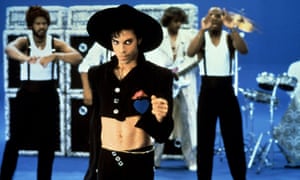
Shakin’ that ass: Prince at the Zenith in Paris. Photograph: Pascal George/AFP/Getty Images
But if I was a little apprehensive by what Prince was doing sexually, I was outright terrified of what he did racially. In school I dreaded to be accused of “acting white”, but I also knew that being labeled an angry black man was dangerous, too. And so when Prince changed his name to a symbol, told Warner Brothers to go to hell, wrote the word “slave” on his cheek and became the Artist Formerly Known As Prince, I was terrified for him – and absolutely thrilled.
My father was a loud and outspoken black man, but he didn’t have much material wealth to show for it. Black people who’d “made it”, I was starting to see, were supposed to be as grateful as Oprah Winfrey to the corporate machine that gave them wealth. But like baseball player Curt Flood, who famously said “a well-paid slave is still a slave”, Prince was willing to talk about the exploitation of the professional black artist and he refused to play anyone’s game or to act with gratitude. Choosing a symbol, (and one that fused the icons for male and female), meant journalists couldn’t even print his old name anymore. It was, in retrospect, the first time I experienced someone refusing to live under the oppressive binary regime of gender, or to submit to the dominant power’s rules.
Shaking that ass, shaking that ass …
In college, when most of my classmates were white, I noticed that Prince was often their connection to black America. For straight, white fanboys (I went to film school in the late 90s), liking Prince gave them a claim to understanding blackness much the way liking Beyoncé does today (at least, before Formation).
By day, I was taking a class with Donald Bogel, the author of Toms, Bucks, Mulattoes, Mammies and Coons, which taught me how to start deconstructing the five primary archetypes used to represent black people in mass media. Prince did not fit into these molds – particularly in the way he owned his sexuality positively, and because he refused to play the grateful court jester in loudly defying his studio.
Prince: refusing to play the court jester. Photograph: Michael Ochs Archives/Getty Images
By night, I was rooming with my best friend Peter, a white guy from New Jersey who adored Prince and who was my partner in crime. Prince was the soundtrack of our dorm room, our films, and the huge parties we threw when we moved into our off-campus apartment. Let’s Go Crazy scored our victory videos after we wrapped a shoot. Little Red Corvette belted as we set up the bar before a raging party. And 1999 was spun often as if talking about a fantasy in the distant future. (The only fun thing about considering Y2K doomsday scenarios was imagining so many people experiencing Prince as the last music they heard.)
A lot of those straight, white film boys loved Prince with an affection that seemed pretty gay. I remember asking my friend Jason why he loved Prince so. “He’s so sexy,” he said, “that you want to stand near him, because you’re hoping a little of what makes him so attractive will splash onto you, and then it will work for you.” Black, white, gay, straight, male, female – it seemed everyone I knew either wanted to sleep with Prince or wanted to be him, or both.
Prince lifts off in 1986. Photograph: NILS JORGENSEN/REX/Shutterstock
But my sweetest memory of listening to Prince in my college years is of listening to Peter’s Purple Rain album late at night, which concludes with the nine-minute title song. Sometimes it would be on as I fell asleep in my lumpy dorm bed. The single edit ends with Prince’s epic guitar riff that seems to go to outer space and back, which is beautiful in its own right. But in the full version, Purple Rain doesn’t come back down to earth; instead, it drifts into the cosmos into a symphonic orchestration, taking what is perhaps Prince’s most magisterial song and composing it into to the hands of an orchestra. It is the most beautiful thing; in my tumultuous college years, I think I felt safest and happiest drifting off to sleep to those violins playing the most gentle movement of Purple Rain.
In recent years, long after I figured I was gay, I started buying Prince on vinyl: five albums have gotten me through writing this: 1999, Parade, Controversy, For You, and Around the World in a Day. Prince was so ahead of me in my own understanding of what it means to be black in this country, to have a sexuality and gender expression at odds with the white men who try to tell everyone else how to behave – and to embrace what is amorphous, not easily categorized, beautiful, and yet unknown.
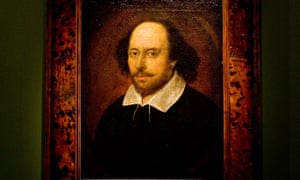
Saturday kick-starts a year of celebrating British literature, including a lesson in every Russian school devoted to the Bard and art exhibitions in both countriesThe ‘Chandos portrait’, believed to be of Shakespeare, will be part of a major exhibition of British portraits to open at the Tretyakov gallery in Moscow on Friday. Photograph: Sang Tang/AP
Britain and Russia may have trouble agreeing on Ukraine, Syria or pretty much any other issue on the international agenda, but a man who died 400 years ago can perhaps help bring the two nations a little closer together amid the mutual distrust.
Events across Britain and the world will commemorate the 400th anniversary of William Shakespeare’s death on Saturday, but in Russia the date will be used to kickstart a year celebrating British literature.
On Monday next week, every Russian school will have a lesson devoted to Shakespeare, and next month a Moscow metro train will be decked out with a Shakespeare theme, both inside and outside.
“Shakespeare is popular everywhere, of course, but he’s so significant here you could even think of him as being a Russian writer in some ways,” said Michael Bird, head of the British Council in Russia.
Shakespeare plays are frequently performed on Russia’s stages; his works influenced a number of Russian writers including the national poet, Alexander Pushkin; and he has been rendered in Russian by translators ranging from Catherine the Great to Boris Pasternak.
On Friday, a major exhibition of British portraits will open at the Tretyakov gallery in Moscow, including the “Chandos portrait”, from around 1600-1610, the most famous portrait believed to be of the playwright.
Also among the 49 works on display at the Tretyakov is the “Ditchley portrait” of Elizabeth I, painted during the monarch’s lifetime.
“Some of these works have never left the walls of the National Portrait Gallery,” said Nicholas Cullinan, the gallery’s director, who travelled to Moscow for the launch. “This is a fantastic act of cultural exchange and diplomacy.”
A return exhibition, Russia in the age of Tolstoy and Tchaikovsky, is already running at the National Portrait Gallery in London, featuring iconic Russian portraits, many of which have never left Russia before.
Bilateral relations between Britain and Russia have been poor since the radioactive murder of Alexander Litvinenko in 2006, and the relationship took another turn for the worse after the annexation of Crimea and war in east Ukraine in 2014. As part of the EU, Britain has enforced sanctions against Russian individuals and companies and there are few high-level contacts between the two nations.
However, even at the height of the Ukraine crisis, the Russia-Britain year of culture went ahead in 2014, and the literature year is a continuation of that.Relations between London and Moscow remain frosty. Earlier this month, state television broadcast a programme claiming that leading opposition figure Alexei Navalny had been recruited by MI6 and was working as a British spy to destroy Russia. The report was discredited by the fact that the “MI6 documents” shown on screen were written in semi-comprehensible English due to style and grammar mistakes.
In such a climate of political mistrust, British diplomats believe more rather than less cultural engagement is important. In late 2014, the British Museum loanedpart of the Parthenon marbles collection to the Hermitage in St Petersburg, while from last September until March, a major exhibition about the Soviet space programme, Cosmonauts, was on display at the Science Museum in London.
“I think it’s perhaps because of, rather than despite, the political climate that all of this is happening,” said Bird. “Even though there are all the political difficulties, both governments are interested in having a good relationship.”
The British Council, which is coordinating events in Russia, has itself fallen victim to the political climate in the past. In 2008, it closed its regional offices in Russia after what it described as a coordinated campaign of harassment against its staff.
However, while the regional offices remain closed, the council continues to work in Russia. In the summer, the British Council hopes to bring a group of contemporary British novelists to Russia and put them on the Trans-Siberian railway, organising pop-up literary festivals in cities along the route.