How to Explain Mansplaining

Photo
Credit
Kaye Blegvad
SYDNEY, Australia — It was on a recent trip to Indonesia that, as a male bureaucrat sounded forth on a vast span of subjects without being asked to do so, I realized that the English language was in need of a new addition: the manologue. This otherwise perfectly charming man droned on and on, issuing a steady stream of words as I sat cramped in a tiny room with a group of fellow journalists and squinted at the labels on the soda cans hospitably placed on a table in front of us.
Finally, I deciphered the words “HERBAL — TO RELEASE TRAPPED WIND.” After several minutes during which I silently prayed none of my colleagues would reach for a drink, the official at last uttered the words, “Now, to answer your question.”
So why did we get so many words between the question asked and the answer given? Why were they spoken at all? And how can you stem such extraneous, long-winded trains of thought? How can you politely say to a prolix associate, as a TV host might: “We’re almost out of time; can you keep this short?”
Above all, why do so many men do this?
It was not the first time one of us had asked a question about a minor issue during our study tour of the bustling, gridlocked capital Jakarta and been treated to a largely unrelated exposition on an entirely different idea. Our schedule was jammed with politicians, diplomats, ministers and editors from Indonesia and Australia, important men who were used to occupying space, time and attention, and would talk at numbing length. The perfect conditions, in other words, for an epidemic of manologues.
The manologue takes many forms, but is characterized by the proffering of words not asked for, of views not solicited and of arguments unsought. It is underwritten by the doubtful assumption that the audience will naturally be interested, and that this interest will not flag. And that when it comes to speeches or commentary, longer is better.
The prevalence of the manologue is deeply rooted in the fact that men take, and are allocated, more time to talk in almost every professional setting. Women self-censor, edit, apologize for speaking. Men expound.
Of course, some women can be equally long-winded, but it is far less common. The fact that this tendency is masculine has been well established in social science. The larger the group, the more likely men are to speak (unless it is in a social setting like a lunch break). One study, conducted by researchers at Brigham Young University and Princeton, found that when women are outnumbered, they speak for between a quarter and a third less time than the men.
Men also talk more directly; women hedge. They use more phrases like “kind of,” “probably” or “maybe,” as well as more fillers like “um,” “ah” and “I mean.” They also turn sentences into questions, seeking affirmation: “Isn’t it?” Women are interrupted more, by both men and women.
It is also clear that the more powerful men become, the more they speak. This would seem a natural correlation, but the same is not true for women. The reason for this, according to a Yale study, is because women worry about “negative consequences” — that is, a backlash — if they are more voluble. Troublingly, the study found that their fears were well founded, as both male and female listeners were quick to think these women were talking too much, too aggressively. In other words, men are rewarded for speaking, while women are punished.
The problem is global and endemic across all media. Female charactersspeak less in Disney films today than they used to — even princesses get a minority of the speaking lines in films in which they’re the principal: In the 2013 animated movie “Frozen,” for example, male characters get 59 percent of the lines. A quick search for best monologues in film or movies reveals that they are almost all male. If you took Princess Leia out of “Star Wars,” the total speaking time for female characters is 63 seconds out of the original trilogy’s 386 minutes.
One New Zealand study found that in formal contexts calling for expository speech, like seminars, TV discussions and classroom debates, men talk more often and for longer. Women use words to explore, men to explain.
So here is the conundrum: Including women is not the same as hearing women. As the Princeton and Brigham Young study noted, “having a seat at the table is very different than having a voice.” Women at the table will attest to finding themselves talked over, cut off, interrupted or forced to politely listen to reams of lengthy speeches.


The conditions required for women to speak more are, not surprisingly, that more women are present, and that women are leading. According to a Harvard study, female students spoke more when a female instructor was in the classroom.
One leading Australian current affairs television show, “Q&A,” came up with an obvious yet smart response. After a review found that the program featured a greater number of male panelists, who were asked more questions and spoke longer, the producers promised to publish data documenting not just the show’s gender balance, but accounting for how much time guests spoke.
“We won’t get the voice share perfect straight away,” wrote the show’s producer, Amanda Collinge, “but we are actively trying to improve, and being open about it.”
But if you’re a man who wants to counter your manologue tendency, try this: When you hear yourself saying, “Now, to answer your question,” ask yourself whether there was a good reason you didn’t start at exactly that point. Otherwise, these manologues may never, ever end.

Prince, an Artist Who Defied Genre, Is Dead at 57. Little Red Corvette

Continue reading the main storySlide Show

Prince, Onstage and On the Town

CreditKristian Dowling/Getty Images
Prince, the songwriter, singer, producer, one-man studio band and consummate showman, died Thursday at his residence, Paisley Park, in Chanhassen, Minn., according to a statement from his publicist, Yvette Noel-Schure. He was 57.

Last week, responding to news reports that Prince’s plane had made an emergency landing because of a health scare, Ms. Noel-Schure said Prince was “fighting the flu.”
No cause of death has been given. In a statement, the Carver County sheriff, Jim Olson, said that deputies responded to an emergency call at 9:43 a.m.: “When deputies and medical personnel arrived, they found an unresponsive adult male in the elevator. First responders attempted to provide lifesaving CPR, but were unable to revive the victim. He was pronounced deceased at 10:07 a.m.” The sheriff’s office said it would continue to investigate his death.

Share Your Memories of Prince

Prince, born Prince Rogers Nelson on June 7, 1958, was a man bursting with music — a wildly prolific songwriter, a virtuoso on guitars, keyboards and drums and a master architect of funk, rock, R&B and pop, even as his music defied genres. In a career that lasted from the late 1970s until an arena tour this year, he was acclaimed as a sex symbol, a musical prodigy and an artist who shaped his career his way, often battling with accepted music-business practices.
“When I first started out in the music industry, I was most concerned with freedom. Freedom to produce, freedom to play all the instruments on my records, freedom to say anything I wanted to,” he said when he was inducted into the Rock and Roll Hall of Fame in 2004. In a tribute to George Harrison that night, Prince went on to play a guitar solo in “While My Guitar Gently Weeps” that left the room floored.
Prince’s Top 10 hits included “Little Red Corvette,” “When Doves Cry,” “Let’s Go Crazy,” “Kiss,” and “The Most Beautiful Girl in the World”; albums like “Dirty Mind,” “1999” and “Sign O’ the Times” were full-length statements. His songs also became hits for others, among them “Nothing Compares 2 U” for Sinead O’Connor and “I Feel for You” for Chaka Khan. With the 1984 film and album “Purple Rain,” Prince told a fictionalized version of his own story: biracial, gifted, spectacularly ambitious. Its music won him an Academy Award and the album sold more than 13 million copies in the United States alone.

Prince in The Times

Prince was a prolific artist with a career that began in the late 1970s with the release of the album “For You.” He shattered stereotypes on race and sexuality throughout his career.
In a statement, President Obama said, “Few artists have influenced the sound and trajectory of popular music more distinctly, or touched quite so many people with their talent. As one of the most gifted and prolific musicians of our time, Prince did it all. Funk. R&B. Rock and roll. He was a virtuoso instrumentalist, a brilliant bandleader, and an electrifying performer. ‘A strong spirit transcends rules,’ Prince once said — and nobody’s spirit was stronger, bolder, or more creative.”
Prince recorded the great majority of his music entirely on his own, playing every instrument and singing every vocal line. Many of his albums were simply credited, “Produced, arranged, composed and performed by Prince.” Then, performing those songs onstage, he worked as a bandleader in the polished, athletic, ecstatic tradition of James Brown, at once spontaneous and utterly precise, riveting enough to open a Grammy Awards telecast and play the Super Bowl halftime show. Often, Prince would follow a full-tilt arena concert with a late-night club show, pouring out even more music.
In Prince’s biggest hits, he sang passionately, affectionately and playfully about sex and seduction. With deep bedroom eyes and a sly, knowing smile, he was one of pop’s ultimate flirts: a sex symbol devoted to romance and pleasure, not power or machismo. Elsewhere in his catalog were songs that addressed social issues and delved into mysticism and science fiction. He made himself a unifier of dualities — racial, sexual, musical, cultural — teasing at them in songs like “Controversy” and transcending them in his career.
He had plenty of eccentricities: his fondness for the color purple, using “U” for “you” and a drawn eye for “I” long before textspeak, his vigilant policing of his music online, his penchant for releasing huge troves of music at once, his intensely private persona. Yet for musicians and listeners of multiple generations, he was admired well-nigh universally.
Prince’s music had an immediate and lasting influence: among songwriters concocting come-ons, among producers working on dance grooves, among studio experimenters and stage performers. He sang as a soul belter, a rocker, a bluesy ballad singer and a falsetto crooner. His most immediately recognizable (and widely imitated) instrumental style was a particular kind of pinpoint, staccato funk, defined as much by keyboards as by the rhythm section. But that was just one among the many styles he would draw on and blend, from hard rock to psychedelia to electronic music. His music was a cornucopia of ideas: triumphantly, brilliantly kaleidoscopic.

Samples of Prince’s Hits

The prolific, often inscrutable singer and songwriter, released 39 albums.
Continue reading the main story

Queen photographed with youngest royals to mark 90th birthday

Family portrait shot by Annie Leibovitz shows first nonagenarian monarch surrounded by her five great-grandchildren and two youngest grandchildren
 The Queen with her great-grandchildren and two youngest grandchildren, from left to right: James, Viscount Severn and Lady Louise, Mia Tindall, Princess Charlotte sat on the Queen’s lap, Savannah Phillips, Prince George and Isla Phillips. Photograph: Annie Leibovitz/Getty Images
To most she is the Queen, but to her great-grandson and future king, Prince George, she is apparently “Gan Gan”. To mark her 90th birthday, it is in the latter role that the celebrity photographer Annie Leibovitz has captured Britain’s first nonagenarian monarch, surrounded by her five great-grandchildren and two youngest grandchildren.
In a highly stylised portrait, released by Buckingham Palace, it is the woman who is celebrated, rather than the sovereign. With Princess Charlotte, the 11-month-old daughter of the Duke and Duchess of Cambridge on her lap, the Queen is flanked by Prince George, and Zara Phillip’s daughter Mia, both two, Peter Phillips’s daughters Savannah, five, and Isla, three, and the Earl and Countess of Wessex’s children, James, Viscount Severn, eight, and Lady Louise Windsor, 12.
The last time the Queen was photographed by Leibovitz, “Crowngate” exploded,when a trailer for a BBC documentary featuring behind-the-scenes footage of the shoot was edited in such a way as to erroneously suggest the Queen had stormed off in a huff.
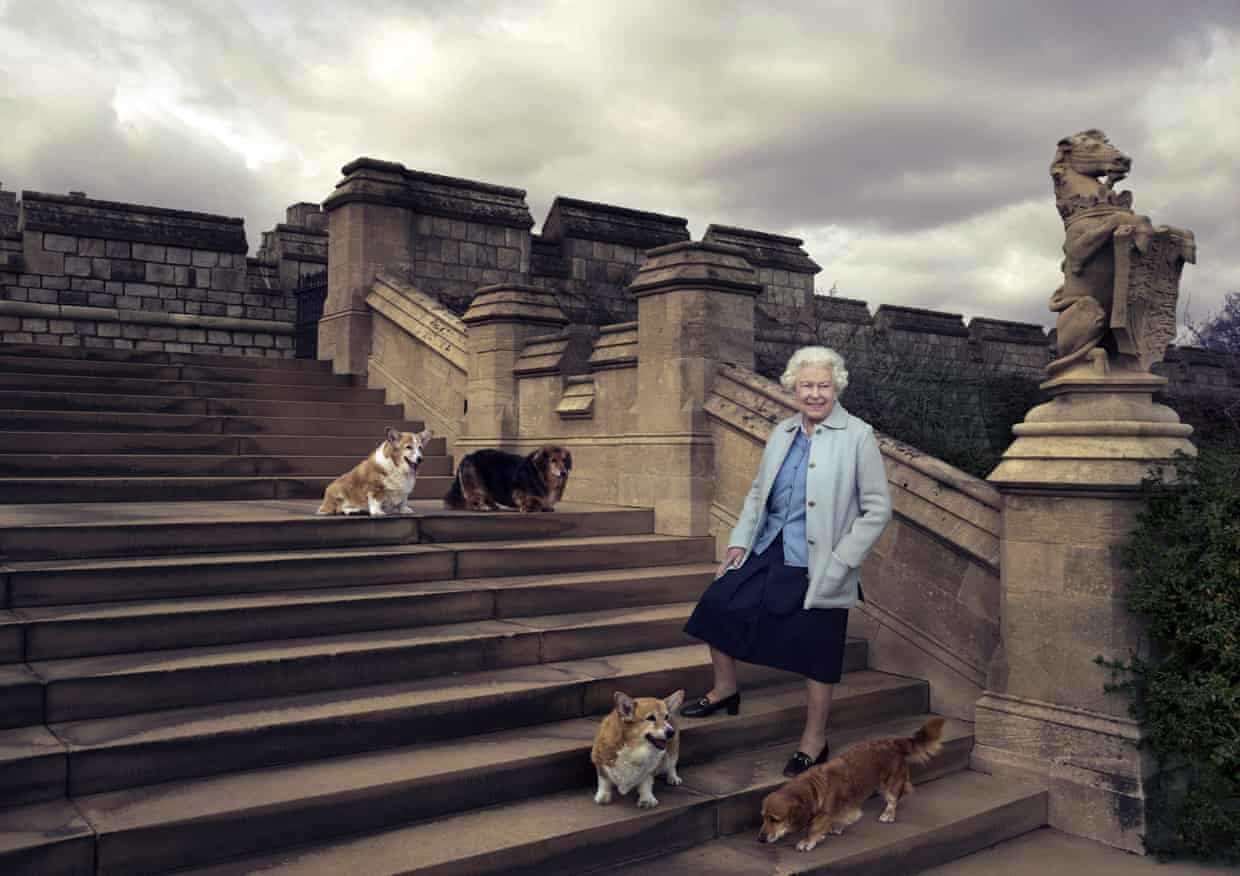
Two other official pictures are released today, one showing the Queen on the stone terrace of Windsor Castle with her four dogs, corgis Willow and Holly, and dorgis Vulcan and Candy, and another of her sitting with her only daughter, the Princess Royal.
On the eve of her birthday, the Queen was in Windsor to mark a significant milestone in the history of another British institution.
Queen and her dogs
FacebookTwitterPinterest
 The Queen poses in the private grounds of Windsor Castle with four of her dogs Willow (top right), Vulcan (top left), Candy (bottom right) and Holly (bottom left). Photograph: Annie Leibovitz/Getty Images
Five hundred years after Henry VIII knighted the first master of the posts, leading to the creation of the Royal Mail as we know it, she visited her local Windsor postal department which was being renamed in her honour.
On being told the Royal Mail delivers over a billion parcels a year, the Queen drily noted: “I’ve probably added to that this week.”
Moya Greene, Royal Mail chief executive, joked: “I have it on good authority that your own postmen and women will be especially busy with tomorrow’s mailbag.”
Thursday’s celebrations are planned to be relatively low key. After a walkabout on her Windsor doorstep, she will later light the first of a chain of more than 1,000 beacons across the UK and overseas before attending a birthday dinner hosted by Prince Charles and attended by members of her family.
Being the Queen she is blessed with two birthdays each year, one actual and one official. More formal celebrations, including a service of thanksgiving at St Paul’s Cathedral and giant street party in the Mall, are planned for her official birthday in June
The Queen with her daughter, princess Anne
FacebookTwitterPinterest
 In this official photograph, Queen Elizabeth II is pictured with her daughter, princess Anne, in the White Drawing Room at Windsor Castle on 20 April 2016. Photograph: Annie Leibovitz/Getty Images
The Duke of Cambridge, Prince William, paid tribute to his grandmother in TV interviews and spoke of the support she has given him as he described his own sense of destiny and duty.
Of the recent “workshy” jibes, he said he was “going to get plenty of criticism over my lifetime, and it’s something that I don’t completely ignore, but it’s not something I take completely to heart”.

His grandmother and father were both very active and engaged, and his family was “extremely supportive” of him not carrying out more royal engagements and having “time and space to explore another means of doing a worthwhile job,” he said.“When the Queen decides that she’s going to hand down more responsibilities, I’ll be the first person to accept them,” he told the BBC. “I take duty very seriously. I take my responsibilities very seriously. But it’s about finding your own way at the right time, and if you’re not careful duty can weigh you down at a very early age.”

Thoughts on what kind of king he wanted to be “very much occupies my thinking space”, he said. But it was not a priority at present. It could be twenty or more years hence, he said. “I have no idea when that’s going to be, and I certainly don’t lie awake waiting or hoping for it, because it sadly means that my family have moved on, and I don’t want that.”