
Louder than Bombs Isabelle Huppert: ‘When I act, I don't think about anything’

 ‘Not all movies are definitive – but there is always a necessity for me, a reason for me to have done the movie” … Isabelle Huppert
‘Not all movies are definitive – but there is always a necessity for me, a reason for me to have done the movie” … Isabelle Huppert Photograph: Peter Lindbergh
Famous for immersing herself in challenging roles, the French actor plays a war photographer in her latest film Louder Than Bombs. She talks about her commitment to directors, acting with Gerard Depardieu and playing a woman who stalks her rapist
I
sabelle Huppert strides into the salon, full of pep and vinegar, as you would expect. “Right now, I am completely immersed in theatre,” she says, not especially apologetically. “That’s why I might sound a little asleep at times.” It’s true: she is midway through a two-month Paris run of Phaedra(s), the classical Greek tragedy as reinterpreted by Sarah “Blasted” Kane, Wajdi Mouawad and JM Coetzee. “It is a very demanding production,” she says, and you wouldn’t want to doubt her.

But she doesn’t sound in the remotest bit asleep. One of Huppert’s principal attributes, and one that has served her brilliantly as an actor over the decades, is her wide-awake steeliness and resolution beneath the unassuming exterior, the toughness and wariness of someone who is not going to be messed with. Now 63, she has been making films for more than 40 years, ever since bagging a small role in the 1972 teen comedy Faustine et le Bel Été. (She didn’t play Faustine, but the cast also included future heavy-hitters Isabelle Adjani and Nathalie Baye.) She’s now completed more than 100 films, a decent percentage of which are masterpieces. What’s her secret and why does she keep going? Has she ever thought of packing it in?
Huppert snorts politely. “Oh, I don’t think so. You do one film after the other, and of course sometimes you have peaks, and sometimes it gets quieter, but no matter what, you keep going.” What keeps her motivated? “It has a lot to do with the encounter with the director. It’s really a process. Not all movies are successful, not all movies are definitive – but there is always a necessity for me, a reason for me to have done the movie.”Huppert has a deep, unshakeable – and very French – commitment to the cult of the auteur, the master director in whom she says a “complete belief” is a prerequisite, the vessel of a film’s “spiritual and creative power”. Huppert’s directors are the great and good of European art cinema: Michael Haneke, Claude Chabrol, Claire Denis, Raul Ruiz, Jean-Luc Godard, Maurice Pialat, Catherine Breillat, Bertrand Tavernier, Bertrand Blier. She’s made occasional forays into American cinema, too: Heaven’s Gate, Hal Hartley’s Amateur, I Heart Huckabees. Directors, she says, are her “only criterion of choice”.
“All movies are intense,” she says, “but the commitment may not be exactly the way people think it is. It’s a total engagement with the film; it’s beyond work, it’s beyond effort.”
FacebookTwitterPinterest
This certainly sounds like the Huppert we are familiar with: the total-immersion actor who simulated genital self-mutilation in Haneke’s The Piano Teacher, or the isolated plantation owner facing down armed rebels in Denis’ White Material. She played a pyschopathic killer and a wartime abortionist for Chabrol in La Cérémonie and The Story of Women respectively.

No doubt principally becuase of Huppert’s involvement, Elle will premiere at Cannes in May (Verhoeven hasn’t troubled the festival circuit for a decade, not since 2006’s Black Book). Despite the fact that no one has seen it, Huppert is animated on the subject. She says it’s a “portrait of a prototype of contemporary woman” who “can handle everything, including being raped by an unknown man”. The woman runs a videogame company (and no, Huppert says, she didn’t bone up on Call of Duty to prepare for the role) and “plays a strange game with her rapist”. But she “is never a victim, which she could be, because of her past”. She says that Verhoeven, the mastermind behind Robocop, Starship Troopers and Showgirls, turned out to be a “very attentive” director, and a “very delicate” one to boot; she was as surprised as anyone else.Huppert’s frenetic workrate means that you are never far from a new film from her, and with the film world’s chaotic schedules, we are right on top of four of them. Of immediate interest is Louder than Bombs, a moody, knotted drama in which Huppert plays the small but key role of a veteran war photographer who may or may not have deliberately killed herself in a car crash. Out shortly in France is L’Avenir, or Things to Come, where she plays a teacher who has to fend off a midlife crisis after her husband leaves her. Hovering in the distance (for UK audiences at least) after a successful debut at Cannes last year is Valley of Love, where Huppert is a grieving mother opposite Gerard Depardieu, as the two perform an odd ritual in Death Valley to honour their dead son. And most remarkably of all, perhaps, Huppert has taken the lead role in Elle, a new film from seemingly dormant Dutch director Paul Verhoeven, a typically lurid thriller about a woman stalking her rapist.

Pinterest
Louder Than Bombs, she says, was another case of directorial attraction: she met Norwegian film-maker Joachim Trier at a film festival in Stockholm, and happily agreed to take the small-but-memorable role he offered her, “as it would be nice to spend some time together”. There’s one particular shot in the film, a long-held close-up of her staring fixedly out of a front door, that is a striking testament to her ability to hold the camera. Huppert says she finds it “horrible”, but accepts it “impresses people because it’s very intense and dramatic”.
But she lets on she pretty much blanked out, mentally, to do the scene: the Huppert gaze does not involve method acting, inner investigation or any psychological gymnastics. “In fact, when I act I don’t think about anything. My acting depends on the staging: you know, you put the camera in front of me, and I do it.”
She won’t be drawn on the subject of Depardieu, whose epic form she shares the screen with in Valley of Love, and whose increasingly raddled physique and wayward lifestyle appears to be part of the film’s fascination: “We act together very easily” is the most she’ll say.
Pinterest
Huppert is famous for being intensely private, presenting a poker face when asked about her political thoughts or family life. She is happy enough to talk about the Action Christine, the cinema she bought and which her son Lorenzo programmes. (“It is one of the mythical cinemas in Paris. I had the opportunity to buy it, so I did.”) But I get a taste of the freezer when I mention her husband, film-maker Ronald Chammah; the shutters slam down, and she instantly changes the subject.
We’re back on less tricky ground when I ask about her (possibly not entirely serious) suggestion that she would like to play a “power villain” in a Hollywood blockbuster. The mind boggles at the thought of Huppert sneering, Blofeld-style, or yukking it up in a comic-book movie. “Yes, why not? It would be an experience. These kinds of roles never really happened to me, but it would be interesting. It would be for my children, really; they ask me: why don’t you do this kind of a superhero? I have not been asked yet, but I would say: ‘OK.’”
Hollywood, what are you waiting for?

UK,.Barack Obama has a right to be heard on Europe. And Britain should listen

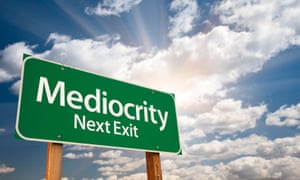
Road sign saying Mediocrity
For all the criticism of ‘Washington’ in the US today, echoing our own complaints about ‘Brussels’, none of the 50 states is seriously considering breaking up the union.’ Photograph: Andy Dean/Alamy
P
resident Obama’s visit to the UK this week will provide a reality check as to what our closest ally thinks of us, and of Britain’s place in the world, as we prepare to vote on whether to stay in the European Union. Almost every big news item – Syrian migration, the crisis in the steel industry, even offshore investment trusts – is prayed in aid by one side or the other to help make its case. So there is a risk that we will vote on the most important issue to have been put to the British people in decades on the basis of misleading or at best incomplete arguments.

Political friends in France remind me that they are past masters at holding referendums that become a barometer of the public mood, not a decision on the question on the ballot paper. Britain shouldn’t fall into the same trap.
Our partners are deeply concerned that we might leave the EU. This is partly because the UK has often come up with many of Europe’s better ideas – completion of the single market, a common energy policy, climate change initiatives, CAP reform, defence cooperation, and so on. It is partly because we provide useful balance between other big beasts in the EU. But it is also because Britain’s departure could, like pulling on the thread of an old jumper, unravel the entire postwar construction that has given us 70 years of stability.
Beyond Europe – in America in particular – we are seen as more of a force for good, and a more potent ally, inside the EU than outside. During my time in the United States I have found no takers for the fantasy that we can somehow leave Europe and rejoin the world as America’s, or the old Commonwealth’s, best friend and ally.
On the contrary, Washington appreciated the leading role we played in ensuring there was a firm European response when Russia helped itself to large parts of Ukraine. Because of our EU membership, we were major players in the group of nations negotiating the deal to stop Iran developing nuclear weapons. During the summer this deal came close to being voted down by the US Congress. Countless people on Capitol Hill, in the White House and in the State Department told me it was the UK’s arguments that made the difference because our judgment was trusted.
Much has been made of President Obama’s concern that we were not committed to spending 2% of our GDP on defence, as agreed at the Nato summit in late 2014. That concern has since been laid to rest. But why was he so concerned when the UK was even then the second largest contributor to the alliance? Because we were regarded as key to ensuring that other Europeans did their bit. Americans see us as being at the heart of EU foreign and security policy.
That applies to the efforts Britain has made to help conclude the Transatlantic Trade and Investment Partnership (TTIP). US officials have been clear that they will be in no hurry to conclude bilateral deals with the UK if we leave the EU and seek our own arrangements from what will, inevitably, be a far weaker negotiating position.
And business leaders in the US – our largest foreign investor – tell me very directly that if we leave the EU, they will consider Britain a much less attractive destination for the job-creating investments they make. That’s because we are, today, a door into the EU’s single market, and an ideal location for the centre of their European operations.

Other Brexiters say Americans would never accept EU-style constraints on sovereignty. In fact despite enjoying a union which emerged from the bloodiest of civil wars 150 years ago, Americans still argue – and litigate – over the distinction between states’ and federal rights. But for all the criticism of “Washington” in the US today, echoing our own complaints about “Brussels”, none of the 50 states is seriously considering breaking up the union. The benefits of staying together are just too great.I will be surprised if Obama does not find a way of making some of these points this week – and some Brexiters will argue that Americans should mind their own business. However, the US came to our rescue in two world (but largely European) wars, helped rebuild our continent with the Marshall plan, and is now the ultimate guarantor of the continent’s security, for which it pays a disproportionate share of the bill. So its president has a right to be heard.

The British people have more reason than most Europeans to be attached to their sovereignty and their political institutions – after all, they have survived the test of time and numerous would-be invaders over the centuries.
We are indeed subject to European laws that we, with the other member states, have legislated, just as we are bound by international agreements we have voluntarily joined, on everything from torture, genocide and climate change to nuclear weapons. But we have significant opt-outs in critical areas such as border control, where we aren’t in the Schengen area, and the eurozone.
We really do enjoy the best of both worlds. Having spent the last 40 years working to uphold the UK’s interests and reputation abroad, I cannot see why we would voluntarily relegate ourselves from the Premier League.
Of course there is room for improvement in how the European Union works, and its accountability: Britons are not alone in thinking more decisions should be taken at national level.
The prime minister’s renegotiation of Britain’s terms of membership this year produced some significant wins. But it was a missed opportunity for the EU as a whole to address the democratic deficit and the issues that are causing voters across the continent to lose faith in its institutions and policies.
However, the answer is to embark on a widespread programme of reform, and to ensure that the EU’s institutions are capable of addressing today’s needs, not committed to “ever closer union” for the sake of it. And we should do it together, with our partners, not walk off the stage and consign ourselves to irrelevance.

Juan Manuel Santos.- 'Legalise all drugs,' business and world leaders tell UN

Leaders of Global Commission on Drug Policy including Richard Branson and three ex-presidents say special session on drug policy was ‘fatally flawed’
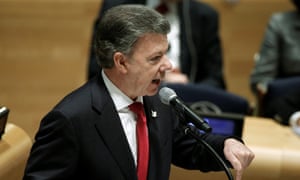
Colombia’s President Juan Manuel Santos
 Colombia’s President Juan Manuel Santos addresses the United Nations General Assembly special session on the world’s drug problem on Thursday. Photograph: Mike Segar/Reuters
A British billionaire, three former presidents and a renowned Aids researcher have called for all drugs to be decriminalized at a press conference that was sharply critical of the United Nations’ latest drug policy agreement, adopted this week.
Leaders of the Global Commission on Drug Policy said the UN’s first special session on drugs in 18 years had failed to improve international narcotics policy, instead choosing to tweak its prohibition-oriented approach to drug regulation.
“The process was fatally flawed from the beginning,” said Richard Branson, the head of the Virgin Group, adding that it may “already be too late” to save the international drug law system.
This week’s United Nations general assembly special session, UNgass, clearly displayed the deep divisions between member states over narcotics: while a growing number of countries, including several states in the US, have moved towards decriminalizing or legalizing drugs, others continue to execute people convicted of drug crimes. Three UN conventions prohibit drug use that is not medical or scientific.
The meeting, held Tuesday through Thursday in New York City, was billed as a forum to debate drug laws, called for by Mexico, Colombia and Guatemala in 2014. All three countries suffered disproportionate violence from cartels controlling drug supplies to the north. In Mexico alone, the government estimates164,000 people were the victims of homicide related to cartel violence between 2007 and 2014.
On Thursday, Mexico’s president, Enrique Peña Nieto, announced plans to legalize marijuana-based medicines and proposed raising the amount of the drug that can be legally carried.
Activists for drug policy reform had already warned there was little hope that UNgass would provide a forum for serious debate of the issue. Activists criticized the process by which the meeting’s agreement – known as the “outcome document” – was drafted and negotiated. Some accused countries with repressive drug control policies, such as Russia and Egypt, of exerting undue influence on the outcome.
Meanwhile, provisions advocates hoped for, such as a ban on capital punishment for drug crimes and a reference to “harm reduction”, were left out.
Within the general assembly, the divide between countries over drug policy was in stark relief. Though the outcome document was immediately adopted after the session opened, many liberal nations called its conclusions “insufficient” and vowed to fight for reform at the next drug meeting, in 2019.
Over the past two decades, nations from Portugal to Uruguay have experimented with liberal drug regimes. Uruguay legalized marijuana in 2014; the states of Colorado and Washington legalized marijuana in 2012; and Portugal decriminalized drugs at the beginning of the millennium.
Meanwhile, a representative of Indonesia was booed when he called capital punishment “an important compenent” of drug policy, a statement backed by nations such as China. In another instance, a scientific panel organized by the Russian Federation veered away from widely accepted science when a Russian medical representative called methadone, used for opiate addiction treatment, and heroin the “same narcotic”.
“We are not expecting a lot from UNgass,” said former president of Switzerland Ruth Dreifuss. “In this sense, our provision is what the reality is: that the world community is not ready, is not willing, to have the change of politic that is absolutely necessary.”
Former Colombian president César Gaviria Trujillo told the small crowd at the Grand Hyatt in New York City that the UN’s aim of a “society free of drug abuse” is “unrealistic, totally naive, almost stupid”.
“That we are going to live in a world free of drugs, which will never happen, which is never happening,” said Trujillo, apparently frustrated and even emotional. “It is totally stupid – unreachable.”
Other commissioners that joined the chorus included former UK deputy prime minister Nick Clegg, former US Federal Reserve chairman Paul Volcker and former president of Mexico Ernesto Zedillo, among others.