Russian artillery deployed for Aleppo offensive as Syria talks falter

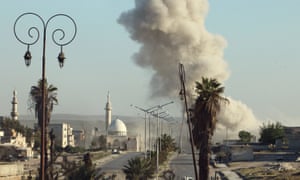
Smoke rises after an airstrike in a rebel-held area of Aleppo
Smoke rises after an airstrike in a rebel-held area of Aleppo this week. 
Opposition negotiators say they are leaving Geneva, overshadowing final day of Barack Obama’s visit to Saudi Arabia
Fears are mounting over the fate of a fragile truce in Syria following the deployment of Russian artillery in support of government forces preparing an offensive south of Aleppo, while UN-brokered peace talks appear close to collapse.
Opposition units said artillery pieces were being flown in by helicopter, adding to a belief that Moscow, which helped broker the cessation of hostilities seven weeks ago, now intends to spearhead efforts to retake the city’s rebel-held east.
Alarm at the deteriorating situation overshadowed the final day of Barack Obama’s visit to Saudi Arabia, where he spoke to Gulf leaders about Iran and the fight against Isis, as well as the Syrian crisis now in its sixth year with no end in sight.
“We think it would be negative for Russia to move additional military equipment or personnel into Syria,” said Ben Rhodes, the deputy US national security adviser. The Kremlin said Vladimir Putin had expressed concern at the crisis in the peace process.

FacebookTwitterPinterest
 Staffan de Mistura i Balibouse/Reuters
Staffan de Mistura, the UN envoy for Syria, declined to answer questions about the reported Russian deployment but said he would be assessing the state of the Geneva proximity talks on Friday. Syrian opposition negotiators announced that they were leaving after suspending their participation earlier this week.
The opposition official Mohammed Alloush said Syrian government forces must “stop massacres” and release thousands of prisoners before talks could resume. Bashar Jaafari, the Syrian government representative, had repeatedly scorned the rebels as the “Riyadh delegation” – a reference to the Saudi backing they enjoy.
If the talks end it is hard to see how they could be reconvened any time soon, and the sides are far apart on the question of forming a transitional government. The opposition has insisted on Bashar al-Assad’s departure; Damascus is adamant the president’s role is not up for negotiation.
Without any diplomatic process, however fragile, the stage seems set for a further escalation of conflict. The US has been hinting at a “plan B” while the Saudis, Qatar and Turkey will boost arms deliveries to rebels units they support. Russia and Iran would be likely to step up their military aid to Assad.
Speaking at the opulent Diriyah Palace in Riyadh, Obama promised Saudi Arabiaand the other five members of the Gulf Cooperation Council that the US would support efforts to fight Isis and restore regional stability.
The US president told the Gulf monarchs: “None of our nations have an interest in conflict with Iran.” He said Washington would not ignore “destabilising acts” by Tehran, and the US security commitment was “ironclad”.
Barack Obama and the crown prince of Abu Dhabi in Riyadh
FacebookTwitterPinterest
 Barack Obama speaks with Sheikh Mohammed bin Zayed al-Nahyan, Crown Prince of Abu Dhabi, during the US-Gulf Cooperation Council summit in Riyadh. 
Still, suspicions linger about the fraying of a relationship based for decades on Saudi oil and US military backing but now looking less solid against a background of economic and political uncertainty. The Saudi-owned al-Arabiya TV headlined its coverage of the summit: “Fighting terrorism and restraining Iran.”
Ambivalence about the US-Saudi relationship was captured vividly in a cartoon in the pan-Arab daily al-Sharq al-Awsat. It showed a Shia cleric in turban and robes sweating with alarm as he read a newspaper headlined “Obama in Riyadh”. But social media was flooded with critical comments reflecting mistrust in the US.
Prince Turki al-Faisal, the kingdom’s former intelligence chief, told CNN that Obama’s conduct and declarations had made Saudis realise that their relationship was not what it once was. “How far we can go with our dependence on America?” he asked. “How much can we rely on steadfastness from American leadership?”
The Saudis, in particular, will be watching carefully to see how the US responds to the latest developments in Syria, after strong criticism that Washington has moved too close to Moscow’s position since Putin’s direct intervention last autumn. Russia used its air power to attack anti-Assad fighters, not just Isis as it claimed.
The ceasefire, tenuous from the start, is now barely holding, with two airstrikes by Syrian jets on towns in Idlib province this week. The strikes killed close to 50 people, many of them civilians, say observers on the ground and in Turkey.
On a positive note, De Mistura said there had been some “modest but real” improvement in the delivery of humanitarian aid to besieged areas of Syria. On Wednesday, relief agencies evacuated 500 wounded people from four towns, the largest such operation so far.


Pop and rock.- Zara Larsson on Dr Luke, Beyoncé and why life isn’t ‘over at 25’

As a 14-year-old, the singer won Sweden’s version of Britain’s Got Talent. Now she’s the queen of the charts with three songs in the UK top 40
 Zara Larsson: ‘I just wanna sing Beyoncé songs all day long in front of a mirror’
Zara Larsson: ‘I just wanna sing Beyoncé songs all day long in front of a mirror.’ Photograph: PR Company Handout
Back in 2008, Zara Larsson was worried that her career might be over.
“I was like, ‘Why am I not getting signed? Why is this not happening?’” she says, looking back now. “I was so stressed out.”
It should probably be pointed out that Larsson was 10 years old at the time. She had just won Talang, Sweden’s version of Britain’s Got Talent, and clearly did not view patience as a virtue. She eventually got signed, but only at the ripe old age of 14: “And I was still pretty stressed out, but the older I get, the more relaxed I feel. ’Cos when I was younger, I thought life was over by 25. But now I’ve kind of realised that life begins at 25.”
FacebookTwitterPinterest
If so, Larsson has managed to accomplish quite a lot before her life has technically started. Her singles have gone platinum multiple times across Scandinavia, and she’s recently launched an assault on the UK, too. She’s currently in the Top 40 three times: her brilliant Rihanna-sounding single Lush Life is at No 5; Girls Like, her single with Tinie Tempah, is at No 6; Never Forget You, a duet with MNEK, peaked at No 5 and has not yet dropped from the charts. She has clocked up hundreds of millions of Spotify streams and even had a song named after her by Swedish band Regimen.
It all comes from cramming as much musical practice into her 18 years as possible. As a child in love with Celine Dion and Whitney Houston, she used to sing for her parents after every meal. They weren’t musical themselves, she says, although her dad was in a punk band when he was 15. “I don’t dare to say that he was no good,” she says, “but I think that he was no good. He quit the band anyway, and then, later on, they became super-rightwing extremists.”
Oh my God!
“Yeah!” she says, laughing. “I don’t even want to say the name. He quit before it escalated – it’s not what my dad thinks and believes at all.”
Pinterest
Larsson’s music is probably as far away from Swedish Nazi punk as it’s possible to get: take Rooftop, which exemplifies the Scandi knack of combining sleek pop with lyrical melancholy. She matches her music’s youthful charm with a brilliantly unguarded social media presence, in which tweets about sex, body hair and panic attacks go out to almost half a million followers (“I can’t think about that, it gives me anxiety”). One Instagram post in which she put a condom on her leg – to mock guys who claimed they couldn’t wear them because they were “too big” – went viral.
“I just did it because it was funny,” she says. “I didn’t think it was going to be that big of a deal. And I had so many mentions in my timeline from guys, like ‘but it doesn’t feel as good with a condom on’. Well, no, but it feels better than having an STD.”
Larsson has said in the past that Sweden’s ability to punch above its weight in pop comes from the country’s socialist mindset (“In America, you can’t say to your family: ‘Hey, I’m off to LA to make it as a songwriter, sorry I can’t pay for the dentist’”) and the fact that everyone is encouraged to learn an instrument in school music classes. She doesn’t back up the latter argument particularly convincingly when I ask what instrument she chose.
“Erm, honestly? I kind of skipped the music classes. It sounds fun but there’s a lot of music theory, a lot of history. Learning what they were playing back in, like, 1571),” she says, sounding particularly appalled at the state of 16th-century pop. “History is important but … I just wanna sing Beyoncé songs all day long in front of a mirror.”
Larsson’s Beyoncé fandom is actually quite something to behold. When she got the chance to see her idol recently, she says she spent the whole time weeping in the front row. On meeting her backstage, Beyoncé told Larsson: “You’re the girl I saw crying!”
“I can’t really remember what I was thinking or saying because I had this adrenaline,” she says, gabbling away at manic speed. “It was weird – to look at the person you love the most in their eyes and she’s looking at me and talking to me and that’s INSANE!”

Last year, she also worked with Dr Luke, the hit producer accused of rape by Ke$ha (Luke denies the allegationsand claims Ke$ha invented them to get out of a Sony contract with him. Further to Ke$ha filing the claim against Dr Luke, a New York court recently refused to release her from this contract).Larsson held herself more together in order to collaborate with MNEK: the pair of them – inspired by Justin Bieber’s Where Are Ü Now – wrote Never Forget You and ended up fighting over who should get to record it. In the end, they agreed on a duet – it went Top 5 in the UK and has received more than 62m Vevo plays.

“I believe it’s karma,” she says of the case. “I won’t be the one to say whether he raped her or not because I don’t know.” However, she makes a wider point about rape: “Too many women are not being believed when it comes to this. And to be honest, whether he’s a rapist or not, he’s not the nicest guy. He’s very talented, you can’t take that away from him, but where do we draw the line? I think Chris Brown is very talented, too, but I won’t support him because he’s an asshole.” Larsson says she’s thankful she doesn’t work with Dr Luke any more.
Larsson performing with Tinie Tempah.
FacebookTwitterPinterest
 Larsson performing with Tinie Tempah. Photograph: Hotsauce/REX/Shutterstock
Since she has turned 18, Larsson says, people are seeing her less as a cute novelty and more as an artist in her own right. She might be more chilled out now than when she was 10, but her run of hits – she has only really known chart success – can make her edgy. “I’m just waiting for the day when my songs aren’t flying,” she admits. “Because I kind of believe in Murphy’s law – if something can go wrong, it eventually will.”
Pessimism doesn’t come naturally to her, though: “I also believe that if something can go right, it will. So that means if I can’t have a No 1 on Billboard now, then I will still have one when the time is right. I mean, my life is kind of a fairytale. I work so hard, but … everything just goes my way! It’s insane!”
So if life really does begin at 25, where does she hope to be by then?
“Ummm … I would love to have a world tour, or two, or three. No, two, not three. Whatever! And maybe a couple of Grammys. Some No 1 songs ...” She exhales, stumped for the first time. It seems the thought of a time so distant is almost incomprehensible to her. “I don’t know,” she sighs: “I mean, 25? Maaan!”

Bolivia's cholita climbers scale highest mountain yet: 'I cried with emotion'


Two years ago, 11 Aymara indigenous women who worked for mountaineers decided to do their own climbing and have since tackled five peaks near La Paz
  • Bolivia’s cholita climbers conquer highest peaks near La Paz – in pictures
bolivia cholita climbers 
Bolivia’s ‘cholita’ climbers descend a glacier at the Huayna Potosí mountain in the Cordillera Real range. Photograph: David Mercado/Reuters
For years, Lydia Huayllas, 48, has worked as a cook at base camps and mountain-climbing refuges on the steep, glacial slopes of Huayna Potosi, a 19,974ft (6,088-meter) Andean peak outside of the Bolivian administrative capital, La Paz.
But two years ago, she and 10 other Aymara indigenous women, ages 42 to 50, who also worked as porters and cooks for mountaineers, put on crampons – spikes fixed to a boot for climbing – under their wide traditional skirts and started to do their own climbing.
These women have now scaled five peaks – Acotango, Parinacota, Pomarapi and Huayna Potosí as well as Illimani, the highest of all – in Bolivia’s Cordillera Real range. All are higher than 19,500ft (6,000 meters) above sea level.


bolivia cholita climbers
Pinterest
 Bolivia’s cholita climbers put on crampons under their traditional skirts while scaling mountains. Photograph: David Mercado/Reuters

“What do you do up there, how does it feel?” Huayllas said she asked her husband, mountain guide Eulalio Gonzales, two years ago. That was when he proposed that she climb the peak to find out for herself.
Last weekend, the women climbed the imposing Illimani, which has a five-mile (eight kilometer) long series of four peaks. It is the highest mountain in the Cordillera Real with its peak at 21,122ft (6,438 meters).
It looms above the Bolivian highlands, La Paz and Lake Titicaca to the west, and the valleys of the Amazon to the east. Eight of the 11 managed to reach the summit, braving a snowstorm and heavy winds.


The women climb in their traditional “cholita” garb, but trade in their bowler hats for helmets, and use modern equipment including ropes, harnesses, crampons and boots.
One advantage the women have over outsiders who come to the Andes to climb is that highland Bolivians are already well acclimated to the thin air at high altitudes.


bolivia cholita climbers
FacebookTwitterPinterest
 The women braved snowstorms and heavy winds to climb the Illimani mountain last weekend. Photograph: Stinger/Reuters

The short-term goal for the group is to climb eight mountains higher than 19,700ft (6,000 meters).
“The first experience was the Huayna Potosí. I cried with emotion. And I’m strong, I’m going to continue and get to the top of eight mountains,” said Dora Magueño, 50.
The group’s ultimate dream is to plant a Bolivian flag on the summit of Aconcagua, the highest mountain outside of Asia at 22,841ft (6,961 meters), located in the Argentinian Andes near the border with Chile. 

OLYMPICS.-Flame for Rio Olympics Is Lit at Birthplace of Ancient Games

ANCIENT OLYMPIA, Greece — The flame for South America's first Olympics was kindled Thursday at the birthplace of the ancient games in Greece, heralding the start of a 15-week journey that will culminate with the August 5 opening ceremony in Rio de Janeiro.
International Olympic Committee leaders and Brazilian organizers attending the flame-lighting in the ruins of Ancient Olympia voiced strong confidence that Brazil will stage successful games, despite a political crisis which forced Brazilian President Dilma Rousseff to cancel a scheduled appearance at the ceremony.
Rousseff faces possible impeachment before the games over alleged accounting tricks in managing the federal budget. The host country is also beset by corruption scandals, a deep recession and the Zika virus outbreak, while games-related problems include spending cuts, slow ticket sales and delays in some venues.
Brazilian Sports Minister Ricardo Leyser said the country's woes will have "no impact" on the games.
"It will be a big party and people will forget the other problems and just focus on the games," he told reporters. "So I don't think it's really a problem for the games."
Carlos Nuzman, head of the Rio organizing committee, said the Olympics will help unite Brazilians and pledged that the host city "is ready to deliver history."
"We are incredibly proud to have come so far, sailing through some of the most challenging waters the Olympic movement has seen," Nuzman said, adding that the Olympic flame "brings a message that can and will unite our dear Brazil."
The IOC insists that the Rio Games will be a success, maintaining that preparations are already at an operational phase.
IOC President Thomas Bach said Rio will provide "a spectacular stage" for the Olympics.
"These Olympic Games will be a message of hope in troubled times — and indeed the flame will carry this message into all corners of Brazil and, indeed, all the world," he said. "Despite the difficulties that Brazil is facing today, the flame is a timeless reminder that we are all part of the same humanity."
Bach said 98 percent of all infrastructure is ready and the test events are going well, adding that he is "very confident" on the games' success.
The flame was lit outside the 7th Century B.C. Temple of Hera in Olympia by Greek actress Katerina Lehou, in a long pleated dress impersonating a pagan high priestess. After a mock prayer to the ancient Greek gods, she used a concave mirror to focus the sun's rays on her torch, and the ceremony continued in the ancient stadium — which was used at the 2004 Athens Games as the shot put venue.
The flame-lighting ceremony, a key part of the Olympic pageantry, dates to one of the more awkward moments of the modern games, the 1936 Berlin Olympics conducted by Nazi Germany.
The first torchbearer, Greek world gymnastics champion Eleftherios Petrounias, took delivery of the flame and handed it to Brazilian former volleyball great Giovane Gavio at the beginning of a relay involving hundreds.
The relay will traverse Greece for six days until the April 27 handover to Brazilian officials in Athens, at the refurbished ancient stadium where the first modern games were held in 1896.
"This is the beginning of ... the last stretch of the organization," Bach said. "We're really looking forward to the moment when this flame is finally burning in the Olympic cauldron in Rio de Janeiro."
In a nod to the global refugee crisis, the Greek leg will include a stop at a camp in Athens that is home to 1,500 refugees and migrants trapped in Greece — one of whom will participate in the relay — while a young Syrian boy from another camp will accompany the torchbearer in a small town just north of Olympia.
For the first time at the Rio Games, the IOC will allow a group of 5-10 refugee athletes to participate, marching behind the Olympic flag at the opening ceremony. IOC officials say there are 42 potential participants, and the final selection will be made in June.
"We thought that this is the responsibility of the International Olympic Committee to send a signal of solidarity with refugees who are fleeing their homes from war and from violence," Bach said. "We wanted to give (them) a home in the Olympic village. We wanted to give them a flag, with the Olympic flag ... an anthem to identify with — the Olympic anthem."
After a brief stopover in Switzerland, the flame will start its travels through Brazil on May 3, starting in the capital of Brasilia. Organizers say it will reach most of the vast country's 200 million population, covering 20,000 kilometers (12,000 miles) by road and 16,000 kilometers (10,000 miles) by air to reach hundreds of cities and towns in a giant effort involving 12,000 torchbearers.
In a departure from customary practice, Rio will have two stadiums: the Maracana for the opening and closing ceremonies and soccer, and the Olympic Stadium across town, which will be used for track and field. After the first night in the Maracana, the flame will depart for an undisclosed downtown location for the rest of the games.