Las desconocidas razones que explican sus millonarias ganancias, Adele.

Si bien la cantante británica Adele vive algo más alejada de los escenarios, no afecta en nada las altas cifras que continúa facturando
Adele ha logrado ganar millonarias cifras hasta ahora con su carrera de cantante y de acuerdo al listado elaborado por el diario inglés The Daily Star, existen 7 puntos que revelan las cifras que han engrosado su cuenta corriente:
1. La edición digital del Daily Mail dijo que Adele no necesita trabajar para ganar dinero, porque aún se vende su último disco ‘21’ de 2012, con el que gana hasta US$80 mil al día.
2. Celebrity Net Worth estima que la fortuna actual de Adele es de US$75 millones. Según cálculos de esta página web, la cantante británica subió sus ingresos gracias a la publicación de su primer disco ‘19’ en 2008. Este álbum le permitió triunfar en la premiación de los Grammy de 2009, llevándose los trofeos a ‘Mejor artista nuevo’ y ‘Mejor intérprete vocal femenina de pop’
.
3. Los US$75 millones que ostenta Adele le han permitido ser la artista menor de 30 años más rica del mundo. Según el listado de The Sunday Times Music, la británica sigue liderando este conteo superando incluso a la banda juvenil One Direction.
4. En 2011, Adele publicó su segundo material discográfico titulado ‘21’. Según la empresa encargada de contabilizar las ventas de discos en Inglaterra, la producción llegó a vender más de 30 millones de copias en todo el mundo.
La popularidad que obtuvo Adele con ‘21’ le permitió ser considerada en distintos rankings a nivel mundial. Entre ellos, la revista Forbes la incluyó dentro de su listado de l*as celebridades que dieron que hablar durante 2012, en el puesto 24.
photo[1]
5.La cantante además fue convocada por la producción de ‘Skyfall’ –película que es una secuela más de las historias de James Bond– para grabar la canción homónima y oficial del filme. Esta participación le permitió llevarse un premio Oscar a Mejor canción original, en la ceremonia que se realizó en 2013.
6.El disco 21’ también hizo que Adele abandone el servicio de Spotify. Ella se dio cuenta que las ventas del disco eran gigantescas y decidió retirar su música de dicha plataforma. El único álbum de Adele que aún permanece en Spotify es ‘19’.
7.En una entrevista con la cadena de noticias CBS, Adele presentó la mansión donde vive. Dicho inmueble está compuesto por 10 hectáreas de campo, 10 habitaciones, dos piletas y otros tantos lujos.
Resultado de imagen de Adele

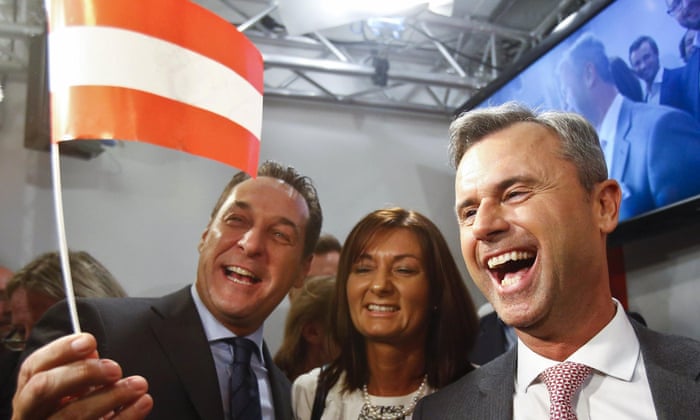
Norbert Hofer.-Austrian far-right party wins first round of presidential election


Norbert Hofer of the Freedom party takes 36.7% of the vote as candidates from the two governing parties fail to make runoff
Austria’s government was licking its wounds on Monday after a historic triumph for the anti-immigrant far-right Freedom party in a presidential ballot.
It won more than a third of the vote in Sunday’s election and will face an independent in next month’s run-off, dumping the country’s two main parties from the post for the first time.
It was the far right’s best result in a national election after a campaign that focused on the impact of the crisis caused by the arrival of approximately 100,000 asylum seekers in Austria since last summer.
Norbert Hofer, who ran on an anti-immigrant and anti-Europe platform, won 36.4% of the vote to become head of state. He will face Alexander Van der Bellen, a former Green party figurehead, who won 20.4%, according to official preliminary results.
While the presidency is largely a ceremonial role, the fact that neither of the main ruling parties will be battling for the post on 22 May marks a major change in Austrian politics – as well as the rising role of the far-right in Europe.
Members of the centre-left Social Democrats and the conservative People’s party held onto the job since it was first put to a popular vote in 1951. The two parties have ruled the nation of 8.7 million in tandem for most of the postwar era.
The president is head of state, swears in the chancellor, has the authority to dismiss the cabinet and is commander in chief of the military.
The election outcome was “a resounding slap in the face” for the government coalition, said Wolfgang Bachmayer, who founded market research institute OGM.
His comments were echoed by political analyst Peter Filzmaier. “Only those who are satisfied vote for a government party or its candidate,” he said. “This time, the annoyed voted for Norbert Hofer.”
Around 70% of eligible voters cast their ballots, a big turnout compared with around 50% six years ago when Social Democrat Heinz Fischer, now 77, was elected for his second term. He could not run for a third term.
Peter McDonald, general secretary of co-ruling People’s party acknowledged the scale of the defeat after coming fifth in the poll, with just 11.2% of the vote. “We have experienced a landslide that should give the entire political centre food for thought,” he said.

Should Hofer get the top job, he could push to bring forward a parliamentary election due to take place in 2018 as support for his party has been growing. Polls show the Freedom party above 30%, while the coalition parties would struggle to get a combined majority.The social democratic chancellor Werner Faymann, whose party ranked fourth, said the outcome was a clear warning to the government to work harder and cooperate better.
Showing the far-right’s growing confidence in Europe, Marine Le Pen, leader of France’s National Front, hailed a “beautiful result”, writing on Twitter: “Bravo to the Austrian people”.
Both the candidates who made it through to the run-off had taken aim at the government over its handling of the migrant crisis. Van der Bellen criticised the government for being too harsh in its treatment of asylum applicants, while Hofer said it had been too soft.
“It could hardly be any more dramatic,” said political consultant Thomas Hofer, adding that he thought Van der Bellen would face a difficult task to win the run-off with the gap between him and Hofer.
Neither Faymann nor vice chancellor Reinhold Mitterlehner from the People’s party said they would make any recommendation for the run-off. Voters should decide independently, they said.

Srivastava.-In the aggressive world of cosmetic surgery, patients can't afford to be naive

T
he lovely young woman on my medical rounds has a gaping hole on her forehead. The hole is deep and there is pus brimming from the side. The edges look macerated and discoloured and the stench emanating from it is noticeable. She looks like the victim of a vicious accident until we discover that this is the result of a cosmetic procedure gone wrong. She is flustered and angry, but mainly worried about the possibility of permanent disfigurement.

The plastic surgeon duly arrives, his response one of unmitigated dismay: “Oh God.”
Over the next week, the woman receives powerful antibiotics and one round of surgical debridement. The surgeon advises that the repair process will take several months.
When she knows us a little better she produces consecutive images capturing the unfolding catastrophe. The final picture is from Instagram before intervention. Her skin is smooth and young and her features look nice, but all she notices is the blemish of a mole.
“See that? I couldn’t bear it, but now I am positively ugly.” Then she bursts into tears.


We console her as best we can but there is no escaping the fact that in the quest to fix a small perceived defect she has attracted a lot more trouble than she bargained for. She seems nonplussed when the plastic surgeon questions her about the qualifications of her provider. “He was a doctor,” she says defensively. “What else did I need to know?”
This woman may sound naïve but qualified plastic surgeons say that she is typical of uninformed patients who belatedly realise the consequences of their decision to have “routine” cosmetic surgery.
Cosmetic surgery clinics have long operated with impunity but they have recently been in the spotlight with reports of widespread shoddy procedures including unsafe anaesthetic practices and inadequate infrastructure to monitor serious complications.

Ranjana SrivastavaBut unregulated cosmetic clinics are thriving, offering everything from Botox, laser and fillers to breast and nose jobs, tummy tucks and facelifts. Slick websites promise the world: quick and painless makeovers that will restore patients (mostly women) to their pre-baby self or sculpt the confident, trim and taut body they have always dreamt of having.Beauty clinics that once offered safe services now perform a ubiquitous trade in laser procedures. “Getting a Brazilian does not involve nearly the same level of risk as laser resurfacing,” says a dermatologist, who sees examples of interventions gone wrong.

The word “cosmetic” is affixed to doctor, physician, surgeon, plastic surgeon and dermatologist. Of these, only the latter two have undergone years of specialist training and accreditation by a professional college. While clinics claim that other cosmetic providers may have a basic medical degree, their training in performing complex cosmetic procedures is variable and unscrutinised.
According to plastic surgeons who end up picking up the pieces after cosmetic surgery gone wrong, many providers know that patients don’t have the sophistication to question the difference. They describe removing botched breast and nose implants, treating disfiguring scars and resuscitating patients who suffer large fluid shifts after aggressive liposuction. Many of them have taken place on a “luxury” overseas holiday that combined tourism and surgery at a fraction of the price. The corrective procedures are painful, time-consuming and place an extra burden on the public healthcare system.
But “cosmetic” does not mean “unimportant”, as one dermatologist rightly says. It’s naïve to think that appearance doesn’t matter. It matters in every walk of life. Even the ancient Egyptians, free of the influences of social media, regarded beauty as a sign of holiness, going to considerable lengths to procure Kohl and malachite for their eyes and red ochre for cheeks.


When a woman tells me she settled on a tummy tuck after a single phone call, I wonder how uninformed buyers can be so easily convinced of the merits of expensive and major surgery. Visiting various websites, I am struck by the glossy pictures selling the attractive proposition that a tummy tuck is perfect for the woman who wants to look more feminine, regain her self-esteem and nicer contours – for someone who doesn’t mind the children but hates the resulting abdominal baggage, for the woman who dreads the beach and who is at risk of sinking into depression because her waist is larger than her hip.A man wants the red veins on his nose removed to remove the impression of being an alcoholic. A woman feels that the permanent frown on her forehead makes her look angry to her colleagues and is threatening her job security. A young man says people can’t look beyond the large birth malformation on his face. Modern medicine has the tools to help, and patients ought to benefit from them, but they also deserve an honest discussion of the evidence underlying treatment.

There is an outwardly sympathetic but sinister implication that sometimes, no amount of healthy living can make a woman as beautiful as a round of surgery. The mention of complications is notably sparse and that of cost virtually non-existent. You could be forgiven for thinking that although the benefits are self-evident and compelling, the risks are a side issue and the costs immaterial.
In a 2015 study published in the journal Plastic and Reconstructive Surgery, American researchers reported on the outcomes of 25,000 abdominoplasties (tummy tucks) – 95% of patients were women, with an average age of 42. Two-thirds combined the procedure with other cosmetic surgery. Tummy tucks can be undertaken alone or as part of the “Mummy Makeover Package”, combining breast, abdominal and vaginal work. Less serious problems managed in the clinic were not included in the study but the rate of major complications was high at 4%, rising to an alarming 10.4% for combined procedures. The commonest complications were bleeding, infection, venous thrombosis, and lung injury, all potentially life-threatening.
When I call a popular cosmetic clinic on a Friday afternoon and ask to speak to a patient advisor, demand is high and the wait is long. I introduce myself as a mother enquiring about cosmetic surgery for the first time and am immediately asked which one of the extensive menu of procedures I want. An abdominoplasty, I venture, and am rewarded with the knowledge that it’s “incredibly popular.”
“I’d like to know who this procedure is right for,” I ask.
“It’s right for anyone who wants it’.
I am astounded by this claim, and from a nurse too.
Her advice contradicts professional guidelines that advise surgery in cases of massive weight loss (that leaves redundant skin behind), documented serious infection or skin necrosis due to overhanging fat or functional limitation with walking or hygiene, and only when non-surgical management has not worked.
After hearing a slick promotion about the tummy tuck that will iron out more than the abdominal sags, I ask about side effects and costs and am told this requires a discussion with the doctor. I concede this as reasonable but can’t help noticing that the anticipated benefits have already been aggressively impressed upon me without the same doctor’s input.
“Do women decide so quickly?” I enquire, considering I am none the wiser about the provider’s qualifications, cost or complications.
“Most of our women have already decided and they walk out of here with a date.”
Research into the preferences of first-time cosmetic surgery recipients finds that viewers of plastic surgery reality television are more likely to be influenced by the shows, believe themselves to be better informed, but have more unrealistic expectations of surgery.


“When you have bought a six-figure laser machine and are spending tens of thousands in maintenance fees, there is a perverse incentive to suggest a procedure instead of reassuring a woman that her nose looks just fine,” a clinic owner tells me. If patients are to be adequately protected, the cosmetic industry will need to be regulated rather than customers relying on a voluntary code of conduct.Experts say that cosmetic surgery is a sign of our times and here to stay, which is why qualified plastic surgeons and dermatologists, who might previously have avoided the field, want a hand in the game. They say that while most patients are satisfied, cosmetic surgery providers are obliged to screen out those with depression, psychosis, body dysmorphic disorder and minimal deformity who need other forms of help instead of surgery they can ill-afford. But many openly admit that the multimillion dollar cost of running a modern cosmetic clinic causes ethical obligations that clash with the financial imperative.

In today’s aggressive world of cosmetic surgery, the patient’s role can’t be ignored. The patient can’t afford to be naïve and trust the most polished advertising. Before committing to cosmetic surgery, there is a personal obligation to reflect a little on what it will actually accomplish.
Disappointingly, research shows that when it comes to almost every form of healthcare, with every pill we swallow and procedure we subject to, we consistently overestimate the benefits and underestimate the harm.
Combine this with an unchecked industry, and the potential for tears is as boundless as our longing to look good.

Hanover.-Obama hails Merkel over handling of refugees


US president Barack Obama said Angela Merkel was on the right side of history with her management of the refugee crisis and praised the German chancellor as a steady and trustworthy ally with a really good sense of humour, as he embarked on the final phase of the last official European tour of his presidency.
Lauding Merkel for taking “very tough politics not just to express a humanitarian concern but also a practical concern”, Obama said: “She is giving a voice to the kinds of principles that bring people together rather than divide them.”
But beneath the smiles and mutual compliments lurked a range of pressing global issues that the two leaders will try to address at a G5 meeting with British prime minister, David Cameron, the French president, François Hollande, and the Italian prime minister, Matteo Renzi, in Hanover on Monday afternoon.
Merkel and Obama both expressed grave concerns about the collapse of the Syrian ceasefire during a joint press conference in the German city on Sunday.
Syrian opposition forces left the third round of peace talks in Geneva on Friday following reports of escalating regime attacks. On Saturday, Syrian warplanes bombed the rebel-held town of Douma near Damascus and parts of Aleppo in the north, killing 23 people, according to the UK-based Syrian Observatory for Human Rights.


Merkel said that a visit to a refugee camp near the Turkish-Syrian border on Saturday had shown her at first hand the devastating effects a surge in attacks could have.
Obama said in Hanover: “We all care deeply about the tragic humanitarian crisis inside Syria. I live with this every day: I read about it, I talk to people who have experienced or witnessed suffering.”
But the US president ruled out establishing “safe zones” inside Syria, while the German chancellor stood by the idea as part of the ceasefire plan.
Obama said: “As a practical matter, sadly, it is very difficult to see how it would operate short of us being willing to militarily take over a chunk of that country. And that requires a big military commitment to protect refugees from attacks.”


The patrols, the most serious intervention in Libya since the toppling of Muammar Gaddafi in 2011, would be capable of sending refugees back to the country.During Monday afternoon’s two-hour meeting, the US president and the four EU national leaders are also likely to discuss stemming the flow of migrants from Libya by placing EU naval patrols in Libyan waters.
On Libya, Obama said he did not regret America’s military intervention in the country in 2011, even though other countries including Germany had declined to be involved in the operation. “I still believe it was the right thing for us to intervene. I do believe that it was important to plan and resource what would happen next,” he said. “We didn’t do it as effectively as we should have. The fact that we have a government of national accord obliges us to encourage it.”
Merkel agreed there was a duty to support Libya’s unity government but said the country had never been a functioning state as we know it.
The meeting of the G5 will focus on the power vacuum in the Middle East and its impact on mass migration into Europe. It is likely to discuss the extent to which the EU naval mission needs the permission of Fayez al-Sarraj, the Libyan prime minister, to operate in Libyan waters.
Sarraj is struggling to win political support for his fledgling government and any sign of diminished Libyan sovereignty weakens his ability to extend his internal support.
The British foreign secretary, Philip Hammond, has also raised the possibility of military support for any Libyan government attempt to drive Islamic State from its stronghold in Sirte on the Libyan coast. He said in an interview published on Sunday he would consider a request to deploy British ground troops in Libya. “If there were ever any question of a British combat role in any form – ground, sea or air – that would go to the House of Commons,” he said.


It is increasingly unpopular in Germany, as well as in the US, amid fears that it will benefit corporate America and not European consumers. More than 30,000 demonstrated against TTIP in Hanover on Saturday and Obama’s visit, coinciding with the city’s prestigious trade fair, will see further street protests against the president.Obama also used his Germany visit to lobby for the EU-US trade deal, the Transatlantic Trade and Investment Partnership.
“What you are seeing around the world is people are unsettled by globalisation,” Obama said. “People see a plant moving and jobs lost and narratives develop that this is weakening the position of normal people.
“It is indisputable that globalisation has made our economies stronger and our businesses the most competitive in the world.” While he said he did not expect the treaty to be ratified by the end of 2016, Obama said he remained confident that a complete deal could be agreed on before the end of his presidency.
Merkel said that TTIP would help Europe’s economy to grow. “When I see how far the talks have already progressed then I believed we should hurry up,” she said.
On Sunday morning, US secretary of commerce Penny Pritzker lobbied for a speedy completion of the trade deal in front of members of the Federation of German Industry.
“We have a rapidly closing window of opportunity to make progress. If we do not complete TTIP negotiations before the end of the year, it could be months, maybe even years, before serious talks resume. Whether it is TTIP, the privacy shield and the digital single market, we must ask ourselves: what is the cost of delay? What happens to our economies, to our companies, and to our people if we fail?”

ALEMANHA "Merkel está do lado certo da história", diz Obama

Em visita à Alemanha, presidente dos Estados Unidos elogia chanceler federal por manter fronteiras do país abertas em meio à crise de refugiados. Líder americano também defende acordo de livre comércio entre UE e EUA.
Barack Obama e Angela Merkel
Em visita à Hannover, no norte da Alemanha, o presidente dos EUA, Barack Obama, afirmou neste domingo (24/04) que a chanceler alemã, Angela Merkel, está "do lado certo da história" na crise de refugiados.
Em entrevista coletiva logo após um encontro bilateral, Obama disse que Merkel soube adotar medidas "difíceis", mantendo as fronteiras de seu país abertas diante de uma enxurrada de pedidos de asilo.
Obama também observou que no mundo de hoje é "muito difícil" construir muros e que, talvez, a chanceler federal tenha adotado esta posição porque ela mesma já esteve "atrás de um muro", se referindo ao fato de Merkel ter vivido na Alemanha Oriental até a queda do Muro de Berlim. "Estou muito orgulhoso disso", concluiu.
A Alemanha recebeu 1,1 milhão de pedidos de asilo no ano passado, a maior parte deles de cidadãos da Síria, do Iraque e do Afeganistão.
Merkel, que visitou um campo de refugiados sírios na Turquia neste sábado, defendeu a criação de "zonas de segurança" na Síria, para garantir ajuda humanitária à população do país em meio à guerra civil. Tais áreas deveriam ser discutidas nas negociações de paz em curso em Genebra, adicionou.
Tratado de livre comércio
Um dos objetivos da visita de Obama à Alemanha era impulsionar um acordo de livre comércio entre a União Europeia (UE) e os EUA. Na entrevista coletiva, Obama disse que não espera que as negociações sobre o tratado cheguem ao fim ainda neste ano.
"Não acredito que conseguiremos uma ratificação até ao final do ano", afirmou, se referindo ao controverso Acordo de Parceria Transatlântica de Comércio e Investimento (TTIP). No entanto, o presidente ressaltou que tem esperança de que pelo menos o conteúdo do pacto esteja pronto até dezembro, de forma a permitir que os parlamentos envolvidos possam analisá-lo.
Obama pediu mais confiança no tratado. Ele observou que muitos ficaram alarmados com a globalização, embora as economias americana e europeia tenham se beneficiado dela.
"Quando você vê que uma fábrica é transferida, empregos são perdidos e que a situação do homem comum fica pior, então, isso provoca desconfiança", frisou. Ele disse, no entanto, ter certeza de que no longo prazo as vantagens do TTIP vão se tornar visíveis para a maioria das pessoas.
O acordo, que é negociado entre UE e EUA, é especialmente controverso na Alemanha. Neste sábado, dezenas de milhares de militantes foram às ruas de Hannover protestar contra o plano.
O presidente dos Estados Unidos chegou à cidade neste domingo, para sua terceira e provavelmente última visita oficial à Alemanha, na última etapa de uma viagem na qual passou por Arábia Saudita e Reino Unido.
Ao lado de Merkel, Obama inaugura neste domingo a Feira de Hannover, encontro industrial mais importante do mundo. Também foi agendada para segunda-feira uma cúpula informal, na qual o presidente americano deve se reunir com os chefes de Estado e de governo de Reino Unido, Itália e França, além da chanceler federal alemã.