The Queen's private family album revealed: Candid footage taken by Her Majesty offers a fascinating insight into royal life

Taken from the Queen's private family album, images showing joyous celebrations, and intimate rarely seen shots, will be given a commentary by members of the royal family in a BBC documentaryThe Queen's private family album revealed: Candid footage taken by Her Majesty offers a fascinating insight into royal life - including pillow fights, toy cars and horsing around on her beloved yacht 

  • Ever since her father gave her a Box Brownie, a camera has been an indispensable part of the Queen’s life 
  • From joyous celebrations to intimate shots from family albums, stunning images offer an insight into royal life
  • A BBC programme set to air tomorrow night will show the family commenting on the footage Goggle-box style

  • An amazing treasure trove of royal memories has been released to mark the Queen's 90th birthday. 
The private cine films - many taken by the Queen herself - offer a unique insight into her family life. And a BBC programme set to air tomorrow evening will show the family commenting on the footage Goggle-box style.
From joyous celebrations, to intimate rarely seen shots from family albums, the stunning photographs which span decades have captured the life of the royal family.
Elizabeth at 90 - A Family Tribute is on BBC tomorrow at 4.35pm. 
Taken from the Queen's private family album, images showing joyous celebrations, and intimate rarely seen shots, will be given a commentary by members of the royal family in a BBC documentary
The two happy children seen here buried up to their necks in the sand are Prince Charles and Princess Anne. Standing guard is one of the Queen's corgis 
The two happy children seen here buried up to their necks in the sand are Prince Charles and Princess Anne. Standing guard is one of the Queen's corgisAs close as two sisters could ever be: Elizabeth, left, and Margaret were never happier than when they could spend time together 
As close as two sisters could ever be: Elizabeth, left, and Margaret were never happier than when they could spend time together 
The mischievous young Elizabeth and Margaret start a pillow fight with their mother Queen Elizabeth and pinstripe-suited courtier Arthur Penn
When Princesses attack: Elizabeth and Margaret start a pillow fight
When Princesses attack: The mischievous young Elizabeth and Margaret start a pillow fight with their mother Queen Elizabeth and pinstripe-suited courtier Arthur Penn 
Smile, please: A very young Charles is fascinated by his mother's expensive Rollei camera. She loved chronicling her children growing up with still photographs and home movies 
Bottoms up: Charles copies his little sister as she makes intricate patterns in the wet sand on the beach at Holkham 
Hanging around: This fun photo taken from the family album shows Prince Philip upending a red-suited young Charles 
Lookalike: As he watched the film, Prince William commented, 'Doesn't the young Charles look like Prince George!'
Queen reminisces about taking tea outside with King George VI
Loaded: 0%
Progress: 0%
00:00
Play
Mute
Current Time0:00
/
Duration Time0:37
Fullscreen
Need Text
A wonderfully informal day on the beach at Holkham, near Sandringham, in 1957 shows Anne enjoying being off the leash
Charles enjoying a day out at the beach in 1957
Running and jumping: A wonderfully informal day on the beach at Holkham, near Sandringham in 1957, shows Anne, left, and Charles, right, enjoying being off the leash 
Peek-a-boo: Wearing their summer dresses, Margaret, left, and Elizabeth shield their eyes from the sun as they play happily together in the garden in the Thirties 
Splashing fun: Charles and Prince Phillip, his trousers rolled up, soak each other at Holcombe beach in Norfolk
Naughty girl: King George pretends to smack Margaret as Elizabeth looks on and laughs before joining in the joke
Ha ha, fooled you: The king, wearing shorts, lovingly embraces a tiny and delighted Margaret in the garden
Don't be scared, Auntie: Charles watches with concern as Princess Margaret prepares to go racing in a toy trolley - helped along by a very big push from her sister Elizabeth 
Taxi for Anne (with Charles at the wheel): 'Take me to the palace, and make it snappy, Charles, as we are late for our luncheon'
Taxi for Anne: 'OK, hop on board...and off they go with Anne balancing precariously on the running board 
The Prince of Wheels: Anne waits patiently for a ride as Charles takes his posh pedal car for a spin at Balmoral 
Wherever he goes today, Charles takes a cushion for his back and it seems he picked up the habit years ago. Watching the film, Prince Harry was upset that the 'cool' car is no longer in the royal collection 
Life on the ocean wave: Elizabeth, then 11, and Margaret, seven, dance a Scottish reel on the Royal Yacht Victoria and Albert 
Now that's a tea party fit for a Queen: The future Queen uses a napkin to discretely wipe stray crumbs from her mouth 
Perfect manners: Elizabeth sips delicately from a large cup during a tea party. That same crockery is still in use at Windsor 
Everything stops for tea: Princess Elizabeth is relaxed and happy as the family enjoy a picnic in the sunken garden at Windsor Castle
King George VI watches as his daughters tuck into their tea during an outdoor party. The Queen is a great fan of alfresco meals to this day 
Home movie shows Queen relaxing aboard royal yacht
Loaded: 0%
Progress: 0%
00:00
Play
Mute
Current Time0:00
/
Duration Time0:32
Fullscreen
Need Text
Daredevil: A laughing Andrew gets ready to race down a water slide on the Royal Yacht Britannia and go between his brother Charles's legs
Dad shows the way: The slide was set up on the Royal Yacht Britannia - which came into service in 1953 a few months before the Queen's coronation - and flooded with water to make it slippery
The challenge was to slide along the deck as far as you could. Naturally, a decorated Navy hero like Prince Philip always thinks he can do best
Dad shows the way: The slide was set up on the Royal Yacht Britannia - which came into service in 1953 a few months before the Queen's coronation - and flooded with water to make it slippery. The challenge was to slide along the deck as far as you could. Naturally, a decorated Navy hero like Prince Philip always thinks he can do best 
A laughing Andrew, after making his way down the water slide on the Royal yacht, adjusts his trunks after they filled with water
Girl's just wanna have fun: The Queen's niece Lady Sarah Armstrong-Jones - now Lady Sarah Chatto - is soaked from head to foot, but it hasn't dampened her spirits 
Wahoo! Have you ever seen the royals having such fun? The boys laugh as The Queen's niece Lady Sarah Armstrong-Jones - now Lady Sarah Chatto - makes her way down the slide 
The girls with their mother, left, and nanny Marion Crawford - known as Crawfie - in 1937 on the Royal Yacht Victoria and Albert 
Charles, then eight, and Anne, seven, are wrapped in towels to dry off after a dip in the sea - but they can't resist working off some youthful energy with a dance
Let's twist again: Charles and Anne dance on the beach
Let's twist again: Charles, then eight, and Anne, seven, are wrapped in towels to dry off after a dip in the sea - but they can't resist working off some youthful energy with a dance
Look out: Philip takes a young Charles for a ride in a trolley down the steep slope on a lawn in Balmoral
Larking about in leaves! Prince Charles laughs at antics in park
Loaded: 0%
Progress: 0%
00:00
Play
Mute
Current Time0:00
/
Duration Time0:32
Fullscreen
Need Text
The Duke can't resist having a go himself - but he's going much too fast
His kilt, his dignity - and very nearly his modesty - go flying as he comes a cropper
My turn! These toys aren't just for tiddlers: The Duke can't resist having a go himself - but he's going much too fast, left. Right, whoops! His kilt, his dignity - and very nearly his modesty - go flying as he comes a cropper
The young pretender: Prince Charles clearly believes he has a superior technique to his father and strips down to his royal blue trunks to gain maximum advantage 

Liverpool defender Mamadou Sakho suspended after positive drug test following Manchester United Europa League clash

Liverpool defender Mamadou Sakho sprints away in celebration having scored in the Merseyside derby


  • Mamadou Sakho has recently impressed in the Liverpool defence 
  • The 26-year-old has made 34 appearances for the Anfield club this season
  • France international Sakho joined Liverpool from Paris St-Germain in 2013 
Sakho, 26, will now have his B sample checked early next week before it is confirmed he has failed the drugs test.
Until that takes place, Sakho will not be available for selection including Saturday's Premier League game against Newcastle United, a decision taken after discussions between the player, manager Jurgen Klopp and the club hierarchy. 
Liverpool defender Mamadou Sakho sprints away in celebration having scored in the Merseyside derby
If his second sample echoes the results of the first, Sakho is facing a lengthy suspension. His Liverpool team-mate Kolo Toure was suspended for six months when he was a Manchester City player after taking prohibited water tablets which he claimed he got from his wife to help him slim down. City also fined the player £740,000.
Liverpool's presence in the Europa League where they play a semi-final first leg against Villarreal in Spain on Thursday night seems assured as two players from the same team have to fail a test before a club can be sanctioned.
At the moment, it is only Sakho as an individual who is being investigated
The news will be a huge blow for Klopp as Sakho has been one of the team's most-improved players in recent weeks.
He played a big part in both the quarter-final victory against United and he scored in the epic 4-3 win against Borussia Dortmund nine days ago that put Liverpool in the last four.
Liverpool received notification of Sakho's test result on Friday and issued a statement at 1.30pm on Saturday just as the rest of the solemn-looking first-team squad arrived at Anfield to prepare for Newcastle. 

KOLO TOURE'S SIX MONTH BAN (2011) AFTER TAKING HIS WIFE'S DIET PILLS 

Kolo Toure received a six-month ban for failing a drugs test back in March 2011 during his Manchester City days.
The Ivory Coast defender tested positive because of a banned substance contained in a diet pill he was given by his wife.
Toure admitted the offence at an FA hearing five years ago but asked for the accidental nature of his actions to be taken into consideration.
The FA commission also heard written character references from City manager Roberto Mancini and Toure's former Arsenal boss Arsene Wenger.
However the FA later announced that Toure had been banned for six months. City also fined the player £740,000
But given that he was suspended as soon as the offence came to light at the start of March 2011 he missed just a month of the start of the next Premier League campaign.
The 26-year-old headed in for Liverpool during the 4-0 demolition of Everton on Wednesday

SAKHO'S MATCHES SINCE UNITED

Mar 20 (PL) - Southampton (A) 2-3. 90 mins
Apr 2 (PL) - Tottenham (H) 1-1. 90 mins
Apr 7 (EL) - B. Dortmund (A) 1-1. 90 mins
Apr 14 (EL) - B.Dortmund (H) 4-3. 90 mins                          (Sakho scored)
Apr 17 (PL) - Bournemouth (A) 2-1. 23 mins
Apr 20 (PL) - Everton (H) 4-0. 90 mins
                   (Sakho scored)
The statement said: 'Yesterday, a formal communication was received from Uefa stating that they are investigating a possible anti-doping rule violation by Mamadou Sakho. The player will respond to Uefa on the matter.
'The player is currently not subject to any playing suspension. However, the club, in consultation with the player, has decided that while this process is followed the player will not be available for selection for matches.'
Sakho was signed by Liverpool from Paris St Germain in 2013 in a joint-deal with Thiago Ilori that cost around £25million. He has scored three goals in 80 games for the Anfield club.
He was dubbed The Eiffel Tower in France because of his size and strength and gone on to become a cult hero on The Kop for his whole-hearted if a little clumsy performances. 
Sakho has impressed for Jurgen Klopp's side this season, scoring twice in 34 appearances for the club

Social mobility Like Victoria Wood, I grew up in the era when the class escalator worked

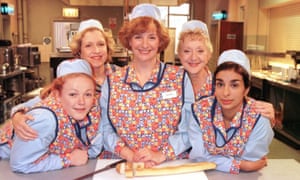
Victoria Wood with the cast of Dinnerladies in 1998: ‘genuinely gifted’.
Deservedly – because she was a genuinely gifted and endearing entertainer – Victoria Wood lived ultimately in a charming and prettily situated house in Highgate, north London, of a kind that otherwise only hedge fund managers and oligarchs can afford.
The tomb of Karl Marx lies just down the hill and beyond it stretches a ruffled plain of streets and towers, where two-bedroom flats cost half a million and schoolteachers travel in from the cheaper parts of Hertfordshire. Marx believed that almost since the invention of agriculture human history could be defined by the struggle between classes, but he had less to say about the individuals who travel between them, the “upwardly mobile”, who for reasons of luck, ambition or talent have left behind the lives their parents led on the plains and are now camped somewhere on the slope that in this case had Victoria Wood at the top.


What class Wood started out in was this week a moot question. A Guardian editorial had her down as working class: “a northern, English, working-class Lancastrian and Mancunian female treasure”. But her obituary thought she was middle class: “a middle-class, sophisticated woman whom critics compared to Noel Coward and Alan Bennett”. The second seems nearer the mark. The parental home in Bury, Lancashire, had a piano; her father, an insurance salesman, wrote plays in his spare time (and later scripts for Coronation Street); and as Wood was growing up her mother went off to Manchester University as a mature student. Then again, a family with those attributes in 1953, the year Wood was born, might have thought they were getting too far above themselves (into the realm of doctors and lawyers) with the label “middle class” and stuck with “respectable working class” instead.
I was born eight years before and eight miles away in a town, Farnworth, to which my parents had moved from Scotland in 1930. We lived on an estate of prewar council houses that had streets named after flowers. Across the road, an elderly man who in my memory looks like Neville Chamberlain sometimes took his straight-backed saloon out of the garage for a good wash and polish; there were no cars otherwise, and no televisions either until the Mort family got one and invited the rest of us in to watch, from behind curtains closed against the sun, some small monochrome figures playing tennis. My father worked as a mechanic in the spinning mill across the playing fields; my mother didn’t work outside the house. They read books, attended classes run by the Workers’ Educational Association, never swore and drank no alcohol beyond my father’s occasional pale ale.


Highgate Village: ‘The tomb of Karl Marx lies just down the hill and beyond it stretches a ruffled plain of streets and towers.’
FacebookTwitterPinterest
 Highgate Village: ‘The tomb of Karl Marx lies just down the hill and beyond it stretches a ruffled plain of streets and towers.’ Photograph: Antonio Olmos for the Observer

We were respectable working class. Not everyone was the same: some runny-nosed children at the top of the avenue ran around, sockless, in clogs. But mainly the people of those streets – Lily, Lupin, Daffodil, Iris – lived in a friendly, decent style that Wood’s parents would certainly have recognised and felt at home in, just as the children of those streets, now in their 70s, recognised and felt at home with their daughter’s comedy.
Of course, that world of factory hooters, wakes weeks and potato pies went long ago, and even if it hadn’t I would no longer belong to it. I was part of what Richard Hoggart in a Guardian interview called “the escalator life, where you move inexorably upwards”. Hoggart knew about escalators – born into an impoverished Leeds family in 1918, he rose through academia. But he always wrote as though he half regretted the ride, writing in The Uses of Literacy, his autobiographical study of working-class life, that the upward journey made him lonely – awkward in the social class he now found himself in as well as the class he had left. The real test of the education that had elevated the scholarship boy, Hoggart wrote, would lie in his ability by the age of 25 “to smile at his father with his whole face and to respect his flighty young sister and slower brother”.


Lynsey Hanley quotes those words in her new book, Respectable: the Experience of Class, which is serialised next week on Radio 4. When I read them, I wondered how genuinely I’d treated my own father after I had “got on”, and concluded that although I had reasons for regret – the largest is neglect, not seeing him enough – the kind of ashamedness that Hoggart seemed to be driving at wasn’t among them. But then my ascent was a modest gradient compared with Hoggart’s struggle up the north face of the class mountain. It happened later, after the welfare state had bedded in, and it happened after we moved back to Scotland, where class differences are, or were, less noticeable. The alarming aspect ofHanley’s book, given that her switch from working class to middle class is so recent, is how much more her experience has in common with Hoggart’s than it has with mine.

I don’t recognise this as my own experience, but then I more or less floated up my little gradient in the warm updraught provided by the postwar expansion of white-collar jobs and well-paid professions. People born in Britain between 1940 and 1960 had much less distance to travel in any case, because the blue-collar jobs of our parents also began to pay better. The escalator was shorter and there were many more of us on it. There was never an easier time to become something else.Hanley grew up on a big West Midlands council estate in the 1980s and 90s and is now a research fellow at Liverpool’s John Moores University. Her book is unsentimental, but to many people of my generation its main contention may seem ridiculous. “Changing class is like moving from one side of the world to the other, where you have to rescind your old passport, learn a new language and make gargantuan efforts if you are not to lose touch completely with the people and habits of your old life,” she writes, adding that while the psychological disruption can be extreme, it gets very little attention compared with the perceived benefits of social mobility, which is always seen “unequivocally [as] a Good Thing”.
That came to an end in the late 1970s, when a prolonged economic crisis and what Hanley describes as “a political hardening against working-class interests” meant that active personal ambition replaced the lazy drift of social change as the main agent of upward mobility. It was never easy to buy higher up the hill than Karl Marx, but it has since become a whole lot harder.