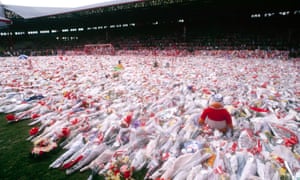
In the wake of tragedy, Liverpool families fought to redeem their dishonoured dead. It has been a defining human impulse, since the time of the Greek heroine Antigone
People have always told stories.
Stories are part of the human condition: they are as old as self-consciousness,
as the remembering of dreams, as the sense that a life is a journey to be
walked through. The ability to mould the material of life into narrative – and,
into truthful narrative, in which the psyche and the story are not separated by
self-deceit – is a fundamental need, as necessary to the soul as air or water
is to the body.
This week, in which we have seen
the culmination of the Hillsborough inquest, has been all about stories: about
the brute strength of a giant falsehood that, over the course of decades, has
patiently, slowly and finally successfully been dismantled by those who have
dared to tell the truth.
And this itself is a story, and a
very old one: that of a small voice that stands up against the power and
authority of a country and its politics and dares to say: “This is not the way
it is.” It is the story of Antigone, the play that the Athenian dramatist
Sophocles wrote in around 442BC.
The play begins after Antigone’s
brothers, Eteocles and Polynices, have battled and killed each other. Creon,
Antigone’s uncle and her king, makes a decree: only one of these brothers will
be given burial. The other, Polynices, will be left to rot. The play hinges on
Antigone’s refusal to accept the narrative begotten of authority and power –
Creon’s narrative. She refuses to accept the falsehood that one brother is good
and the other bad. She will make the story different, and the story will be
that both brothers will be accorded the same dignity. Because this is one of
the most basic things that humans do, something that helps finish the story of
every life, something that civilisation insists upon: we respect our dead. And
so she buries Polynices.
During the Hillsborough inquest
the carefully wrought, sturdy, long-lasting lies of police officers – lies that
were conveniently built on the firm foundations of negative stereotypes about
the city of Liverpool and about football fans, lies that were knowingly
reinforced by the Sun newspaper under the notorious headline “The Truth” – were
corroded, weakened and finally demolished.
The first lie was that on 15
April 1989 Liverpool fans forced their way through a large gate in the
Hillsborough ground. The truth was that a police officer had ordered the gate
to be opened to relieve pressure on the turnstiles, an act that led to the
crush in the central pens of the Leppings Lane terrace. Other lies followed:
that the supporters had been drunk; that uninjured fans had stolen from the
pockets of the dead. Calumnies were piled on calumnies. A dark, ugly and truthless
narrative was shaped. The dead were dishonoured and the truth was buried.
The novelist Ali Smith has
written this about Sophocles’s tale: “It is a story about what matters to human
beings, and how human beings make things meaningful, how we act towards one
another, and what power is, what it makes us do, and how much and how little
power human beings really have.”
Like modern Antigones, the aim of
the families of the Hillsborough dead has been – before redress, before
justice, though all of those things may yet come – to tell the truth about
their loved ones. They have wanted, like her, to give dignity to their dead;
and to have them remembered with the honour they deserve.

No hay comentarios:
Publicar un comentario