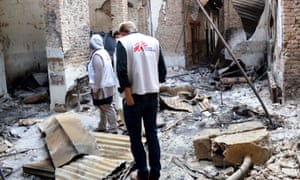
Médecins Sans Frontières’ request for independent inquiry into 3 October airstrike that killed 42 civilians remains open after military fails to yield charges
The October attack on
the hospital contributed to the erosion of protections around medical
facilities in wartime.
Médecins Sans
Frontières reiterated its request for Barack Obama to permit an independent
inquiry into a US attack on its hospital in northern Afghanistan on Friday
after a US military investigation failed to yield criminal charges.
Meinie Nicolai, the
president of the group also known as MSF or Doctors Without Borders, told the
Guardian: “We still have questions on negligence and the list of errors that
we’ve heard” outlined in a declassified report into the 3 October airstrike
that killed 42 civilians in MSF’s Kunduz hospital, one of the most infamous
episodes in the US’s longest-ever war.
On Friday, the
general in charge of US forces in the Mideast and South Asia, Joseph Votel,
said the strike was “not a war crime”, since a US AC-130 gunship crew did not
realize it was striking a hospital. Votel’s predecessor took disciplinary
action against a dozen service members, though no criminal liability will
follow.
Nicolai said MSF
still had to thoroughly review the military inquiry before characterizing it,
but noted that it was performed by the same US military that “committed the
attack”.
“No formal response
was given on our request for an independent investigation by the US
authorities,” Nicolai said. “Our request is still open, and I guess we will not
get it.”
At the Pentagon,
Votel said the strike did not rise to the level of a war crime since striking
the hospital was not an “intentional act” – something John Sifton of Human
Rights Watch called “simply wrong as a matter of law”.
Kunduz hospital
attack: US forces did not act on MSF warnings for 17 min
Read more
Interviews with
Kunduz residents and relatives of the victims indicate a belief that the US
purposefully targeted the hospital. Some rejected the commander’s apology as
insincere and urged harsh punishment for the perpetrators.
Votel, a former
special operations commander, said the investigation determined the hospital
never served as a staging ground for attacks by the Taliban, nor did any enemy
fire come from the hospital, as MSF has long said and in contradiction to
Afghan officials.
Disciplinary action
included letters of reprimand, Votel said, which can be career-ending. The
personnel responsible were not identified.
Patients at the field
hospital in Kunduz, a city that the Taliban had conquered and held, burned
alive in their beds as a US AC-130 gunship made multiple passes overhead in the
pre-dawn chaos. The report concluded that MSF provided the US with coordinates
of the hospital, which under international humanitarian law is supposed to be a
protected facility, before the 3 October strike, but a combination of human and
technical errors in Kunduz led to identification of the facility came too late.
The inquiry found
that MSF contacted a US military liaison within minutes of the strike. But when
the message was relayed to the ground commander in Kunduz, it did not
“immediately register” with him, Votel said, as the ground crew believed the
AC-130 was striking a different location used by the Taliban.
The October attack on
the hospital contributed to the erosion of protections around medical
facilities in wartime, part of a trend that preceded it. Humanitarian groups,
including MSF, have since recorded at least four assaults on hospitals in
Yemen, from both US ally Saudi Arabia and its adversary, the Houthi movement.
This week, an attack on an MSF hospital in Syria met with harsh US
condemnation.
The US military
shifted its story substantially in the days after the October hospital attack:
first eliding the targeting of the hospital, something Votel said some in the
military knew occurred within minutes; then saying the AC-130 gunship strike
hit insurgents attacking US and Afghan forces; then claiming the Afghans
requested the strike; before stating that US special operations forces called
in the strike themselves.
Although the US
expressed regret for the attack on the hospital, the Afghans have claimed that
the Taliban, which had overrun the city, used the hospital as a staging ground
for combat. MSF has ardently denied the claim, and is now vindicated by the US
report, saying no fighting took place at the hospital – a location whose
coordinates, critically, MSF had provided to the US command long before the 3
October strike.
By November,
following an initial internal inquiry, the US military command in Afghanistan
disclosed that US special operations forces had been engaged in days’ worth of
intense combat in Kunduz, in support of Afghan forces attempting to retake the
city, although Barack Obama has publicly declared the US no longer engages in
combat against the Taliban.
According to the
then-commander of US forces in Afghanistan, John Campbell, elite US forces
operating out of Kunduz called in an airstrike on a building seized by the
Taliban miles from the hospital.
But the AC-130
launched early, flew off course, dodging what the inquiry determined was a
surface-to-air missile, and experienced a series of on-board communications and
sensor system failures largely cutting it off from the ground during the
pre-dawn mission.
After a further
sensor failure, crew mistakenly became convinced the hospital was the area it
was ordered to attack – in reality, some 400 metres distant – through visually
identifying the likeliest physical location. The report found that some onboard
were unsure and repeatedly sought clarification, but neither the ground spotter
for the strike nor the ground commander at Kunduz airfield knew the AC-130 was
in the wrong location and urged the strike to take place.
Higher headquarters,
notified by MSF within 11 minutes of the first wave of firing that its hospital
was under attack, did not realize the aircrew was hitting the hospital until it
was “too late”, the report found.
Yet the inquiry found
no combatants were firing on US or Afghan forces from the hospital, raising
questions about how the gunship crew could have considered it a hostile staging
area. Votel said it was “not uncommon” for crews looking through sensors to not
see incoming fire. The report said the AC-130 crew observed the hospital and
personnel around it for 68 minutes before firing 211 rounds.
Additionally, the
report found that US and Afghan forces had fought relentlessly in Kunduz
“throughout the evening of 30 Sep until early evening 2 Oct,” suggesting that
the pre-dawn morning of 3 October, when the strike was called in and took
place, was relatively calm, a point MSF has made for seven months.
“There are
[unresolved] questions here, on the self defense called in by the troops,
although it was a quiet evening, why didn’t they call off the operation if they
had such a malfunctioning system, they had a duty to take precautions, and they
had doubts about the target,” Nicolai said.
In Kunduz, phone
lines are routinely interrupted in the evening, so it was not possible to get a
reaction after the release of the report by press time.
But earlier in the
day, presented with expected findings of the report, relatives of some victims
said they were disappointed. In particular, the telegraphed decision to suspend
and reprimand soldiers responsible for the attack, rather than criminally prosecute
them, raised ire.
Hamdullah
Pakhtuniyar, whose brother, Zabiullah, a security guard at the MSF hospital,
was killed in the strike, said he wanted Afghan law to apply to the
perpetrators, meaning capital punishment.
“According to Islam,
if someone kills an innocent person, they should be killed,” he said.
“The incident
happened in Afghanistan; we need them to be punished according to the Afghan
constitution.”
In March, the top US
commander in Afghanistan, John W Nicholson, who was not in charge at the time
of the MSF attack, travelled to Kunduz to apologise to the victims.
But Pakthuniyar, who
was present at the visit, was not impressed. “He didn’t seem sincere,” he said,
adding that the Afghan government had not done much better. “When [Afghan president
Ashraf] Ghani came to Kunduz, he didn’t even mention the hospital attack or the
victims with a single word,” he said.
The anger may stem
from a widespread belief in Kunduz that the US military targeted the hospital
on purpose. Nobody the Guardian spoke to seemed to believe that a military with
such sophisticated equipment and surveillance would mistake a hospital.
“I don’t know why
they targeted the hospital, but there were white Taliban flags on all the
buildings around it, so why didn’t they target them?” said Hamdullah Salarzai,
a worker at the hospital who was injured in the attack, and whose uncle,
Aminullah, was killed.
Like others in Kunduz
the Guardian spoke to, Samiullah Nazar, 19, whose father, Baynazar, died while
on the operating table at the hospital, had not heard of the US army report
prior to its release. Informed of it, he said he had low expectations.
For his family, who
had lost its sole breadwinner, apologies and explanations would do little to
assuage the hardship of the future, he said. The family received $6,000 in
condolence payments from the US army for the death of Baynazar. Injured victims
received $3,000.
“There’s no one left
to make money for the family,” Samiullah said. ”We want the US to give us more
financial aid.”
He was dismayed to
hear the responsible soldiers would only be reprimanded.
“The punishment needs
to be in accordance with the law. It doesn’t matter if it’s Afghan or US law,
but they need to be punished by law,” he said.

No hay comentarios:
Publicar un comentario