Mostrando entradas con la etiqueta Irán. Mostrar todas las entradas

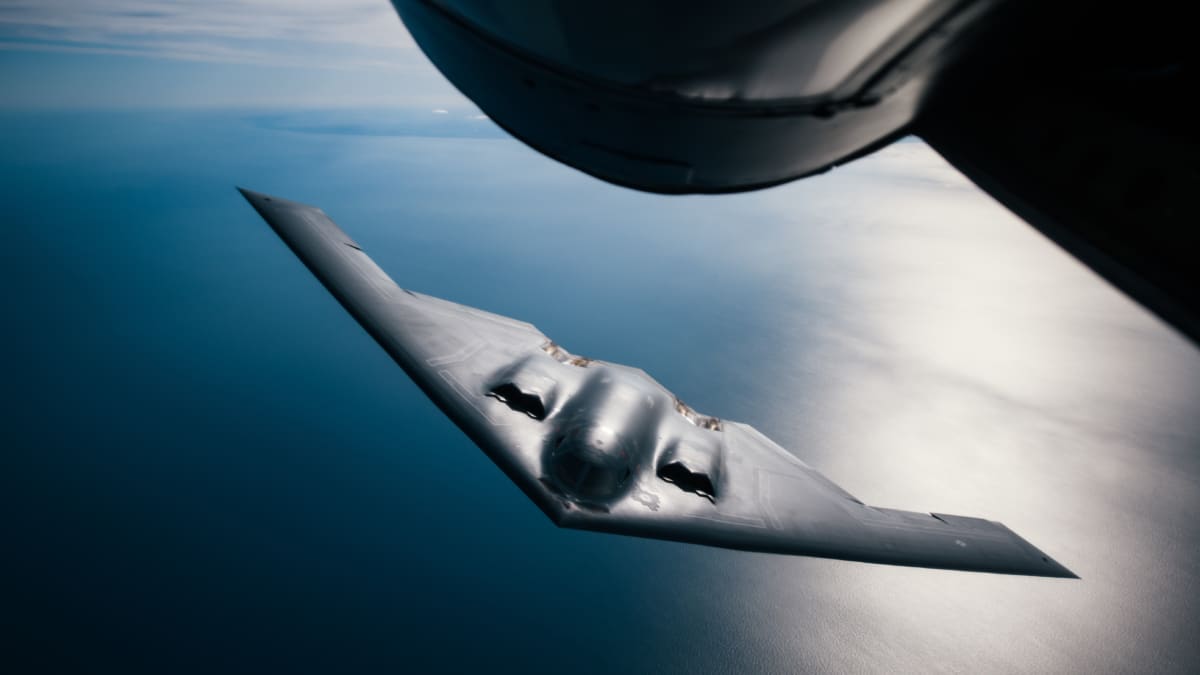
B-2 Spirit, el bombardero furtivo de 1.000 millones de dólares con el que EEUU atacará a Irán y Rusia en caso de necesidad.


Bombardero B-2
Bombardero B-2 | U.S. Air Force

Por primera vez desde el inicio de los ataques aéreos contra el grupo rebelde chií de los hutíes, el ejército estadounidense ha recurrido a una de sus armas más costosas: el bombardero furtivo B-2 Spirit. Los aviones, que pueden penetrar en espacio enemigo sin ser detectados por sistemas de radar, han bombardeado a primera hora de este jueves almacenes subterráneos de la organización que desde hace un año amenaza la navegación comercial en el mar Rojo y ha llegado a lanzar misiles en dirección a Israel.

Según un comunicado del Pentágono, “las fuerzas militares de EE.UU., incluyendo dos bombarderos B-2, llevaron a cabo ataques de precisión contra cinco almacenes subterráneos de armas en áreas controladas por los hutíes en Yemen". "Las instalaciones albergaban armas de varios tipos que los hutíes han utilizado contra barcos civiles y militares a lo largo de la región", explica el secretario de Defensa estadounidense, Lloyd Austin.

Hasta ahora no se habían comunicado el uso de los B-2 Spirit en la campaña de ataques aéreos que Washington y Londres ejecutan desde hace meses para tratar de debilitar las capacidades de los hutíes, un grupo que controla la capital de Yemen, Saná, y el norte del país fronterizo con Arabia Saudí desde hace un década.

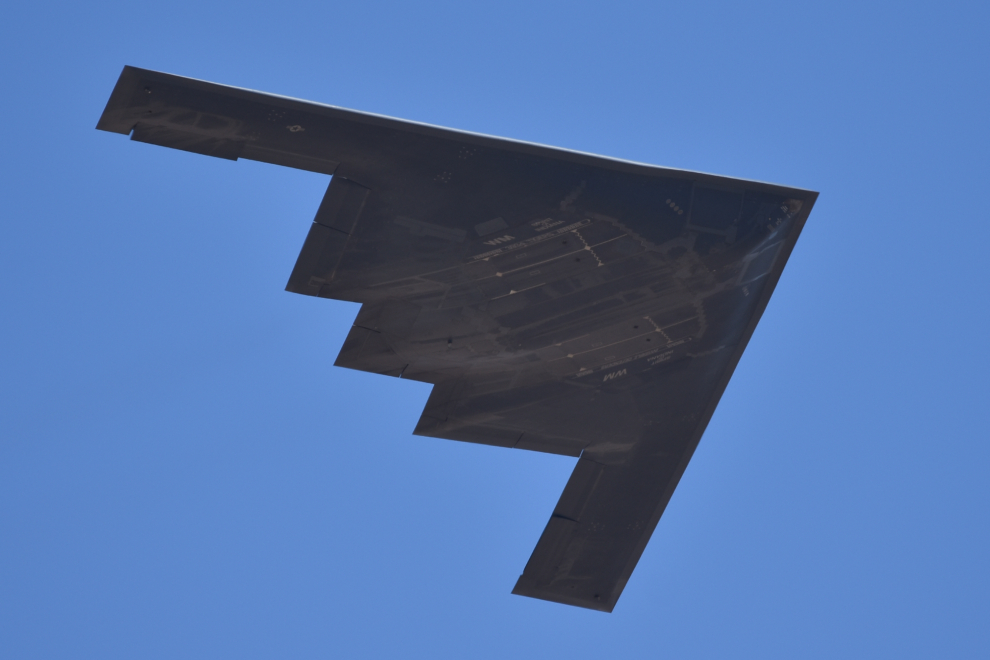
Bombardero B-2
Bombardero B-2

Capacidad nuclear

El B-2 tiene capacidad para transportar bombas de hasta 20 toneladas, incluidas 80 bombas “inteligentes” de 250 kilogramos o 16 bombas termonucleares de 1.100 kilogramos. En funcionamiento desde 1999, su construcción y empleo estuvo rodeado de polémica por su elevado coste. Es, de hecho, el avión más caro construido. Sus costes totales rozan los 1.000 millones de dólares por unidad, lo que obligó a reducir el número de aviones que finalmente adquirió el ejército estadounidense, del más de centenar previstos a los 20 actuales. Hoy es el rey absoluto de las exhibiciones militares por las que aparece.

Según medios estadounidenses, los B-2 que han bombardeado posiciones en Yemen partieron de la base aérea de Whiteman, en el estado norteamericano de Misuri. Es la primera vez desde enero de 2017 que se usa en misión de combate. Con capacidad nuclear, los B-2 -con una tripulación de dos personas- fueron diseñados en el contexto de la Guerra Fría pero se estrenaron hace 25 años en la guerra de Kosovo. Desde entonces, han participado en misiones estadounidenses en Afganistán, Irak y Libia. Su elevado coste explica su limitado uso.

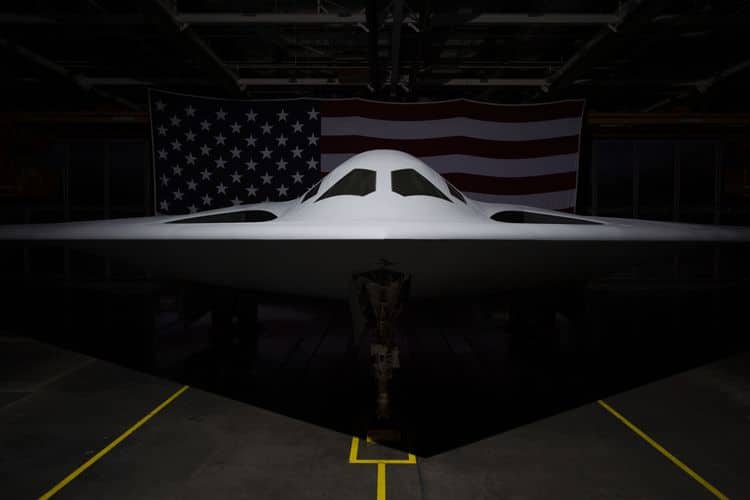
B-21 Raider
B-21 Raider

B-21 Raider, la próxima generación

“El B-2 proporciona la flexibilidad penetrante y la eficacia inherentes a los bombarderos tripulados. Su capacidad para penetrar las defensas aéreas y amenazar con represalias efectivas proporciona una fuerza de disuasión y combate fuerte y eficaz hasta bien entrado el siglo XXI”, presume su fabricante Northrop Grumman Corporation. “La revolucionaria combinación de tecnologías poco observables con una alta eficiencia aerodinámica y una gran carga útil proporciona al B-2 importantes ventajas sobre los bombarderos existentes”, añade. Basado en la experiencia atesorada por el B-2, la compañía prepara ahora el B-21 Raider, “el bombardero sigiloso de nueva generación que Northrop Grumman está desarrollando actualmente para las Fuerzas Aéreas de Estados Unidos”.

La apariencia y capacidades del B-2 han alimentado un halo de misterio en torno a este avión, que algunos militares estadounidenses han llegado a describir como “la mística de lo desconocido”. En su comunicado de este jueves, el Pentágono asegura que “el empleo de bombarderos furtivos de largo alcance B-2 Spirit de la Fuerza Aérea de EE.UU. demuestra la capacidad de ataque global de EE.UU. para actuar contra estos objetivos cuando sea necesario, en cualquier momento y en cualquier lugar”. “Fue una demostración única de la capacidad de Estados Unidos para atacar instalaciones que nuestros adversarios tratan de mantener fuera de su alcance, sin importar cuán profundamente enterradas bajo tierra, endurecidas o fortificadas estén”, agregó.

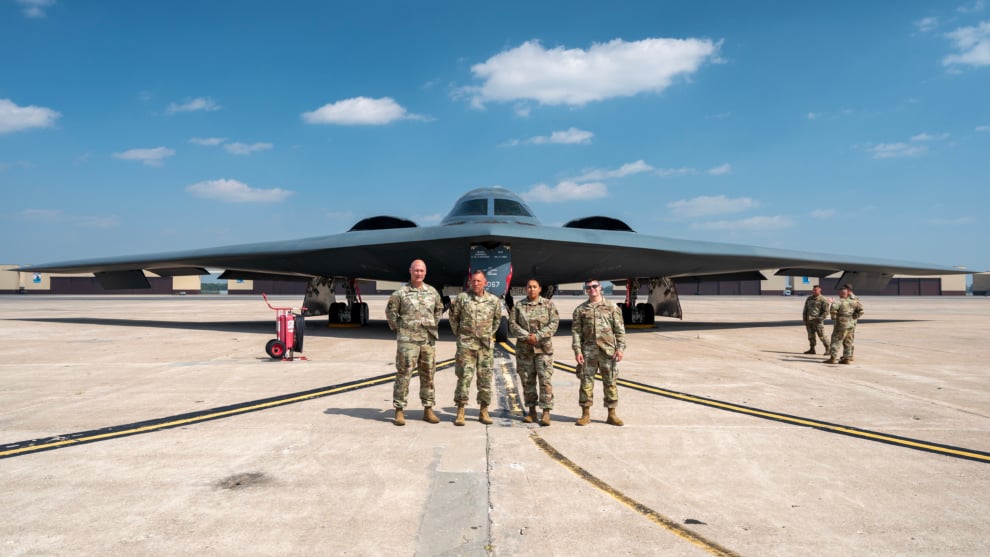
Soldados estadounidenses posan junto al B-2 Spirit
Soldados estadounidenses posan junto al B-2 Spirit | U.S. Air National Guard

Según fuentes hutíes citadas por la televisión afín Al Masirah, los ataques de los bombarderos se han limitado a los alrededores de Saná y la localidad de Saada, uno de los bastiones del grupo.

La entrada en escena de estos bombarderos se produce un día después de que la ONU adviertiera de los riesgos cada vez mayores de que Yemen se sume con más fuerza a la escalada regional, en pleno compás de espera para la respuesta israelí al ataque de Irán y ante el temor de un conflicto abierto entre ambos países países. Así, el enviado especial de la ONU para Yemen, Hans Grundberg, alertó de que el país corría el riesgo de verse arrastrado aún más a la escalada militar en Oriente Próximo. “Los yemeníes anhelan la paz pero las esperanzas de que se ponga fin a la escalada de violencia en la región parecen lejanas”, deslizó  Grundberg ante el Consejo de Seguridad de la ONU. “Como muchos en Oriente Medio, sus esperanzas de un futuro mejor están cayendo bajo la sombra de una conflagración regional potencialmente catastrófica”, concluyó.

Irán dice que podría haber destrido Irán el sábado. El uranio de Irán no es enriquecido por lo que antes hubiesen muerto ellos.

Irán afirma que podría haber destruido Israel en su ataque del sábado pero que optó por una acción "limitada"


Irán afirma que podría haber destruido Israel en su operación del sábado pero que optó por un ataque “limitado”
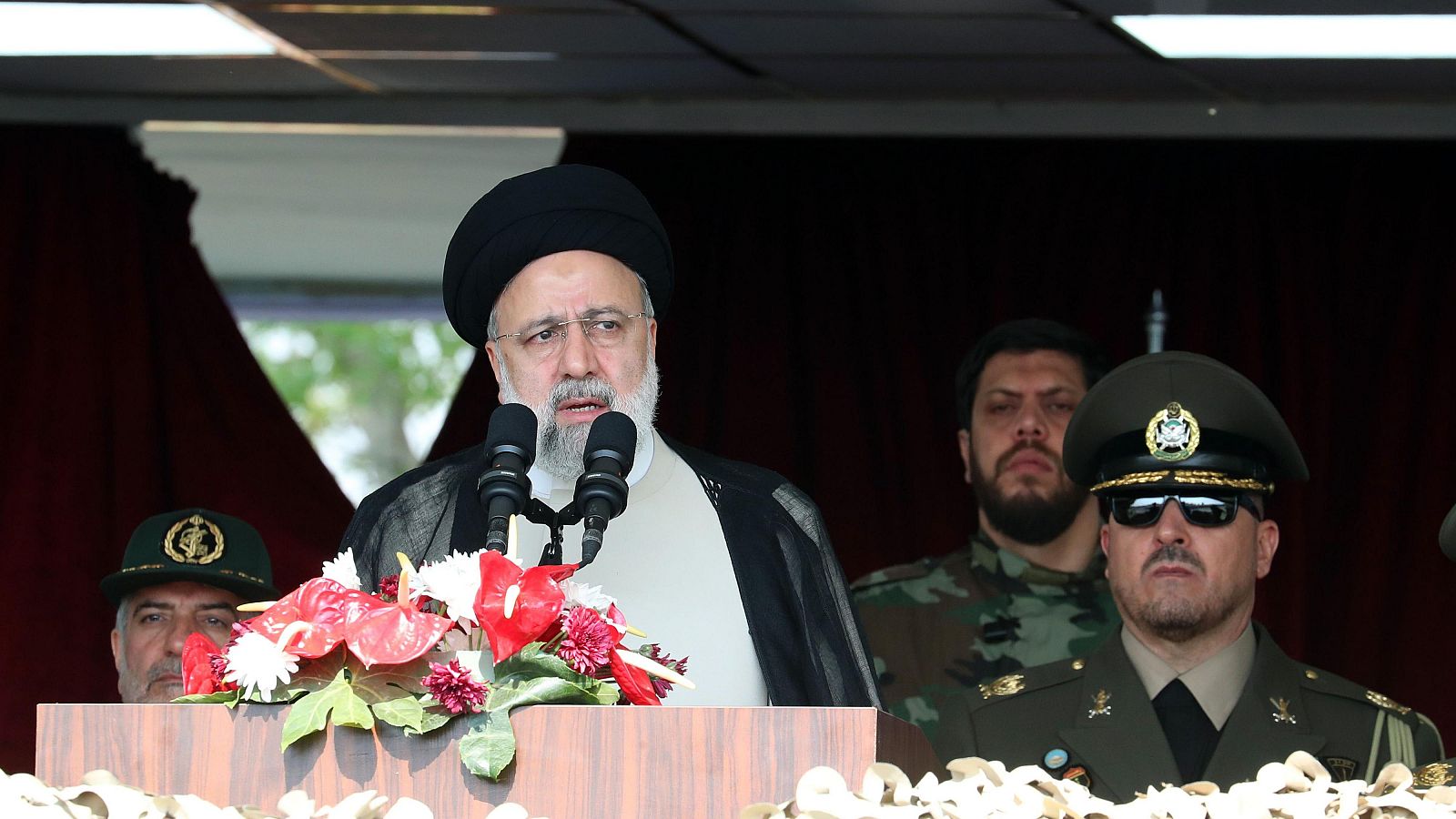
El presidente de Irán durante una exhibición de su Ejército este miércoles 

El presidente de Irán, Ebrahim Raisí, ha asegurado este miércoles que su país podría haber destruido Israel en el ataque perpetrado el sábado con cientos de misiles y drones, pero que optó por un ataque "limitado".

"La (operación) ’Promesa Verdadera' fue una acción limitada y no integral. Si hubiese sido una acción a gran escala, no quedaría nada del régimen sionista", ha afirmado Raisí durante un discurso con motivo del Día Nacional del Ejército.

Frente a Raisí han desfilado efectivos de las Fuerzas Armadas iraníes, además de drones, vehículos blindados y misiles en Teherán, en una exhibición del poderío militar del país que se ha repetido en otras ciudades de su territorio.

Los líderes iraníes han elevado el tono de sus advertencias contra Israel y países occidentales ante una posible respuesta de Tel Aviv al ataque del sábado, que según Teherán estuvo dirigido a objetivos militares. Al mismo tiempo, Estados Unidos y la Unión Europea sopesan nuevas sanciones contra Irán por el ataque sin precedentes contra el Estado judío. 

La UE prepara nuevas sanciones contra Irán tras el ataque a Israel y pide no olvidar a Gaza

"La mínima agresión recibirá una respuesta feroz"

"Si el régimen sionista comete la más mínima agresión en nuestra tierra, recibirá una respuesta feroz y severa", ha advertido de nuevo el mandatario, que en los últimos días ha repetido amenazas contra Israel. Esta vez ha asegurado que la "mínima acción" que vaya contra los intereses iraníes recibirá una "respuesta dura, amplia y dolorosa" contra el perpetrador.

Las autoridades iraníes han insistido en que el ataque en territorio israelí fue "necesario, proporcional y dirigido a objetivos militares" para crear "capacidad de disuasión", como respuesta al bombardeo del consulado iraní en Damasco del 1 de abril, en el que murieron varios miembros de la Guardia Revolucionaria.

Las Fuerzas Aéreas iraníes se han unido este miércoles a las advertencias y han avisado de que tienen los cazas de combate rusos Sukhoi Su-24 listos para "golpear objetivos" si el "enemigo" comete errores estratégicos.

La Armada iraní, por su parte, ha informado de que está escoltando a los navíos comerciales de su país desde el golfo de Aden, frente a las costas de Yemen, hasta el Canal de Suez, a lo largo de todo el mar Rojo.

Israel hará "todo lo necesario" para defenderse

El sábado Irán cumplió su amenaza y lanzó un ataque sin precedentes contra Israel con cientos de drones y misiles balísticos como respuesta al ataque atribuido a Israel en su Embajada en Damasco, Siria. Desde entonces, gran parte de la Comunidad Internacional ha llamado a ambas partes a la "contención" y han insistido en que una escalada no beneficiaría a nadie.

Mientras tanto, el Gobierno israelí sigue calibrando su respuesta. El jefe del Estado Mayor del Ejército de Israel, Herzi Halevi, aseguró el lunes que sí responderían al ataque del sábado, aunque no ofreció más detalles. El primer ministro, Benjamín Netanyahu, ha agradecido a sus socios sus propuestas, aunque ha avisado de que nadie le va imponer qué decisión debe tomar con respecto a Irán.

"Agradezco a nuestros amigos por su apoyo en la defensa de Israel y todos sus consejos. Pero quiero ser claro: tomaremos nuestras decisiones nosotros mismos. El Estado de Israel hará todo lo necesario para defenderse", ha asegurado el mandatario.

Netanyahu se reunió el lunes y el martes con su gabinete de guerra para coordinar una respuesta, aunque su Ejecutivo permanece dividido. Algunos ministros, los más radicales, piden un ataque duro y el primer ministro depende de ellos para mantenerse en el poder. Sin embargo, sabe que una represalia fuerte podría desembocar en una guerra abierta con Irán.


Así funciona el sistema de defensa de la Cúpula de Hierro israelí. Eficacia, TOTAL.

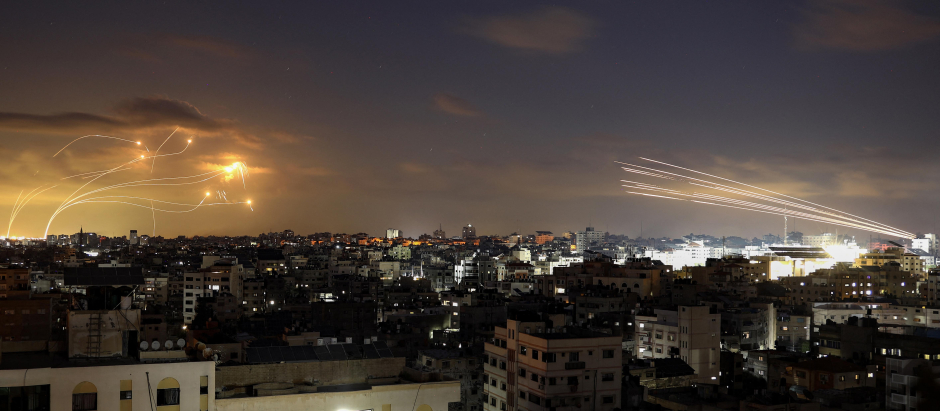
Una imagen muestra cohetes disparados desde la ciudad de Gaza (R) siendo interceptados por el sistema de misiles de defensa Cúpula de Hierro de Israel

Una imagen muestra cohetes disparados desde la ciudad de Gaza (R) siendo interceptados por el sistema de misiles de defensa Cúpula de Hierro de IsraelAFP

¿Cómo funciona el costoso y eficiente sistema de defensa antiaérea de Israel?

Los sistemas de defensa desplegados interceptaron el 99 % de los drones y misiles iraníes con un costo estimado de 1.000 millones de euros

El masivo ataque de Irán contra Israel del sábado comprendió 170 drones, 30 misiles de crucero y 120 misiles balísticos, el 99% de los cuales fueron interceptados por las defensas aéreas según informaron las Fuerzas de Defensa de Israel.

Todos los drones y misiles de crucero fueron derribados fuera del espacio aéreo del país por la Fuerza Aérea de Israel y sus aliados, incluidos Estados Unidos, Reino Unido, Jordania, Francia y otros, según el principal portavoz de las FDI, el contralmirante Daniel Hagari.
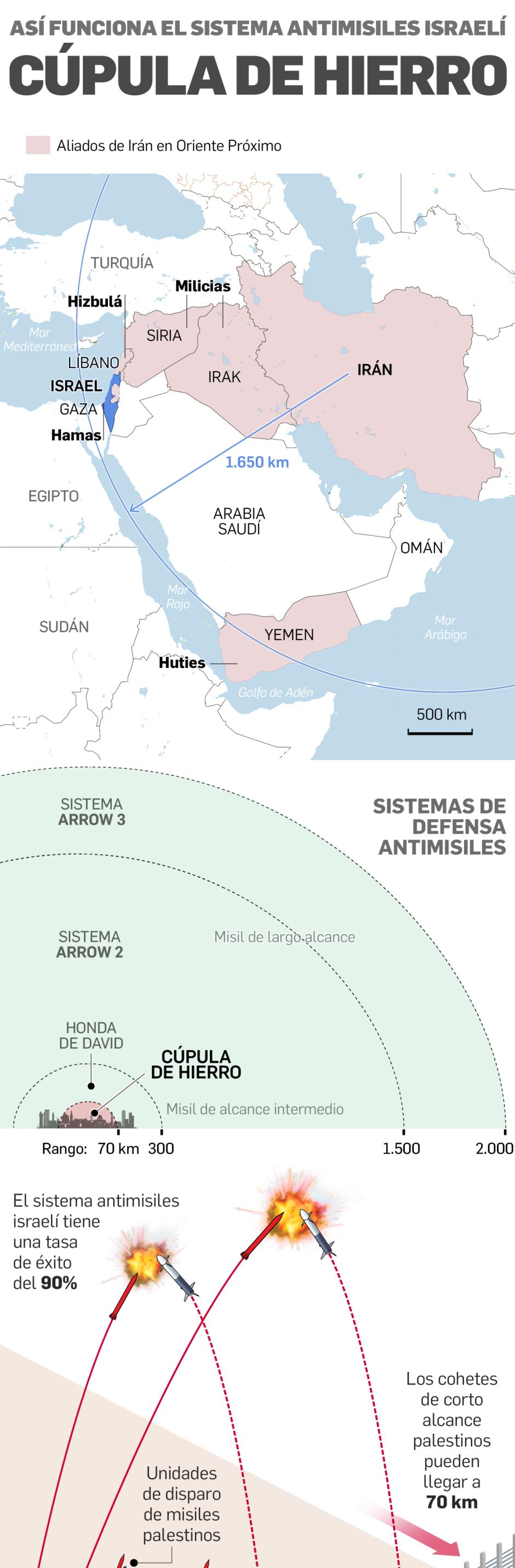
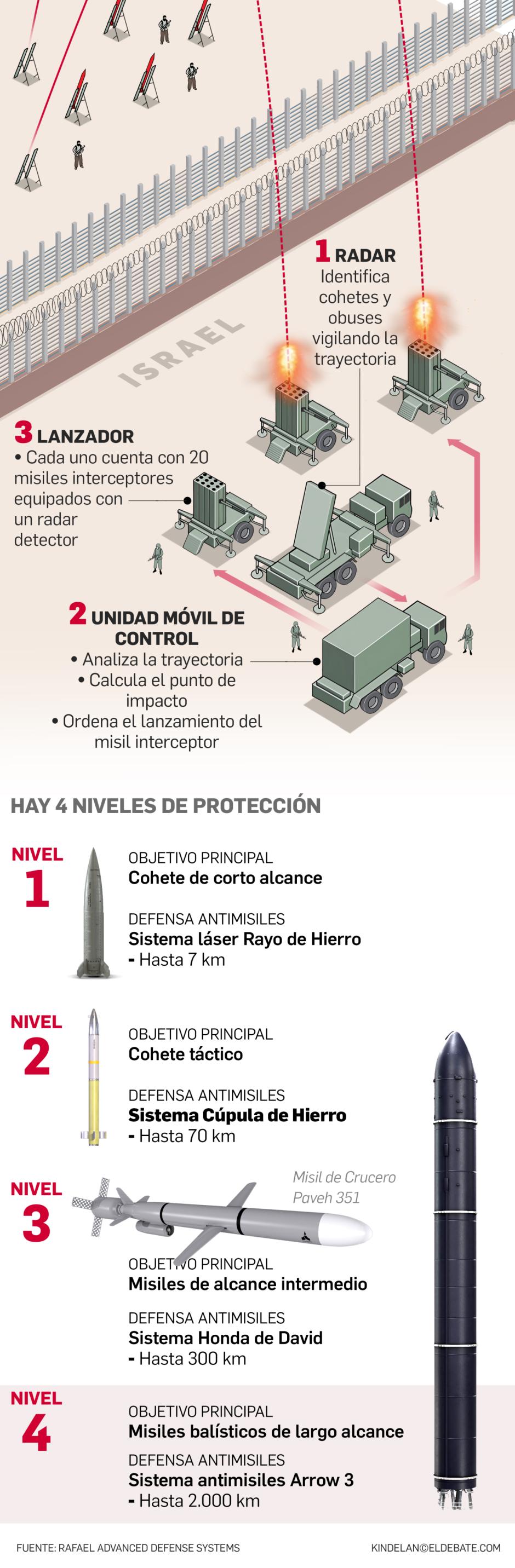
De hecho, el famoso sistema de defensa israelí conocido como la «Cúpula de Hierro» no fue el principal protagonista de la noche del sábado, pero sí uno de ellos entre varias «capas» de sistema de defensa desplegados de acuerdo a las amenazas. Lo que si comparten todos los sistemas desplegados es la lógica de detección e interceptación.
Infografía del funcionamiento de la Cúpula de Hierro de Israel

Infografía del funcionamiento de la Cúpula de Hierro de IsraelKindelán

Los drones tuvieron un tiempo de vuelo de varias horas para llegar a Israel, y los misiles de crucero de manera similar habrían tardado alrededor de más de una hora en alcanzar su objetivo, según evaluaciones de funcionarios de defensa.

A diferencia de los drones y los misiles de crucero, los misiles balísticos fueron derribados sobre Israel, lo que llevó a las FDI a activar sirenas de advertencia por temor a que cayera metralla. La única herida en Israel debido al ataque iraní fue una niña beduina que fue alcanzada y gravemente herida por la caída de metralla en el desierto de Negev.

El millonario coste de la defensa israelí

El costo de la interceptación por parte de Israel del bombardeo de misiles y drones de Irán la noche del sábado se estimó como mínimo en 1.000 millones de euros.
El general Reem Aminoach, ex asesor financiero del jefe del Estado Mayor de las FDI, realizó una estimación para el portal Ynet indicando que «la defensa de esta noche fue del orden de 4.000 a 5.000 millones de shéquels» equivalente a unos 1.000 a 1.258 millones de euros.
Por su lado, la estimación realizada para el Wall Street Journal por Yehoshua Kalisky, investigador principal del Instituto de Estudios de Seguridad Nacional, un grupo de expertos en Tel Aviv, asciende a 516 millones de euros para Israel y otro tanto igual distribuido entre los aliados.

La estimación de Kalisky tiene en cuenta los gastos asociados con la interceptación de la mitad de los misiles y drones iraníes, incluido el uso del sistema de defensa David's Sling air y también tiene en cuenta el coste de mantener 100 aviones de combate israelíes en el aire durante seis horas, incluido el combustible y las armas.
«Estos son costos enormes», dijo al WSJ Kalisky, quien agregó que eran comparables a los costos de las grandes guerras libradas por Israel, como la guerra árabe-israelí de 1973. Sin embargo, de acuerdo con el analista, es poco probable que el precio del sábado tenga un impacto negativo inmediato o de largo plazo en la economía de Israel.


Ione Belarra: "Israel es un Estado okupa y genocida" o ruptura de relaciones comerciales con EEUU y Reino Unido.

 El novio enchufado de Ione Belarra - Edatv News

Belarra recrudece su ataque a Israel en pleno conflicto diplomático: "Es un Estado okupa y genocida"

Obvia a Hamás y reclama el embargo de armas al país hebreo para "acabar con el exterminio de palestinos".


Lejos de rebajar tensiones con Israel en pleno conflicto diplomático con España, el Gobierno en funciones opta por ir a una escalada verbal y califica a Israel de "Estado ocupante" y le acusa de promover un "genocidio" por "exterminar palestinos". Así se ha manifestado la ministra en funciones, Ione Belarra, en una entrevista en Catalunya Radio, justo después de ser entrevistada la portavoz de la embajada Israel.

"En este momento no cabe la equidistancia, el Estado de Israel es un Estado ocupante", ha dicho Belarra después de declarar que "se le había revuelto el estómago" tras escuchar las palabras de la representante del país hebreo, que se pronunciaba en la emisora justo en los minutos previos. "Tenemos que alzar la voz para que termine, de una vez por todas, este genocidio".

Belarra ha insistido en reclamar a Pedro Sánchez que lleve a Netanyahu a la Corte Penal Internacional por "crímenes de guerra". "Lo que estamos viendo en Palestina no lo toleramos y un demócrata no puede mirar para otro lado", ha dicho, recalcando que "ella habla en nombre del gobierno y de su partido".

- Seguir leyendo: https://www.libertaddigital.com/espana/politica/2023-10-17/belarra-recrudece-su-ataque-a-israel-en-pleno-conflicto-diplomatico-es-un-estado-okupa-y-genocida-7059723/

- Seguir leyendo: https://www.libertaddigital.com/espana/politica/2023-10-17/belarra-recrudece-su-ataque-a-israel-en-pleno-conflicto-diplomatico-es-un-estado-okupa-y-genocida-7059723/

Israel tells 1.1MILLION people in Northern Gaza to evacuate south within 24 hours as it prepares to launch ground assault

 A column of heavy armoured personnel carriers (APCs) at an area along the border with Gaza, southern Israel, as Israel gathers its forces around the enclave

Israel tells 1.1MILLION people in Northern Gaza to evacuate south within 24 hours as it prepares to launch ground assault and continues bombardments - which Hamas claims have killed 13 hostages since yesterday

  • Israel's military today said order was 'for [civilians] own safety and protection'
  • On Thursday, Israeli officials it said that while it was preparing, a decision has not yet been made on a large-scale retaliation to the attacks

Israel has ordered more than one million people to evacuate northern Gaza within 24 hours ahead of a feared Israeli ground offensive aimed at eradicating Hamas.

The order this morning sent panic through civilians and aid workers already struggling under Israeli airstrikes and a blockade, while the United Nations called such an evacuation 'impossible' that would turn an tragedy into calamity.

It comes as Hamas claimed at least 13 Israeli and foreign hostages held in northern Gaza have been killed in Israeli air strikes in the past 24 hours.

'Thirteen prisoners... including foreigners' were killed in five locations targeted by Israeli fighter jets, Hamas's armed wing said Friday.

Israel's military sent one evacuation order directly on Friday morning, telling the 1.1 million people living north of an area called Wadi Gaza to move south. This would mean the entire population of Gaza City and its surroundings fleeing their homes.

The UN says it is impossible to move that many people without devastating humanitarian consequences, and has urged Israel to rescind the order.

The 2.3 million people living in the Hamas-ruled Gaza Strip are densely packed into a sliver of land that is just 25 miles long and 7 miles wide which is already largely without power and where hospitals are overwhelmed.

Israel has killed more than 1,530 people in Gaza with airstrikes and cut off food, water and electricity since Hamas terrorists killed more than 1,300 in Israel.

Israel's directive, which comes seven days after Hamas attacked Israel from Gaza, charged that Hamas terrorists were hiding in tunnels under the city.

Meanwhile, a Hamas official called the evacuation order 'fake propaganda', urged Palestinians to stay in their homes and not to 'fall for it'.

The Hamas Authority for Refugee Affairs called on residents in the north of the territory to 'remain steadfast in your homes and to stand firm in the face of this disgusting psychological war waged by the occupation'.

Israel has ordered more than one million people to evacuate northern Gaza within 24 hours ahead of a feared Israeli ground offensive aimed at eradicating Hamas

Israel has ordered more than one million people to evacuate northern Gaza within 24 hours ahead of a feared Israeli ground offensive aimed at eradicating Hamas

The order sent panic through civilians and aid workers already struggling under Israeli airstrikes and a blockade, while the United Nations called such an evacuation 'impossible' that would turn an tragedy into calamity. Pictured: Children are seen in a Gaza City hospital

The order sent panic through civilians and aid workers already struggling under Israeli airstrikes and a blockade, while the United Nations called such an evacuation 'impossible' that would turn an tragedy into calamity. Pictured: Children are seen in a Gaza City hospital

A Palestinian man runs amid the rubble of a building hit in an Israeli air strike on October 13

A Palestinian man runs amid the rubble of a building hit in an Israeli air strike on October 13

Smoke billows following Israeli strikes amid the ongoing conflict between Israel and the Palestinian Islamist group Hamas, in Gaza, October 13, 2023

Smoke billows following Israeli strikes amid the ongoing conflict between Israel and the Palestinian Islamist group Hamas, in Gaza, October 13, 2023

Israeli army soldiers ride in the turret of a Merkava battle tank deploying along the border with the Gaza Strip in southern Israel on October 13

A column of heavy armoured personnel carriers (APCs) at an area along the border with Gaza, southern Israel, as Israel gathers its forces around the enclave

A column of heavy armoured personnel carriers (APCs) at an area along the border with Gaza, southern Israel, as Israel gathers its forces around the enclave

Israel's military sent one evacuation order directly on Friday morning, telling the 1.1 million people living north of an area called Wadi Gaza to move south. This would mean the entire population of Gaza City and its surroundings fleeing their homes

Israel's military sent one evacuation order directly on Friday morning, telling the 1.1 million people living north of an area called Wadi Gaza to move south. This would mean the entire population of Gaza City and its surroundings fleeing their homes

The flurry of directives was taken as signalling an already expected Israeli ground offensive, though the Israeli military has not yet confirmed such a decision.

On Thursday it said that while it was preparing, no official decision has been made. 

Any ground offensive would be the strongest response yet to Hamas' shock assault, and would likely bring even higher casualties on both sides in brutal guerrilla warfare as Israeli soldiers go house-to-house and hunt down Hamas terrorists.

'This evacuation is for your own safety,' the Israeli military said, in a warning it said was sent to all Gaza City civilians.

The UN said it received a separate directive from the Israeli military shortly before midnight, giving all 1.1 million civilians of northern Gaza 24 hours to flee south.

It said the broad evacuation warning it received for all of Gaza's north also applies to all UN staff and to the hundreds of thousands who have taken shelter in UN schools and other facilities since Israel launched round-the-clock airstrikes.

'The UN considers it impossible for such a movement to take place without devastating humanitarian consequences,' spokesman Stephane Dujarric said.

'The United Nations strongly appeals for any such order, if confirmed, to be rescinded avoiding what could transform what is already a tragedy into a calamitous situation,' Dujarric said.

Another UN official said that the United Nations is trying to get clarity from Israeli officials at the senior most political level.

'It's completely unprecedented,' the official said, speaking on condition of anonymity because he was not authorised to speak publicly.

Lieutenant Colonel Jonathan Conricus, spokesman of the Israel Defence Forces (lDF) said in a video update Friday that the evacuations were a 'humanitarian step.'

'The IDF calls for the evacuation of all civilians from Gaza City from their homes southwards for their own safety and protection and to move to the area south of the River Gaza.'

'The Hamas terrorist organisation waged a war against the state of Israel and Gaza City is an area where military operations are taking place,' he continued.

Lieutenant Colonel Jonathan Conricus, spokesman of the Israel Defense Forces (lDF) said in a video update Friday that the evacuations were a 'humanitarian step'

Lieutenant Colonel Jonathan Conricus, spokesman of the Israel Defense Forces (lDF) said in a video update Friday that the evacuations were a 'humanitarian step'

Smoke plumes billow during Israeli air strikes in Gaza City on October 12

Smoke plumes billow during Israeli air strikes in Gaza City on October 12

A fireball erupts from an Israeli airstrike in Gaza City on October 12

A fireball erupts from an Israeli airstrike in Gaza City on October 12

An Israeli army M109 155mm self-propelled howitzer fires rounds near the border with Gaza in southern Israel on October 12

An Israeli army M109 155mm self-propelled howitzer fires rounds near the border with Gaza in southern Israel on October 12

Palestinians stretcher an injured man following an Israeli strike in the southern Gaza Strip Thursday

Palestinians stretcher an injured man following an Israeli strike in the southern Gaza Strip Thursday

Israeli tanks move near Gaza border as Israeli army deploys military vehicles around the Gaza Strip, Israel on October 12

Israeli tanks move near Gaza border as Israeli army deploys military vehicles around the Gaza Strip, Israel on October 12

Israeli tanks head towards the Gaza Strip border in southern Israel on Thursday

Israeli tanks head towards the Gaza Strip border in southern Israel on Thursday

Mourners attend the funeral of Israeli soldier Shilo Rauchberger at the Mount Herzl cemetery in Jerusalem

Mourners attend the funeral of Israeli soldier Shilo Rauchberger at the Mount Herzl cemetery in Jerusalem 

'This evacuation is for your own safety. You will be able to return Gaza City only when another announcement permitting it is made.'

Conricus claimed the IDF has distributed a map showing Gaza City residents where to migrate and warned they should not go near any security fences.

'Do not approach the border, only go south,' he added, saying that they needed to distance themselves from Hamas members 'who are using you as human shields.'

'The IDF will continue to operate with significant force in Gaza City and will make significant efforts to avoid harming civilians.' 

He said that civilians are 'not our enemy' and will not target them. 

As Israel pounds Gaza from the air, Hamas militants have fired thousands of rockets into Israel, with attacks also coming from Hezbollah, in Lebanon to the north.

Amid concerns that the fighting could spread in the region, Syrian state media reported Israeli airstrikes on Thursday put two Syrian airports out of service.

Israeli Prime Minister Benjamin Netanyahu vowed to 'crush' Hamas after the militants stormed into the country's south on Saturday and massacred hundreds of people, including killings of children in their homes and young people at a music festival.

Amid grief and demands for vengeance among the Israeli public, the government is under intense pressure to topple Hamas rather than continuing to try to bottle it up in Gaza. However, the civilian toll is mounting.

Inas Hamdan, an officer at the UN Palestinian refugee agency in Gaza City, said the order had sparked more chaos in the Gaza Strip. 

'No one understands what to do,' she told a reporter with the Associated Press as she grabbed whatever she could throw into her bags as the panicked shouts of her relatives could be heard around her.

She said all the UN staff in Gaza City and northern Gaza had been told to evacuate south to Rafah, a city that sits on the southern border with Egypt.

Nebal Farsakh, a spokesperson for the Palestinian Red Crescent in Gaza City, said there was no way more than one million people could be safely moved that fast.

'Forget about food, forget about electricity, forget about fuel. The only concern now is just if you're make it, if you're going to live,' Farsakh said, breaking into sobs.

'What will happen to our patients?' she asked. 'We have wounded, we have elderly, we have children who are in hospitals.'

Farsakh said many of the medics were refusing to evacuate hospitals and abandon patients. Instead, she said, they called their colleagues to say goodbye.

A view of an explosion following a strike by IDF fighter jets on Hamas targets at a location given as the Gaza Strip

A view of an explosion following a strike by IDF fighter jets on Hamas targets at a location given as the Gaza Strip

Fire and smoke rise above buildings in Gaza City during an Israeli air strike early Friday

Fire and smoke rise above buildings in Gaza City during an Israeli air strike early Friday

Destroyed and damaged buildings of the Islamic University are seen in the aftermath of Israeli strikes amid the ongoing conflict between Israel and the Palestinian Islamist group Hamas

Destroyed and damaged buildings of the Islamic University are seen in the aftermath of Israeli strikes amid the ongoing conflict between Israel and the Palestinian Islamist group Hamas

The body of a Palestinian killed during Israeli air strikes is carried in a sheet on Thursday

The body of a Palestinian killed during Israeli air strikes is carried in a sheet on Thursday

Palestinians carrying their belongings flee to safer areas in Gaza City after Israeli air strikes, on October 13

Palestinians carrying their belongings flee to safer areas in Gaza City after Israeli air strikes, on October 13

A boy carries a mattres as Palestinians with their belongings flee to safer areas in Gaza City after Israeli air strikes, on October 13

A boy carries a mattres as Palestinians with their belongings flee to safer areas in Gaza City after Israeli air strikes, on October 13

Palestinians flash the V for victory sign as they flee to safer areas in Gaza City after Israeli air strikes, on October 13

Palestinians flash the V for victory sign as they flee to safer areas in Gaza City after Israeli air strikes, on October 13

Earlier, the Israeli military pulverised the Gaza Strip with airstrikes, prepared for a possible ground invasion and said its complete siege of the territory - which has left Palestinians desperate for food, fuel and medicine - would remain in place until Hamas militants free some 150 hostages taken during a grisly weekend incursion. 

As the full scale of the horrors of the weekend were coming into focus, Israel's military was ramping up preparations for a ground invasion, and Hamas was continuing to launch rockets into Israel.

'Now is the time for war,' said Israel's military chief, Lieutenant General Herzi Halevi, as his country amassed tanks near the Gaza Strip.

Seeking to build support for its response, Israel's government showed U.S. Secretary of State Antony Blinken and NATO defense ministers graphic images of children and civilians they said Hamas had killed in a weekend rampage in Israel.

Blinken said they showed a baby 'riddled with bullets,' soldiers beheaded and young people burned in their cars.

'It's simply depravity in the worst imaginable way,' he said. 'It's really beyond anything that we can comprehend.'

Israel has vowed to retaliate for the attack - the deadliest by Palestinian militants in Israeli history.

Like others across the globe, Blinken urged Israel to show restraint, but he also reiterated America's support, saying: 'We will always be there by your side.' 

On Friday he was due to meet King Abdullah and Mahmoud Abbas, head of the Palestinian Authority in the Israeli-occupied West Bank, in Jordan as part of a Middle East tour aimed at stopping spillover from the war. 

America's top diplomat, Blinken planned to visit key U.S. allies Qatar, Saudi Arabia, Egypt and the United Arab Emirates - some with influence on Hamas, an Islamist group backed by Iran.

Halevi said lessons would be drawn from the security failures around Gaza that enabled the attack.

'We will learn, investigate, but now is the time for war,' he said.

The U.S. military is placing no conditions on its security assistance to Israel, U.S. Defense Secretary Lloyd Austin said, adding Washington expected Israel's military to 'do the right things' in prosecuting its war against Hamas.

Austin was due in Israel on Friday and planned to meet Israeli Prime Minister Benjamin Netanyahu.

An armed Palestinian militant leading a man during the Supernova music festival

An armed Palestinian militant leading a man during the Supernova music festival 

An armed Palestinian militant is seen walking around the Supernova music festival near Kibbutz Reim in the Negev desert in southern Israel

An armed Palestinian militant is seen walking around the Supernova music festival near Kibbutz Reim in the Negev desert in southern Israel

Sitting on the back of a terrorist's motorcycle, her outstretched arms pointing towards her helpless boyfriend, student Noa Argamani pleads for her life

Sitting on the back of a terrorist's motorcycle, her outstretched arms pointing towards her helpless boyfriend, student Noa Argamani pleads for her life

Aftermath: Burnt-out and abandoned cars where revellers tried to escape the onslaught

Aftermath: Burnt-out and abandoned cars where revellers tried to escape the onslaught 

At least 260 were killed in the massacre while many are still missing ¿ either dead or taken hostage by the bloodthirsty militants

At least 260 were killed in the massacre while many are still missing – either dead or taken hostage by the bloodthirsty militants

Hamas called on Palestinians to rise up on Friday in protest at Israel's bombardment of the enclave, urging Palestinians to march to East Jerusalem's Al-Aqsa Mosque and clash with Israeli troops in the occupied West Bank.

Israel has responded so far by putting Gaza, home to 2.3 million people, under siege and launching a bombing campaign that destroyed whole neighborhoods.

'Not a single electricity switch will be flipped on, not a single faucet will be turned on and not a single fuel truck will enter until the Israeli hostages are returned home,' Israeli Energy Minister Israel Katz said on social media.

Lt. Col. Richard Hecht, an Israeli military spokesman, told reporters Thursday that forces 'are preparing for a ground maneuver' should political leaders order one.

A ground offensive in Gaza, which is ruled by Hamas and where the population is densely packed into a sliver of land only 25 miles long, would likely bring even higher casualties on both sides in brutal house-to-house fighting.

As Israel pounds Gaza from the air, Hamas militants have fired thousands of rockets into Israel. 

Amid concerns that the fighting could spread in the region, Syrian state media reported that Israeli airstrikes on Thursday put two Syrian international airports out of service.

The relentless barrage on Gaza - which the military said has so far involved 6,000 munitions - left Palestinians running through streets, carrying their belongings and looking for safety

A strike Thursday afternoon in the Jabaliya refugee camp took down a residential building on families sheltering inside, killing at least 45 people, Gaza's Interior Ministry said. 

At least 23 of the dead were under the age of 18, including a month-old child, according to a list of the casualties.

The home belonging to the al-Shihab family was packed with relatives who had fled bombing in other areas. Neighbors said a second house was hit at the same time, but the toll was not immediately known. 

The Israeli military did not immediately respond to a request for comment.

'We can´t flee because anywhere you go, you are bombed,' one neighbor, Khalil Abu Yahia, said. 'You need a miracle to survive here.'

The number of people forced from their homes by the airstrikes soared 25% in a day, reaching 423,000 out of a population of 2.3 million, the U.N. said Thursday. Most crowded into U.N.-run schools.

Families were cutting down to one meal a day, said Rami Swailem, a 34-year-old lecturer at al-Azhar University, who had 32 relatives sheltering in his home. Water stopped coming to the building two days ago, and they have rationed what´s left in a tank on the roof.

Alaa Younis Abuel-Omrain has been staying in a U.N. school after a strike on her home killed eight members of her family - her mother, aunt, a sister, a brother and his wife and their three children. Most bakeries stopped producing bread for lack of electricity.

A shell goes off in the water off the beach of Gaza during an Israeli air strike

A shell goes off in the water off the beach of Gaza during an Israeli air strike

Palestinians evacuate wounded after an Israeli airstrike in Rafah refugee camp on the southern Gaza Strip

Palestinians evacuate wounded after an Israeli airstrike in Rafah refugee camp on the southern Gaza Strip

Israel has vowed to "crush" Hamas after gunmen from the Palestinian Islamist group stormed across the border and killed 1,300 people

Israel has vowed to 'crush' Hamas after gunmen from the Palestinian Islamist group stormed across the border and killed 1,300 people

'Even if there is food in some areas, we can´t get to it because of strikes,' she said.

On Wednesday, Gaza´s only power station ran out of fuel and shut down, leaving only lights powered by scattered private generators.

Hospitals, overwhelmed by a constant stream of wounded and running out of supplies, have only a few days worth of fuel before their power cuts off, aid officials say.

'Without electricity, hospitals risk turning into morgues,' said Fabrizio Carboni, regional director of the International Committee of the Red Cross. Newborn incubators, kidney dialysis machines, X-ray equipment and more, are all dependent on power, he said.

Ambulance crews carrying bodies to the morgue at Gaza´s biggest hospital, Shifa, found no space left. 

Dozens of full body bags were lined up in the hospital parking lot. Fourteen health facilities have been damaged in strikes, health officials said Thursday.

With Israel sealing off the territory, the only way in or out is through the crossing with Egypt at Rafah, but Egypt's Foreign Ministry said Thursday that airstrikes on Rafah have prevented it from operating. 

Egypt has been trying to convince Israel and the United States to allow aid and fuel through the crossing.

People are seen around destroyed buildings and debris at the Al-Shate'e refugee camp after an Israeli airstrike

People are seen around destroyed buildings and debris at the Al-Shate'e refugee camp after an Israeli airstrike

An explosion at a residential tower caused by Israeli bombing raids in the northern Gaza Strip

An explosion at a residential tower caused by Israeli bombing raids in the northern Gaza Strip

Israel is employing a new tactic of leveling whole neighborhoods, rather than just individual buildings. 

Hecht, the military spokesman, said targeting decisions were based on intelligence on locations being used by Hamas and that civilians were warned.

'Right now, we are focused on taking out their senior leadership,' Hecht said. The military said strikes have hit Hamas´ elite Nukhba forces, including command centers used by the fighters in Saturday´s attack, and the home of a senior Hamas naval operative used to store weapons.

Israeli Prime Minister Benjamin Netanyahu vowed to 'crush' Hamas after the militants stormed into the country´s south on Saturday and massacred hundreds of people, including killings of children in their homes and young people at a music festival. 

Netanyahu said Hamas' atrocities included beheading soldiers and raping women, descriptions that could not immediately be independently confirmed.

Amid grief and demands for vengeance among the Israeli public, the government is under intense pressure to topple Hamas rather than continuing to try to bottle it up in Gaza.

In a video released Thursday, civilian Hamas figures defended the group´s rampage and decried the civilian deaths in Gaza from six days of Israeli airstrikes. 

The solemn video lacked the bravado of a recording aired Saturday by Hamas´s military wing that hailed 'the greatest battle' as the massacres were still taking place.

Netanyahu said Hamas' atrocities included beheading soldiers and raping women, descriptions that could not immediately be independently confirmed

Netanyahu said Hamas' atrocities included beheading soldiers and raping women, descriptions that could not immediately be independently confirmed

Basem Naim, a former Hamas government minister, said that in the 'swift collapse' of the Israeli military on Saturday, 'chaos prevailed and civilians found themselves in the middle of the confrontation.' 

The claim is contradicted by countless videos and survivor accounts of Hamas militants deliberately targeting and killing civilians in Israel.

Naim added that there would be no action to free the 150 captives taken back into Gaza while Israel's operation continued.

Israel was a nation in mourning. At a funeral for a 25-year-old woman killed with at least 260 other people at a desert rave, and at another service for a slain Israeli soldier, mourners sat cross-legged on the ground next to caskets, wailing or quietly weeping.

In Gaza, too, mourners buried families together in shrouds. At one funeral, they placed the battered body of a little girl in the arms of her slain father.